How to Build an AI Recommendation Engine: A Step-by-Step Guide for Businesses

Your platform can have thousands of listings, products, or time slots. Every visitor sees the same homepage, the same "popular this week" block, and the same search results. Most of them leave before they find the one option they would actually have booked or bought.
At some point, the revenue lost in the gap between what you offer and what each customer sees starts to exceed the cost of building software to close it. That is when most companies start researching how to build an AI recommendation engine.
This guide covers what the process actually involves: how AI recommendation engines differ from traditional ones, the main types and algorithms, the architecture behind them, an 8-step build process, the build vs. buy decision, and what it costs and how long it takes.
Key takeaways
An AI recommendation engine is software that uses machine learning to predict which products, content, or services each user is most likely to choose, and ranks them in real time.
Traditional online recommendation engines rely on fixed rules, popularity, or basic similarity. AI engines learn continuously from behavior and context and personalize for each individual user.
Four main approaches cover most needs: collaborative filtering, content-based filtering, hybrid, and knowledge-based systems. Most production systems are hybrid.
Building one follows eight steps: goals and KPIs, data, approach, model, cold start, evaluation, integration, and monitoring.
Cost ranges from $60K to $200K+, depending on data complexity, real-time requirements, and integrations. An MVP typically falls between $30K and $60K.
Timelines run 2 to 10+ months, with a single-use-case MVP on the shorter end and multi-surface, real-time platforms on the longer end.
The build vs. buy decision comes down to how much of your ranking logic (availability, time slots, location, pricing rules) off-the-shelf software can actually model.
What is a recommendation engine?
A recommendation engine (also called a recommendation system or recommender system) is software that analyzes user behavior, item attributes, and context to predict which products, content, or services a specific user is most likely to want. It then shows those predictions as ranked suggestions: "recommended for you," "similar options," or "customers also booked."
The business case is straightforward. When relevant options surface faster, users search less, convert more often, and come back. The largest platforms have published the impact: Netflix engineers reported that recommendations influence roughly 80% of hours streamed on the service, and McKinsey has estimated that about 35% of Amazon purchases come from product recommendations.
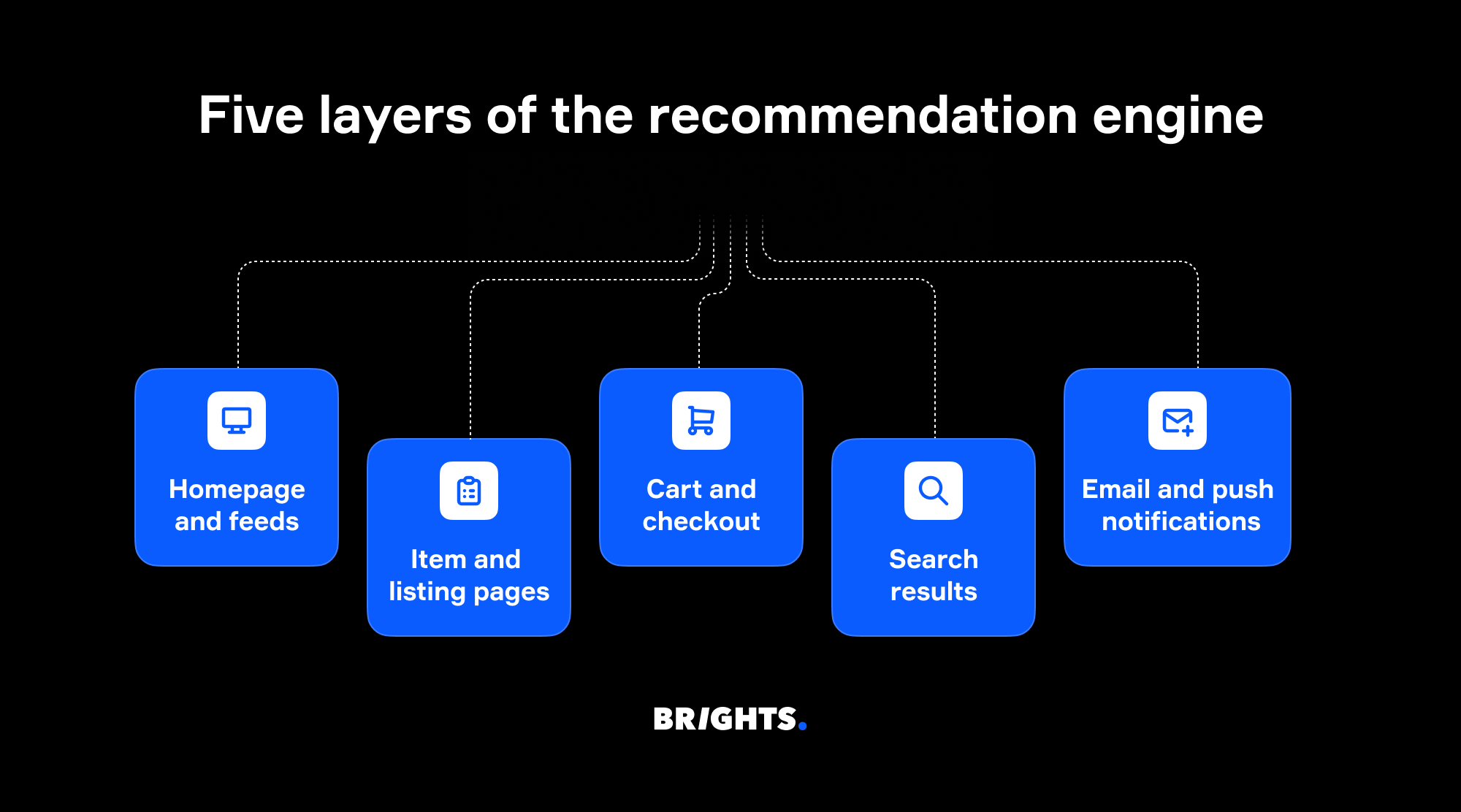
In a product, a recommendation engine typically powers five surfaces:
Homepage and feeds: a personalized selection instead of the same bestseller list for everyone.
Item and listing pages: similar or alternative options when the current one is not quite right.
Cart and checkout: add-ons and "frequently booked together" suggestions that raise order value.
Search results: personalized ranking, so two users typing the same query see the most relevant results for them.
Email and push notifications: re-engagement based on what each user viewed, saved, or booked before.
Online recommendation engine vs. AI recommendation engine
An online recommendation engine is software that suggests products, content, or services to users of websites and apps based on their data. Online recommendation engines are typically based on users' past behavior and preferences, such as views, purchases, ratings, and bookings, compared against the behavior of similar users. An AI recommendation engine uses machine learning models that learn from every interaction and update suggestions in real time.
The line between the two is not a technology switch you flip. It is a question of how the system decides what to show. A traditional online engine follows rules someone wrote or similarity scores calculated in a nightly batch. An AI engine builds a model of each user and each item, and re-scores options for every request based on the current context.
| Factor | Online recommendation engine (traditional) | AI recommendation engine |
|---|---|---|
| How it works | Predefined rules, popularity lists, or basic collaborative filtering | Machine learning and deep learning models trained on user and item data |
| Data used | Purchase history, ratings, basic user attributes | Behavioral signals, context (time, location, device), item content, session data |
| Personalization | Segment-level: similar suggestions for similar groups | Individual-level: unique suggestions per user and session |
| Adapts to change | Manually, when someone updates the rules | Automatically, as new data comes in |
| Cold start (new users and items) | Falls back to bestsellers | Uses content and context signals to recommend from the first visit |
| Build effort | Lower: faster to launch, limited ceiling | Higher: needs data pipelines, model training, and monitoring |
| Best fit | Small catalogs, simple use cases, early-stage products | Large catalogs, high traffic, platforms where conversion depends on relevance |
Which one do you need for your software project?
A rule-based online engine is enough for a small catalog or an early MVP. Once you have enough interaction data and relevance directly affects revenue, an AI recommendation engine usually pays for itself. On a booking platform, that is the difference between showing every user the same "popular this week" list and suggesting the time slot, location, or service each customer is most likely to book.
Where recommendation engines are at work: use cases and examples
Recommendation engines are at work in ecommerce stores, streaming and content platforms, travel and booking services, and two-sided marketplaces. Each industry recommends something different and optimizes for a different metric: ecommerce for order value, streaming for watch time, booking platforms for completed reservations, and marketplaces for successful matches between customers and providers.
| Industry | What gets recommended | Key signals | Primary business metric |
|---|---|---|---|
| Ecommerce | Products, bundles, add-ons | Views, carts, purchases, price range | Conversion rate, average order value |
| Streaming and content | Movies, tracks, articles | Watch or listen time, skips, completion | Engagement, retention |
| Travel and booking | Hotels, tours, restaurants, time slots | Dates, availability, location, party size, price | Booking rate, repeat bookings |
| Marketplaces | Providers, listings, services | Search queries, contact rate, reviews | Match rate, time to first transaction |
Ecommerce
A product recommendation engine is the most familiar example. Amazon's item-to-item collaborative filtering, which it described publicly in 2003, recommends products based on what other customers bought together, not on who the user is. A recommendation engine for ecommerce typically covers similar products, complementary add-ons at checkout, and personalized category pages.
Streaming and content
A content recommendation engine ranks what to watch, read, or listen to next. The Netflix recommendation system personalizes not only which titles appear but also the row order and the artwork shown for each title. The Spotify recommendation algorithm behind Discover Weekly combines collaborative filtering with natural language processing of music text and analysis of the audio itself. A movie recommendation engine is also the classic starting project for teams learning the field.
Travel and booking platforms
Booking is where recommendations get harder, and where off-the-shelf tools most often fall short. A hotel, travel, or restaurant recommendation system has to respect constraints a product catalog never faces: a room is available only on certain dates, a table only for a certain party size, a time slot only once. Recommending a sold-out option is worse than recommending nothing.
The signals are richer, too. Dates, location, group size, lead time, and price sensitivity all shape what a user will book. Airbnb, for example, has published how it uses listing embeddings trained on user sessions to power real-time personalization in search ranking and similar-listing recommendations.
Marketplaces and service platforms
On two-sided platforms, a personalization engine matches customers with providers: tutors, clinics, contractors, and venues. The engine has to balance relevance for the customer with fair exposure for providers, so new or smaller providers get enough visibility to stay on the platform.
Types of recommendation systems
Recommendation systems fall into four main types: collaborative filtering (recommendations based on the behavior of similar users), content-based filtering (based on item attributes), hybrid systems that combine both, and knowledge-based systems that match explicit user requirements to item constraints. Most production AI recommendation engines are hybrid.
Collaborative filtering
Collaborative filtering recommends items that users with similar behavior liked. User-based filtering finds similar users; item-based filtering finds items that are consumed together. Modern implementations use matrix factorization or neural networks to learn hidden patterns from the full interaction history.
Its strength is discovery: it can surface options a user would never search for, without any item metadata. Its weakness is the cold start problem. A new user or a new listing has no interaction history, so collaborative filtering has nothing to work with. It also favors popular items, which can bury the long tail.
Content-based filtering
Content-based filtering recommends items similar to the ones a user has already engaged with, based on item attributes: category, price, location, description, and amenities. A content-based recommendation system builds a profile of what each user prefers and scores new items against it, often using text or image embeddings.
It handles new items well and is easy to explain ("because you booked a sea-view room"). The trade-off is a narrow range: users keep seeing variations of what they already chose. It also depends on clean, consistent item metadata, which many catalogs do not have.
Hybrid recommendation systems
A hybrid system combines collaborative and content-based signals, and usually adds context such as time, device, and location. The most common production pattern is two-stage: a fast model retrieves a few hundred candidates, and a more detailed model ranks them.
Hybrids deliver the best accuracy and handle cold start better than either method alone. The cost is complexity: more data pipelines, more models to train, and more to monitor.
Knowledge-based systems
Knowledge-based systems recommend items that satisfy explicit requirements: budget, dates, number of guests, accessibility needs. They rely on rules and constraints rather than behavior history.
They work from the very first visit and suit infrequent, high-value decisions such as travel, real estate, or events, where users rarely have a long history. The downside is maintenance: someone has to keep the rules current as the catalog and business change.
| Type | Works on | Handles cold start | Main limitation | Best fit |
|---|---|---|---|---|
| Collaborative filtering | User–item interactions | Poorly | Needs a lot of history; popularity bias | Large platforms with active users |
| Content-based filtering | Item attributes + user profile | Well for new items | Narrow suggestions; needs clean metadata | Rich catalogs with detailed attributes |
| Hybrid | Interactions + attributes + context | Well | Build and maintenance complexity | Most production systems |
| Knowledge-based | Explicit requirements and rules | Well | Manual rule upkeep | Infrequent, high-value bookings and purchases |
How AI recommendation engines work: algorithms and architecture
An AI recommendation engine collects user interactions as events, turns them into features, retrieves a shortlist of candidate items, ranks them with a machine learning model, applies business rules such as availability and diversity, and serves the result through an API in milliseconds. Every response it serves generates new interactions that feed back into the next round of training.
Recommendation system algorithms
Machine learning recommendation engines typically use one or more of four algorithm families:
Matrix factorization: decomposes the user–item interaction matrix into compact user and item vectors. Algorithms such as alternating least squares (ALS) remain a strong, cheap baseline for collaborative filtering.
Two-tower deep learning models: one neural network encodes the user and context, another encodes the item. Similar vectors mean a likely match, which makes retrieval from millions of items fast.
Sequence models: transformer-based models read the order of a user's recent actions, so the next suggestion reflects what the user is doing in this session, not only their long-term history.
Embedding-based retrieval: embedding models turn descriptions, reviews, and queries into vectors that capture meaning. Similar vectors mean similar items, so a new listing can be recommended from its description alone, before anyone has booked it. This makes embeddings the most practical way to handle cold start for new items and to add semantic search to an existing catalog.
Re-ranking models: once retrieval has narrowed the catalog to a shortlist, a more powerful model scores each candidate again using more context. Cross-encoders read the user context and the item together, which is more accurate than comparing two separate vectors but too slow to run on the whole catalog.
LLM: Large language models can do the same job and also explain the suggestion or handle a free-text request, but their latency and cost per call are much higher. That is why both are used only on a shortlist of tens or hundreds of items, never as a replacement for the ranking model.
Choosing among recommendation engine algorithms depends less on what is newest and more on your data: how many interactions you have, how rich the item metadata is, and how fast users' intent changes.
Recommendation engine architecture
Most production systems follow the same multi-stage architecture:
Event collection: clicks, views, searches, and bookings are tracked as events and streamed into the data platform.
Data and feature store: raw events become features, such as a user's preferred price range or a listing's booking rate, stored for both training and real-time serving.
Candidate generation: fast retrieval, often vector search, narrows millions of items to a few hundred relevant candidates.
Ranking: a more detailed model scores each candidate using richer features and context.
Re-ranking and business rules: the system removes unavailable options, adds diversity, and applies promotions or provider-exposure rules.
Serving API: the final list reaches the app or website fast enough that the page does not wait for it.
Feedback loop: what users click and book becomes training data for the next model version.
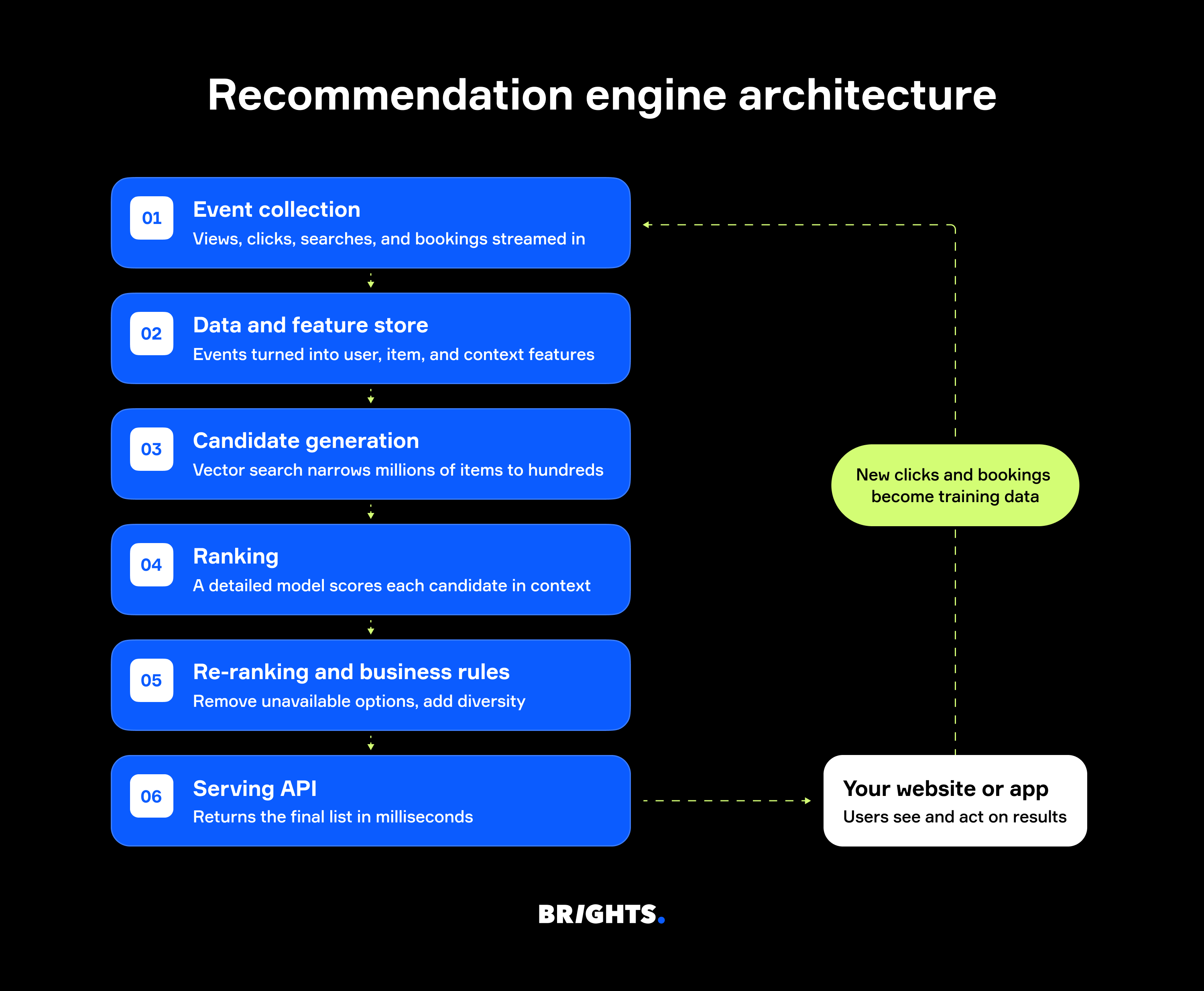
The ranking model is only one of six stages. On booking platforms, the re-ranking layer is where availability and time-slot rules keep sold-out options out of the list.
How to build an AI recommendation engine for your booking platform in 8 steps
To build an AI recommendation engine, define the business goal and KPIs, collect and prepare interaction and item data, choose an approach, build and train the model, solve the cold start problem, evaluate offline and with A/B tests, integrate the engine via an API, and monitor and retrain it after launch. A first production version typically takes 4–7 months.
Here is what each step involves, and what you should expect to provide.
1. Define the business goal and KPIs
Decide what the engine should improve: conversion rate, booking value, repeat bookings, or engagement. Then pick the first surface to personalize, such as the homepage, listing pages, or email. One surface with a clear metric beats five surfaces with vague goals.
What to watch for: optimizing for clicks alone. Clicks are easy to raise and often come at the expense of bookings. Tie the model to the metric your business actually earns on.
Output: a target KPI, its current baseline, and the uplift that would justify the investment.
2. Collect and prepare data
An engine is only as good as its data. You need three kinds:
Interaction data: views, clicks, searches, add-to-cart events, bookings, cancellations, and ratings.
Item data: category, price, location, availability, descriptions, and images.
Context data: time, device, location, and session information.
What to watch for: inconsistent event tracking. If the web app and mobile app log bookings differently, the model learns noise. Fixing tracking often comes before any modeling work.
What you need to prepare: access to your database, analytics events, and catalog, plus someone who knows how each field is populated.
3. Choose the approach and algorithm
Start with a simple baseline, such as popularity by segment or item-to-item similarity, so every later model has something to beat. Then choose the main approach based on your data: collaborative filtering if you have a rich interaction history, content-based methods if your catalog changes fast, and a hybrid two-stage system for most production cases.
4. Build and train the model
Most teams build a recommendation engine in Python. A typical stack includes pandas for data preparation, libraries such as implicit or Surprise for collaborative filtering, TensorFlow Recommenders or PyTorch for deep learning models, and FAISS or pgvector for vector search.
What to watch for: random train–test splits. Recommendations predict the future, so split the data by time. Otherwise, the model "sees" future bookings during training and looks better than it is.
5. Solve the cold start problem
The cold-start problem in recommender systems arises when there is no history to learn from. It affects three cases:
New users: start with popularity by location or context, ask 2 or 3 onboarding questions, then switch to session-based recommendations after the first few clicks.
New items: use content features and embeddings to recommend a new listing before anyone books it.
New platforms: launch with a rule-based or knowledge-based engine and collect data for the AI model in parallel.
6. Evaluate offline and online
Offline evaluation compares models on historical data using metrics such as precision@k, recall@k, and NDCG, as well as coverage and diversity, to catch engines that recommend only bestsellers. Online evaluation runs an A/B test against the baseline and measures the business KPI from step 1.
What to watch for: shipping on offline metrics alone. A model that wins offline can still lose in production because offline data reflects only what users saw under the old system.
7. Integrate via API and deploy
The engine connects to your product through a REST or GraphQL API. Real-time surfaces require low latency, so teams cache frequently used results (for example, in Redis) and precompute recommendations for email and push campaigns in batches. The business rules layer sits here, too: filter out unavailable options, apply pricing rules, and cap repeated suggestions.
What to watch for: no fallback. If the model service is slow or down, the page should still show sensible default recommendations instead of an empty block.
8. Monitor, retrain, and iterate
After launch, track model accuracy, data pipeline health, latency, and the business KPI. User behavior shifts with seasons, prices, and trends, so models are retrained on a schedule (daily or weekly) or updated continuously. Add new signals over time, and review personalization data handling against GDPR and your consent flows.
How much does it cost and how long does it take to build an AI recommendation engine for a booking platform?
Building an AI recommendation engine costs $30,000–$60,000 for a focused MVP, $60,000–$120,000 for a production system with real-time serving, and $120,000–$200,000 or more for enterprise platforms with multiple surfaces and advanced models. Timelines range from 2–4 months for an MVP to 7–10+ months for enterprise builds. Data readiness and real-time requirements are the primary drivers of cost and time.
These are general industry estimates. Actual quotes depend on your data, scope, integrations, and the vendor you choose.
| Build tier | Typical scope | Estimated cost | Typical timeline |
|---|---|---|---|
| MVP | One surface, one model, batch recommendations, clean existing data | $30,000 – $60,000 | 2 – 4 months |
| Production | Hybrid model, real-time API, A/B testing, 2–3 surfaces | $60,000 – $120,000 | 4 – 7 months |
| Enterprise | Multi-stage architecture, deep learning or LLM features, many surfaces, strict compliance | $120,000 – $200,000+ | 7 – 10+ months |
What drives cost up
Data readiness is the largest variable. If events are tracked inconsistently or the catalog lacks clean attributes, data engineering can take as long as the modeling itself.
Real-time requirements add streaming pipelines, a feature store, low-latency serving, and caching. Batch recommendations for email cost far less than in-session personalization.
Booking-specific logic, such as availability, time slots, capacity, and dynamic pricing, has to be built into ranking, not added as a filter afterward.
Integrations with your booking engine, CMS, CRM, and marketing tools each add scope.
Advanced models, such as deep learning, sequence models, or LLM-based features, add GPU infrastructure and training costs.
Compliance, including GDPR consent handling and data residency, adds architecture and documentation work.
What extends timelines in practice: poor tracking that must be fixed before modeling can start, waiting for enough fresh data after tracking changes, A/B tests that need several weeks of traffic to reach significance, and approval cycles for data access and privacy reviews.
How Brights can help
Brights builds custom AI recommendation engines for booking platforms, marketplaces, travel and hospitality services, and ecommerce businesses whose ranking logic has outgrown what off-the-shelf tools provide. Our work covers the full cycle: data and tracking audits, model development, real-time serving APIs, and integration into existing booking systems, web apps, and mobile apps.
If you are evaluating whether an AI recommendation engine is the right next step for your platform, or scoping a project and want a technical assessment of your data, talk to our team.
FAQ.
An online recommendation engine is software that suggests products, content, or services to users of websites and apps based on their data. It powers blocks such as "recommended for you" and "similar items." Traditional online engines use rules or basic similarity; AI-powered engines use machine learning to personalize suggestions for each user in real time.


