Software Development Nearshoring to Poland in 2026: A Decision Guide for Engineering Leaders

Every engineering leader who has tried to scale a team in London, Munich, Amsterdam, or the US Northeast has been going round in circles — senior engineers are expensive, slow to hire, and quick to leave.
Meanwhile, the roadmap does not shrink, even when accounting for AI-powered software engineering. Global IT spending is expanding at double-digit rates, which means the competition for the same people is intensifying, not easing.
Nearshoring and offshoring to Poland is one of the most frequently proposed answers to that stumbling block. But the premise behind that answer has changed.
The typical evaluation compares an hourly rate in Warsaw with one in Munich, identifies a 30–40% gap, and stops there. That framing was already outdated five years ago, but today we’re going to access the market from an engineering and business perspective. In short, Poland today is not a low-cost labor market. In 2026, the country has become a mid-cost engineering market with unusually good structural fit for European and US buyers.
Key takeaways
Poland in 2026 is a mid-cost engineering market, not a cheap one — with realistic savings of 30–50% against Western European and US in-house teams.
It's the largest tech labor market in CEE: 430,000+ software professionals and ~15,000 new IT graduates a year.
Full 6–8 hour workday overlap with Western Europe enables real-time code reviews, feedback, and incident response — an edge offshore can't match.
EU membership removes cross-border data-transfer friction: GDPR applies identically, and vendors have run under DORA and NIS2 for years.
Major hubs — Warsaw, Kraków, Wrocław, the Tri-City area, Katowice, Poznań — with smaller cities running 10–20% cheaper and hiring faster.
Poland ranks 3rd globally for developer skills (HackerRank), backed by 1,637+ software companies and centers like Google, Microsoft, and IBM.
Brights can help you build dedicated, fully integrated software teams in Poland.
What Poland actually has to offer as your next nearshore software development partner
Poland is the largest technology labor market in Central and Eastern Europe. Estimates of the IT workforce vary by definition: narrower counts of software professionals place it at around 430,000, while broader counts that include adjacent IT roles exceed 630,000. Whatever the precise number, Poland represents roughly a quarter of the entire CEE developer population, and no other country in the region comes close.
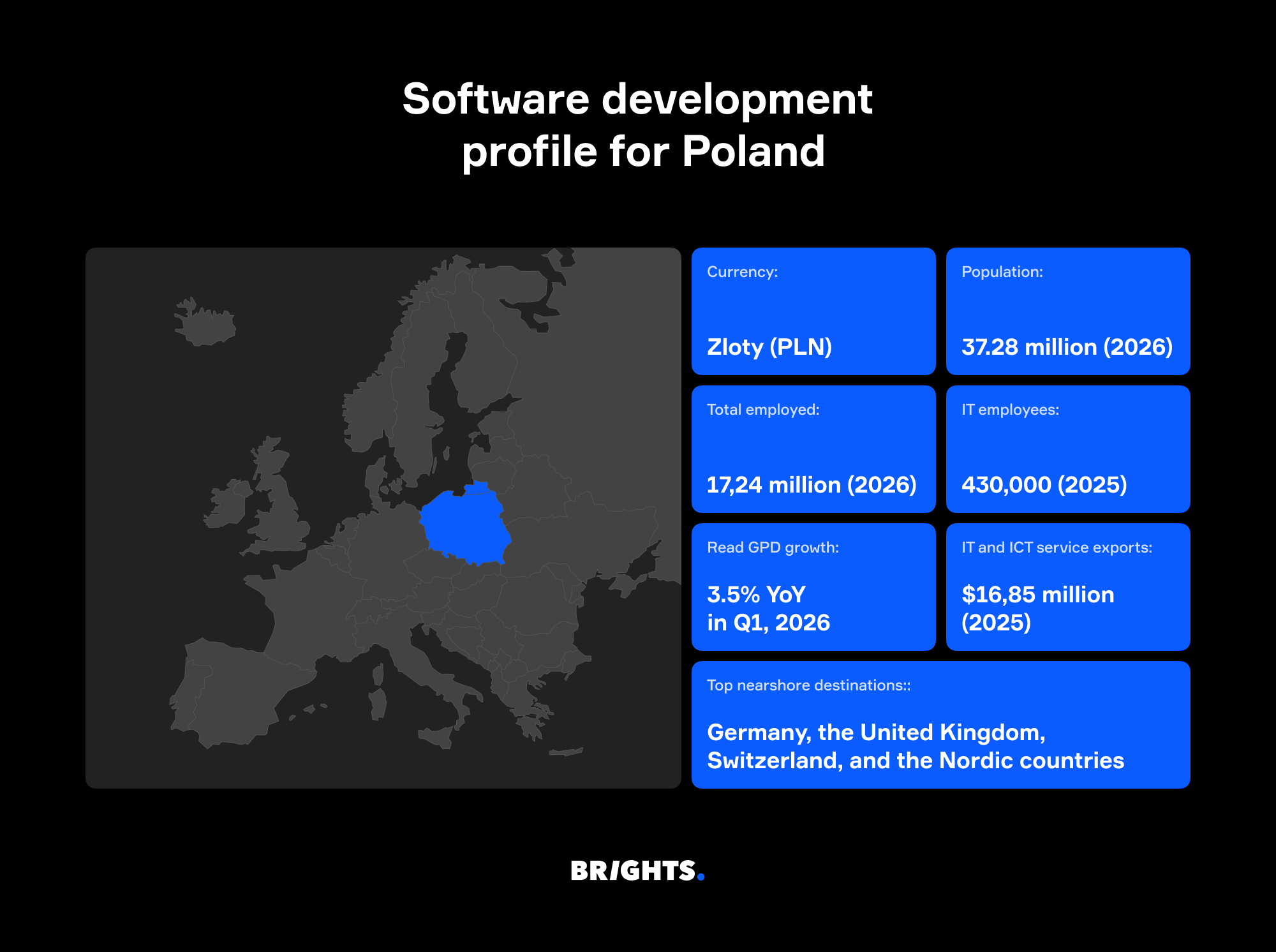
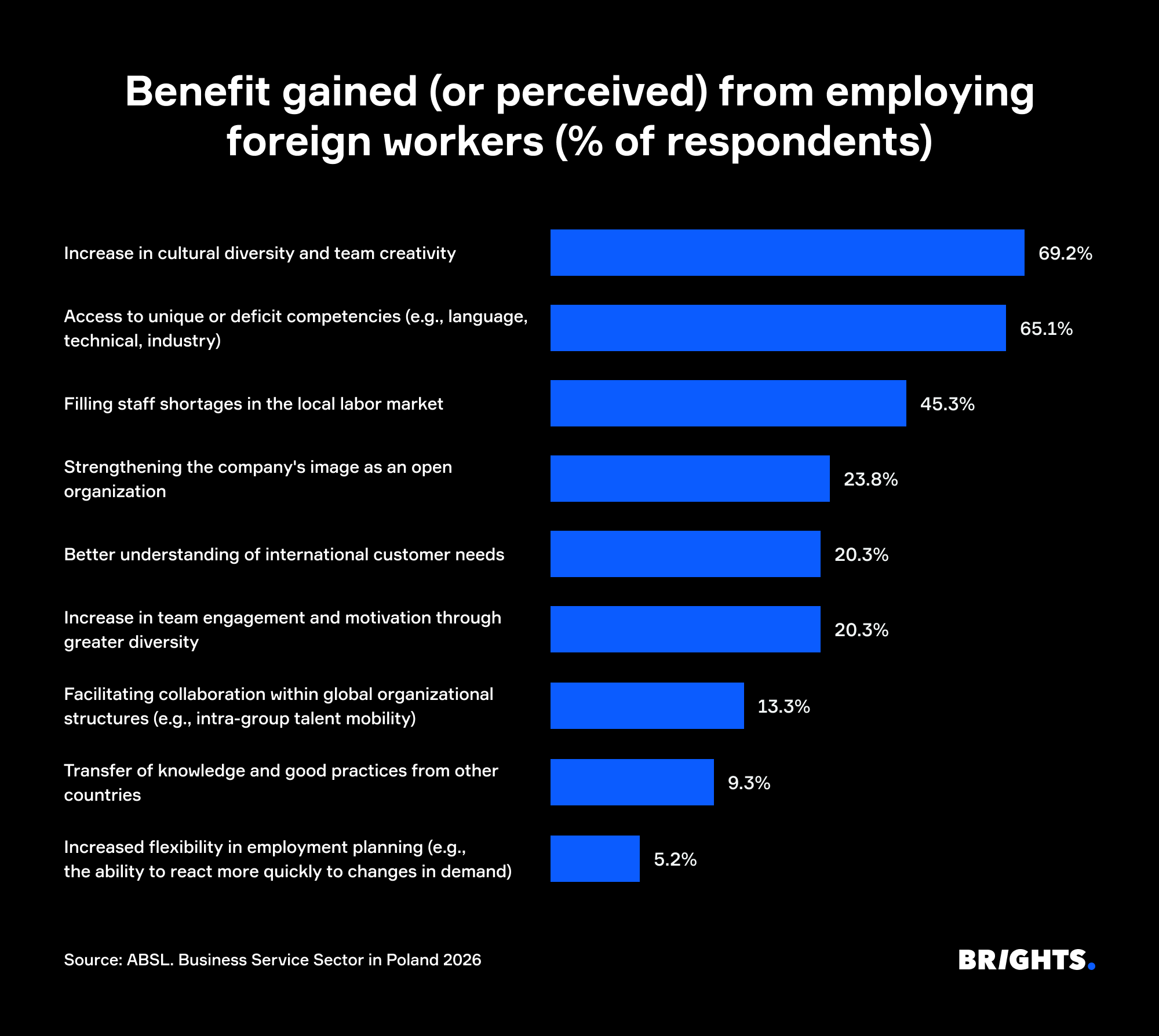
The IT nearshoring in Poland has also benefited from an influx of highly skilled Ukrainian developers and IT specialists who have relocated to Poland in recent years. Many now work across Polish software houses, multinational R&D centers, and fast-growing startups, further deepening an already exceptional engineering talent pool.
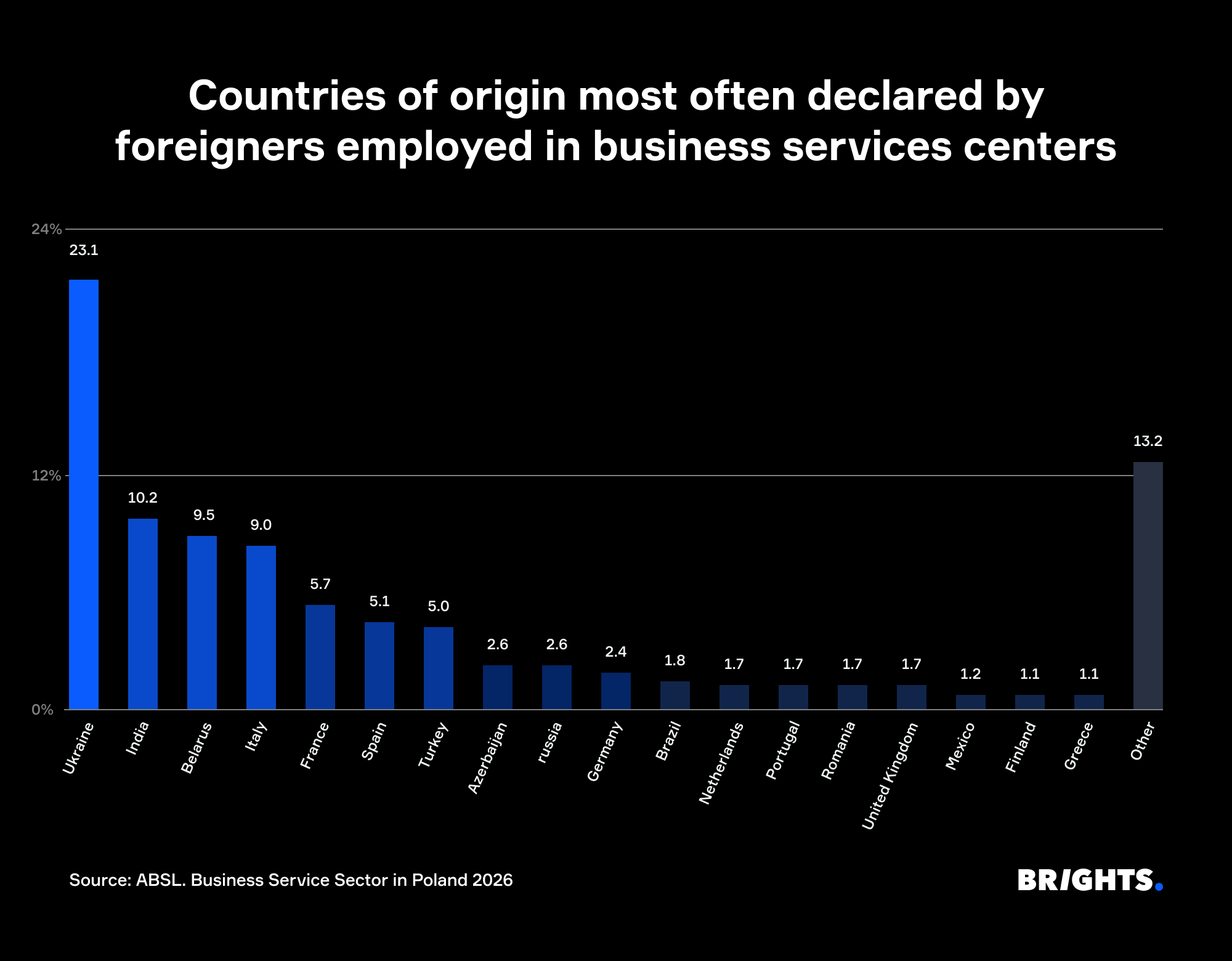
Source: ABSL. Business Service Sector in Poland 2026
What sustains Poland’s engineering talent pool
A strong technical education pipeline
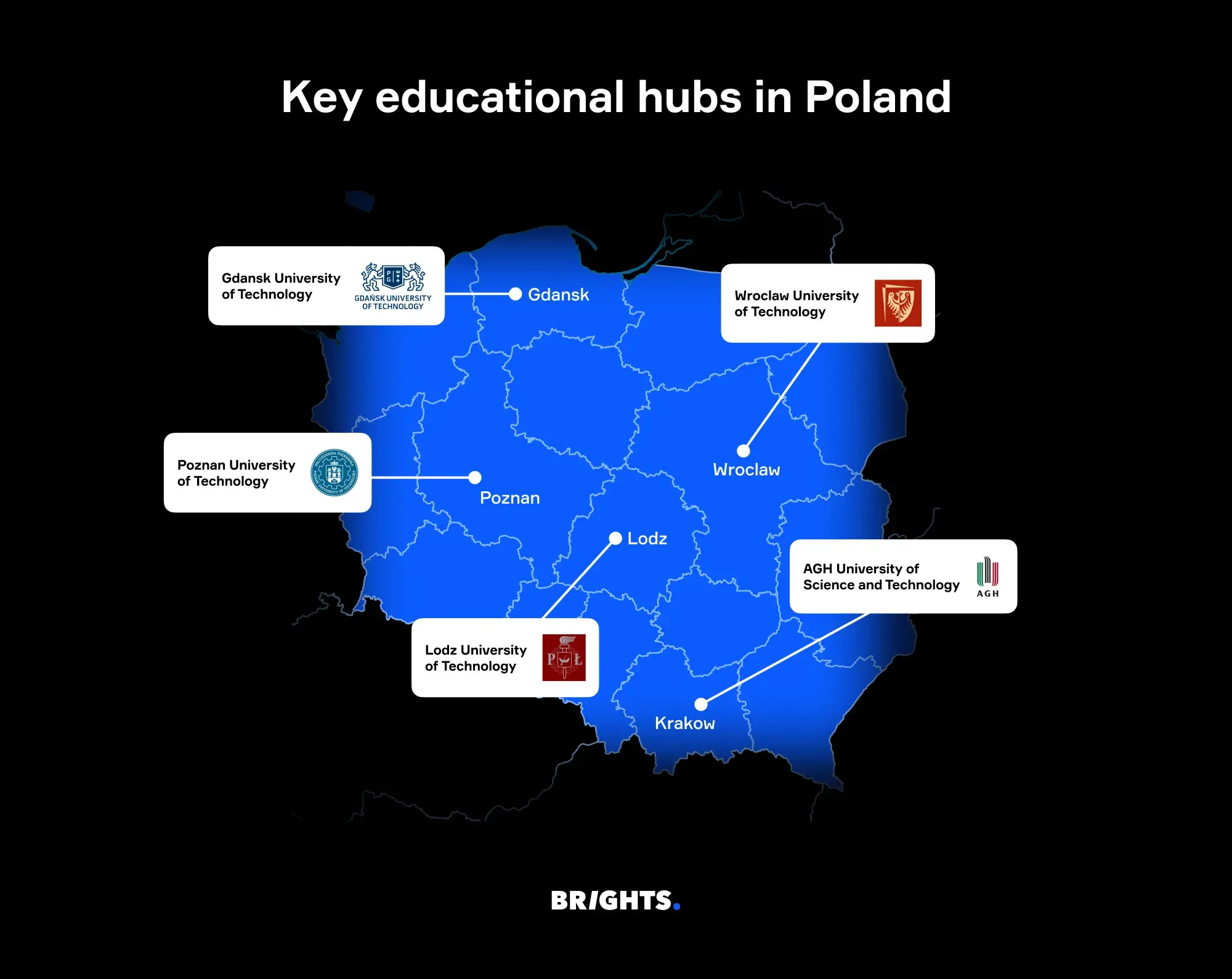
Polish universities, such as AGH in Kraków, Warsaw University of Technology in Warsaw, Poznań, Wrocław, and Gdańsk, have produced consistent results in international competitive programming for two decades. Combined, Polish universities graduate approximately 15,000 new IT professionals each year, ensuring a continuous flow of highly skilled developers into the market and strengthening the attractiveness of software nearshoring to Poland. These results point to strong algorithmic and systems-level capabilities, though other skills, such as product thinking and communication, are typically developed through professional experience.
Two decades of delivery experience for Western clients
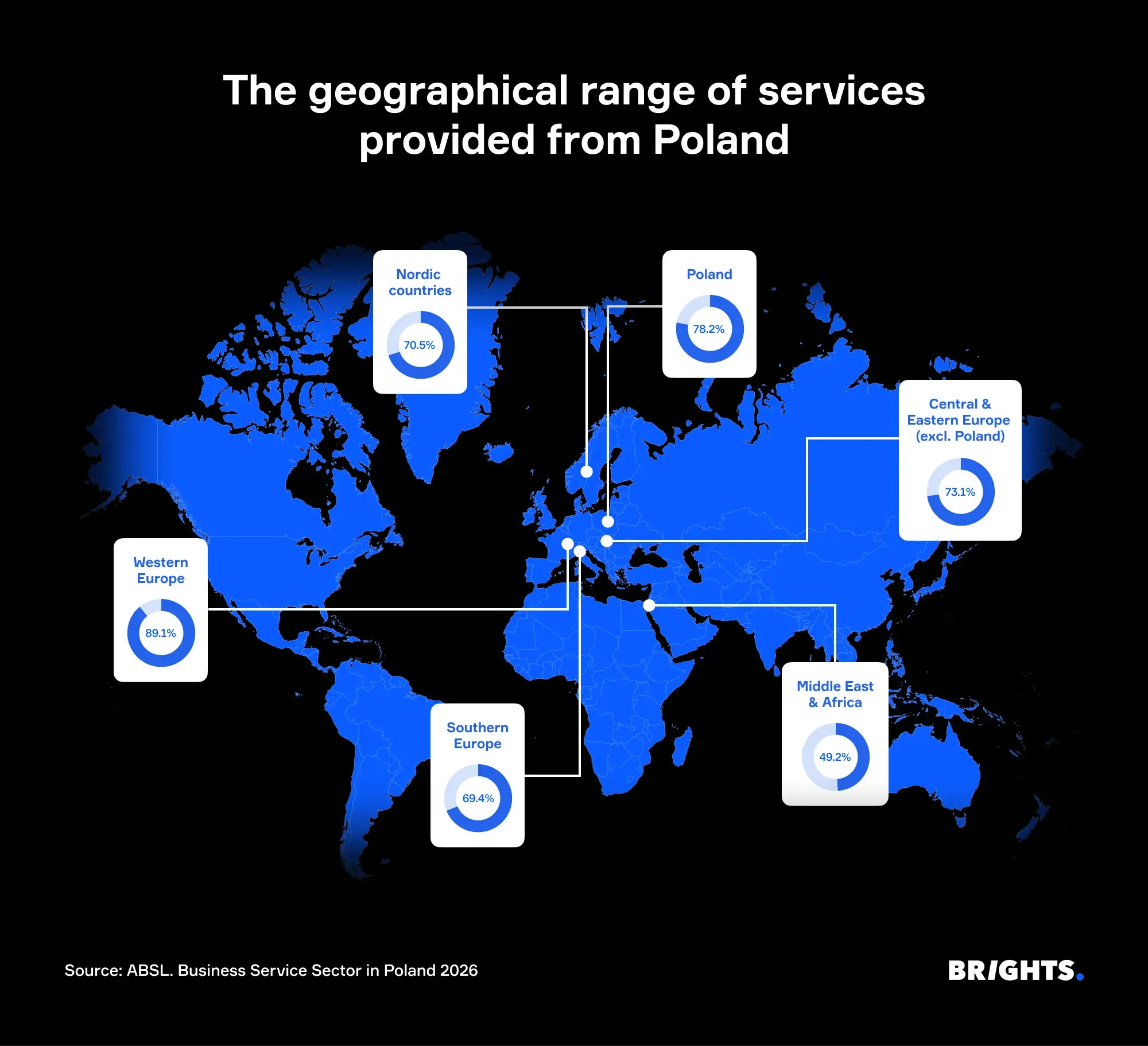
Nearshore services in Poland matured through the 2000s, serving German, Nordic, UK, and US customers. For most international projects, language is not an issue. Senior developers are typically fluent in English, enabling seamless collaboration with global teams. German-speaking professionals are also available, though they command higher rates due to stronger demand.
A large captive-center ecosystem
Google, Microsoft, Intel, Motorola, IBM, Nokia, Credit Suisse, Goldman Sachs, and dozens of others run engineering or global-capability centers in Poland. This matters even if you never hire from them: it means the local market has internalized enterprise-grade practices around code review, security, compliance, and incident management. Engineers move between these centers and the vendor ecosystem, and the standards travel with them.
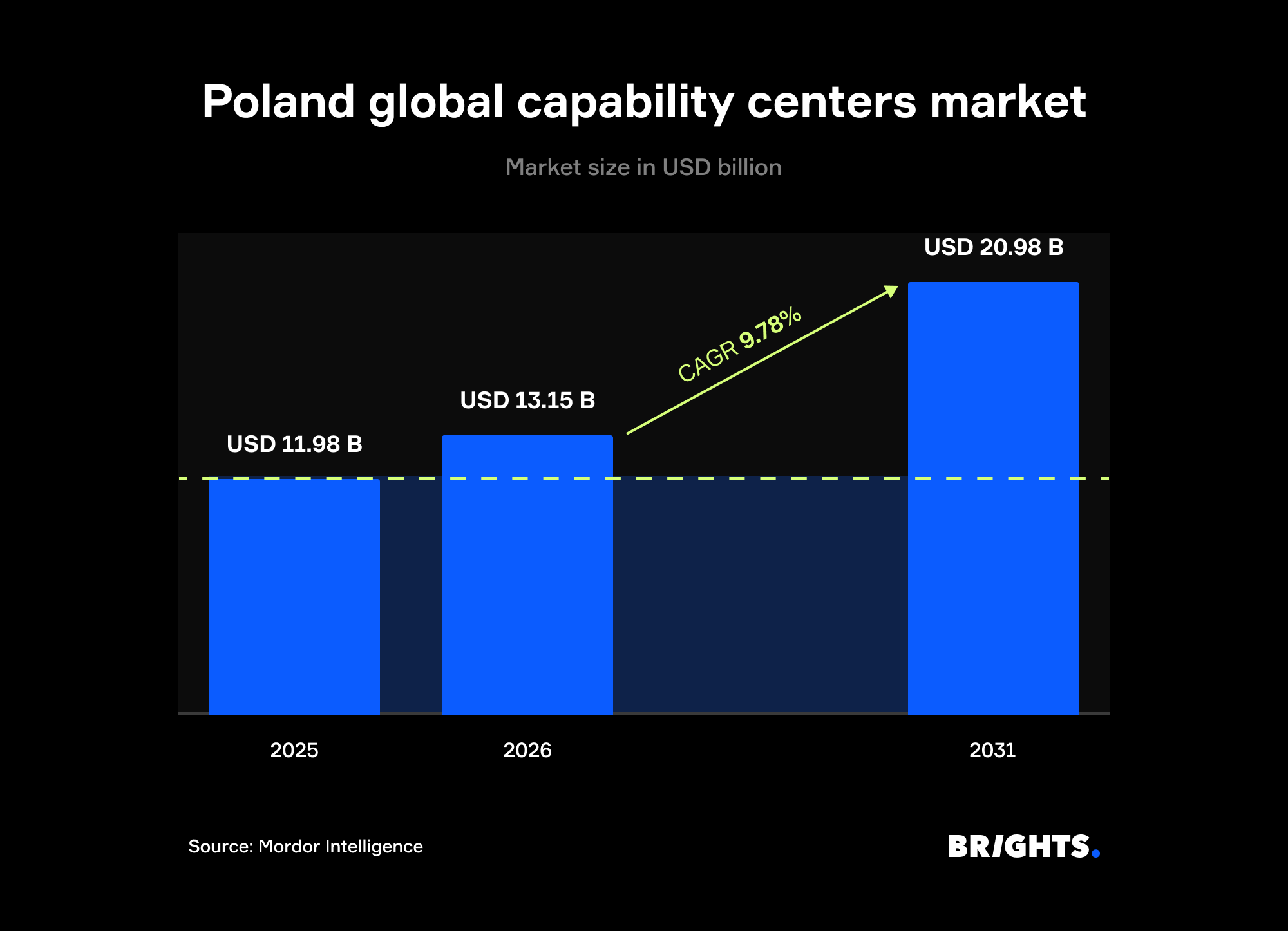
The scale behind this is substantial and still growing; Poland's global-capability-center market is projected to expand from roughly USD 12 billion in 2025 to nearly USD 21 billion by 2031, a pace that reflects the country's shift from a low-cost back-office destination to a genuine strategic services hub for Europe.
AI adoption
Poland's developer market isn't just aware of AI, it's moving on it faster than most. According to Dun & Bradstreet research across 32 countries, 41% of Polish companies are already testing AI tools in production environments, a 14-percentage-point jump in a single quarter. Over the same period, the share of firms stuck at pilot scale fell sharply from 61% to 25%, signaling that Polish businesses are pushing past experimentation and into real deployment.
For anyone hiring or partnering here, this matters: engineers are gaining hands-on experience with AI in live systems, not just proofs of concept, which means the practical know-how around integrating, monitoring, and maintaining these tools is accumulating quickly across the local talent pool.
Legal, tax, and compliance — that’s where Poland really thrives
EU membership
Poland is in the EU and the single market. For an EU-based buyer, this means no cross-border data transfer mechanism to negotiate, no adequacy decision to depend on, no standard contractual clauses, and no transfer impact assessment. GDPR applies to both sides identically.
GDPR and sectoral compliance
Polish vendors serving financial services, healthcare, and public sector clients have operated under GDPR, DORA, NIS2, and sector-specific regimes for years. If you are in a regulated industry, ask for the actual evidence, ISO 27001 certification, SOC 2 reports where applicable, penetration test summaries, and subprocessor lists.
Note: what to check in every contract:
Express written assignment of economic copyright, with enumerated fields of exploitation
Explicit transfer of rights to derivative works
Rights in any moral-rights-adjacent matters waived or addressed to the extent Polish law permits
The chain of assignment reaching from the individual engineer through the vendor to you
Governing law and dispute forum agreed knowingly, not by default
Tax
The IP Box regime allows qualifying income from intellectual property rights to be taxed at a reduced rate of 5%. While this doesn't directly affect your company's taxes, it has helped make the B2B contractor model the dominant employment structure in Poland and influences how many software vendors price their services. Because the rules have been tightened over time, it's also worth monitoring potential changes when planning long-term engagements.
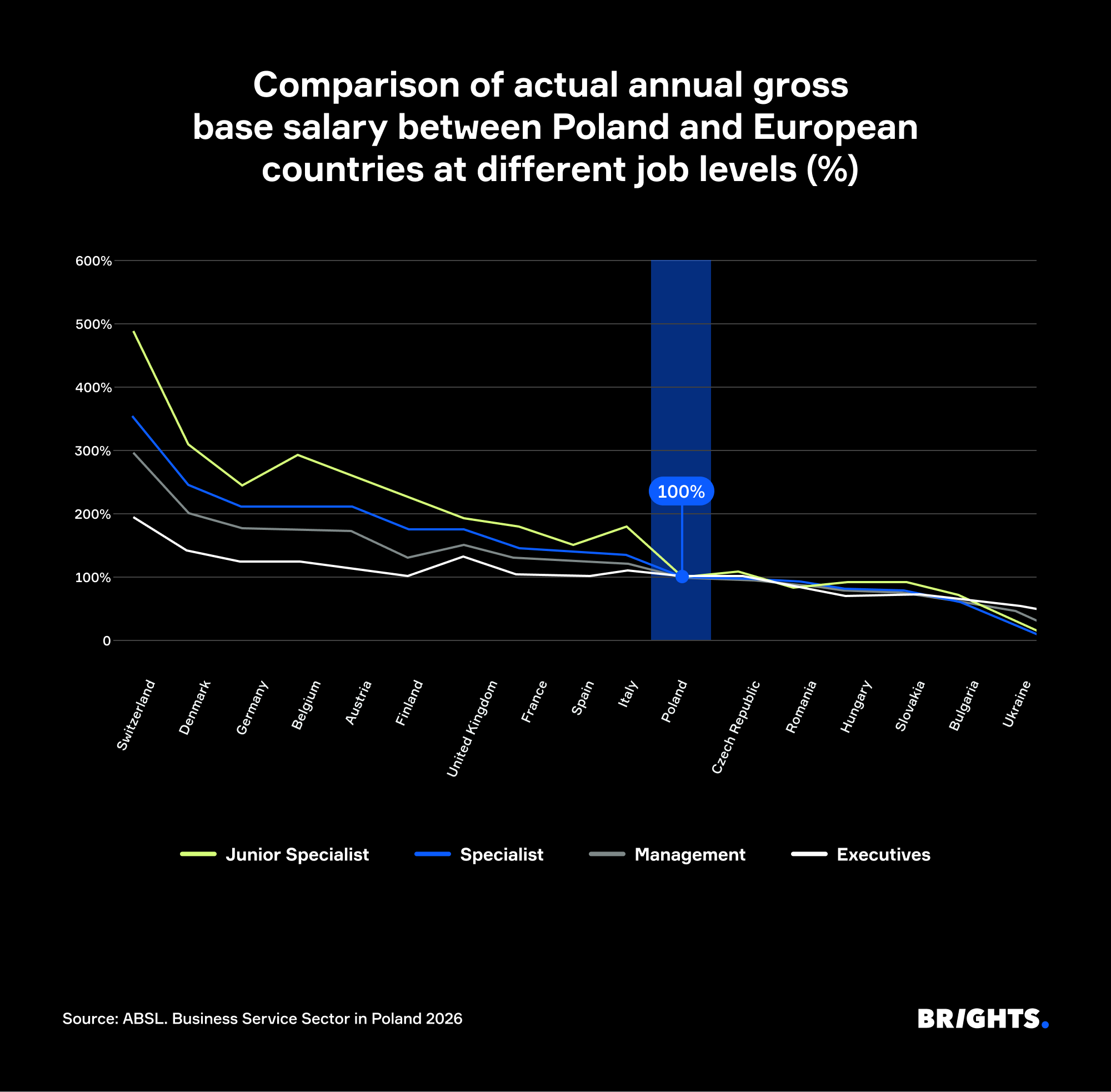
Poland is not the cheap option in its own neighborhood. It is priced at a premium to Romania and Ukraine and at a discount to Czechia and Western Europe. Realized savings against Western European and US in-house teams typically land in the 30–50% range once you account for employer contributions, benefits, office costs, and recruitment fees on the home side.
Salaries vs. rates: reading the numbers correctly
Comparisons across the region go wrong in a predictable way, so it is worth separating three different things that all get called "cost":
Employee salary — what a developer takes home. Useful for understanding talent competition and retention risk, useless for budgeting an engagement.
Contractor rate — what an independent B2B specialist charges. Closer to your cost if you hire directly.
Vendor billing rate — what a software house invoices. This is what you actually pay, and it includes margin, management, bench, and recruitment.
A "Poland is 30% cheaper" claim and a "Poland is 60% cheaper" claim are usually both correct and measure different layers. Salary-to-salary against Western Europe, the gap is modest, roughly 20–25%, and narrowing. Billing-rate-to-fully-loaded-employment-cost against the US, the gap is much wider — 50–65% — because the US comparison absorbs benefits, payroll taxes, recruitment fees, and office overhead that a Polish invoice does not carry. Always state which comparison you are making.
Poland compared to its regional neighbors
On employee compensation rather than billing rates, the CEE picture in 2026 looks roughly like this:
| Market | Average ICT sector monthly pay | Notes |
|---|---|---|
| Poland | €2,600–4,200 gross (mid to senior) | Deepest senior pool in CEE; Warsaw anchors the top |
| Czechia | €2,800–4,000 gross | Comparable to Poland, a smaller market |
| Bulgaria | €2,965–3,680 gross | The euro has been the sole legal tender since February 2026 |
| Romania | €2,000–3,200 gross | Favorable IT tax treatment historically compressed gross figures |
| Ukraine | €1,800–3,000 | Lower cost, non-EU legal context |
Two caveats that matter more than the numbers. First, gross and net are not interchangeable, and Romanian IT compensation in particular has historically been reported net because of sector-specific tax exemptions
Within Poland: the geography discount
Compensation in Katowice, Poznań, Łódź, and Lublin runs roughly 10–20% below Warsaw and Kraków. On its own, that is not a decisive saving. What compounds it is the secondary effect: less competition per candidate, so shorter time-to-hire and lower churn. A team hired in five weeks instead of eleven and retaining its engineers longer can deliver greater savings than salary differences alone suggest. Remote-first vendors outside Poland's two largest tech hubs often benefit from these market dynamics, even if they don't explicitly factor them into their sales pitch.
Why go for nearshoring when offshoring is much cheaper
Offshoring means moving work to a distant, usually much cheaper, geography, historically India, the Philippines, and Vietnam. The defining constraint is time-zone separation: eight to twelve hours of it. Collaboration becomes asynchronous by necessity. That is workable for well-specified, stable-scope work and painful for exploratory product development.
Nearshoring means moving work to a nearby country with substantial overlap in working hours. For Western Europe, that means Central and Eastern Europe (Poland, Romania, Czechia, Bulgaria, Ukraine). For the US, it usually means Latin America, though Poland is a common exception for East Coast companies willing to accept a 5–6-hour offset in exchange for a deeper senior pool.
Actually, the choice isn’t so geographically bound; it mostly depends on which delivery model suits your business model.
| Offshore | Nearshore (Poland) | |
|---|---|---|
| Time zone overlap | Limited (0–3 hours) | Full workday overlap (6–8 hours) |
| Daily standups | Early/late meetings or async updates | Natural collaboration during business hours |
| Real-time code reviews | Often completed the next day | Same-hour feedback and iteration |
| Incident response | Delayed coordination across time zones | Immediate collaboration with your on-call team |
| Discovery & evolving requirements | Slower decisions and frequent context switching | Fast workshops, rapid decisions, continuous alignment |
| Communication speed | Mostly asynchronous | Primarily real-time |
| Typical response time | 12–24 hours | Under 1 hour during working hours |
| Hourly rate | Lowest | Moderate |
| Hidden costs | Higher risk of rework, delays, and misalignment | Lower rework and faster delivery |
| Best suited for | Well-defined, predictable projects | Agile development and long-term product teams |
Cost and time zone overlaps are just one side of the equation. Once you've decided the collaboration model fits your project, the next question is whether you can consistently find engineers with the skills, experience, and availability you need.
That's where Poland stands out. As one of Europe's leading nearshore software development destinations, it ranks 3rd globally for developer skills in the latest HackerRank Developer Skills Report, giving companies access to a deep pool of highly capable engineering talent, not just geographic proximity.
Summing up: Software development landscape in Poland
Today, Poland is home to more than 1,637 software development companies listed on Clutch, ranging from boutique engineering studios to multinational technology consultancies. Many have earned international recognition through rankings such as the IAOP Global Outsourcing 100, Software 500, and Inc. 5000 Europe, reflecting the country's reputation for delivering complex software projects at scale.
What sets the Polish market apart isn't just the number of providers, it's their experience. Most software companies have spent years building products for clients in Western Europe and North America, making Agile delivery, distributed collaboration, and English-first communication standard practice rather than differentiators.
Many teams also work extensively with Nordic and Southern European businesses, giving them a strong understanding of different regulatory environments, business cultures, and product expectations.
Why choose Brights as your software development company in Poland?
With a Warsaw office and engineering teams across Europe, Brights helps companies build high-performing software teams that work as a natural extension of their business.
Why companies choose Brights:
Access to Poland's top engineering talent backed by one of Europe's largest tech ecosystems.
Dedicated development teams that integrate seamlessly with your in-house engineers.
End-to-end product development, from discovery and UX/UI design to engineering, QA, DevOps, and AI.
Transparent communication with Agile delivery, clear processes, and regular reporting.
Experience across industries, including fintech, healthcare, logistics, retail, and SaaS.
Convenient European collaboration with a Warsaw presence and strong time-zone overlap for Western Europe.
Whether you're scaling an existing team or building a product from the ground up, Brights provides the expertise and flexibility to help you deliver faster.
FAQ.
Poland is a mid-cost engineering market, priced at a premium to Romania and Ukraine and at a discount to Czechia and Western Europe. Realistic savings against Western European or US in-house teams land in the 30–50% range once you account for benefits, payroll taxes, office overhead, and recruitment fees on the home side. The value of nearshore services in Poland is structural fit and senior depth, not the lowest rate.


