How to Choose a Software Development Agency (2026)

You have a shortlist. Every agency on it has a polished website, a case study that looks like yours, and a discovery call that went well. At this point, they are difficult to tell apart.
That difficulty is the actual problem. Software development agencies compete on presentation, not on outcomes. The signals that make a vendor look credible in week one are not the same signals that predict whether they will deliver in month six.
The criteria below separate the ones that deliver from the ones that disappoint.
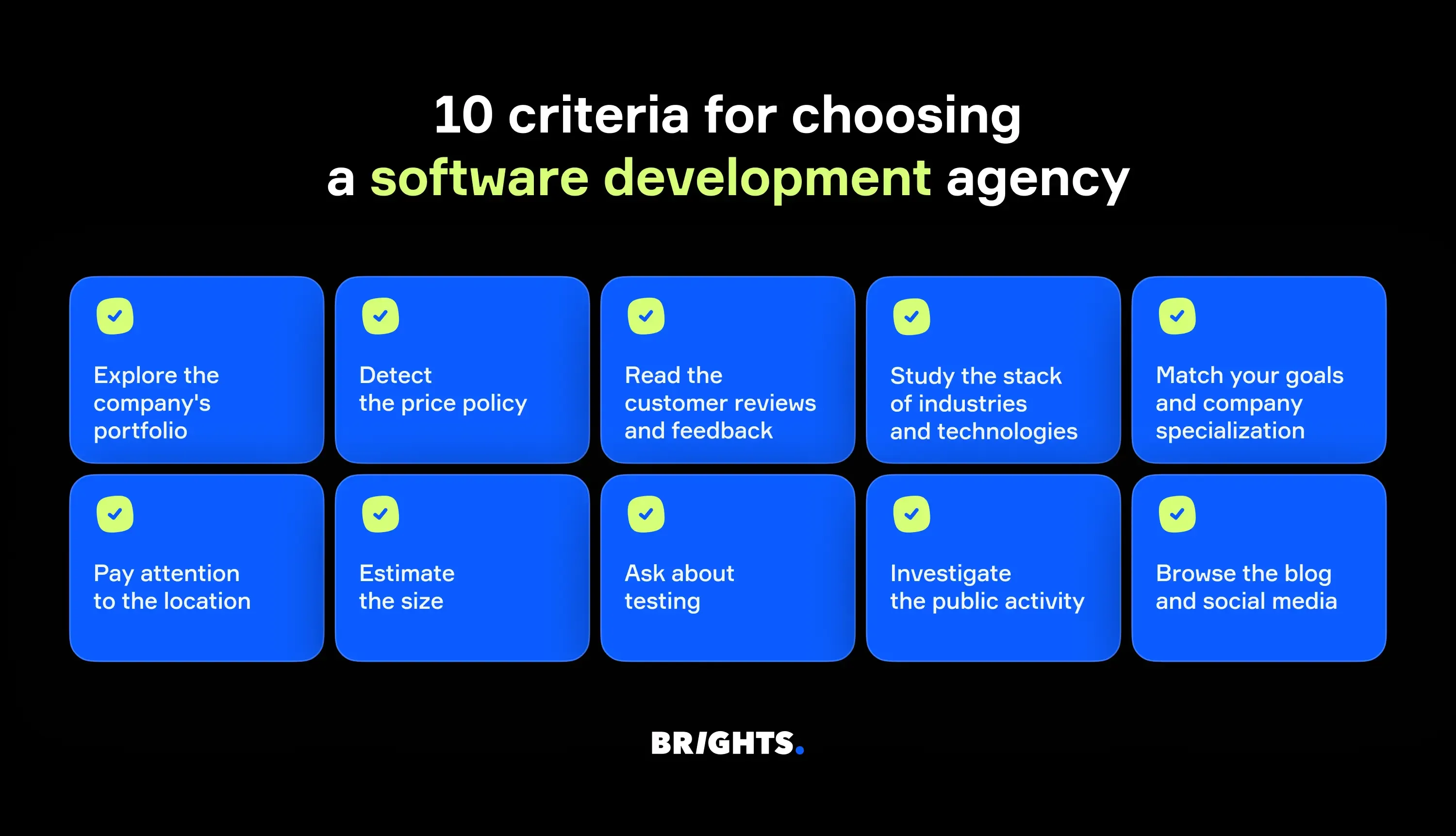
10 criteria for choosing a software development agency
1. Explore the company's portfolio
Nothing tells you more about an agency than its completed work. Start with the portfolio on their website, but go further than browsing screenshots.
Check which technologies they have worked with and whether those match your stack. Look for projects in your industry or a domain with similar constraints. If a company has built three fintech platforms and you are building a fintech platform, that context matters.
Where you can, try the live products. If they have shipped mobile apps or web platforms that are publicly available, use them. Check the design, the performance, the interaction quality. That 20-minute test tells you more than a case study PDF.
2. Detect the price policy
Start from your budget, but do not let budget alone drive the decision. The cheapest options carry real risk. Low rates usually mean junior teams, subcontractors, or both. You are not saving money at that end of the market. You are taking on delivery risk that typically costs more to fix than it would have cost to avoid.
The most expensive agencies are not always the best fit either. Enterprise pricing often reflects brand overhead, not delivery quality. A mid-market agency with strong retention numbers and verifiable client references can outperform a name-brand firm at a fraction of the price.
The signal to look for: transparent pricing with a clear breakdown. An agency that cannot explain how they arrived at a number has not thought carefully about your project.
3. Read the customer reviews and feedback
Reviews on Clutch, GoodFirms, and Google are a reasonable starting point. The more useful signal is consistency: does what the agency says about itself match what clients say about them? Significant gaps between the two are a yellow flag.
Go further. Contact two or three reviewers directly through LinkedIn. Ask what the delivery process was actually like, not just whether they recommend the agency. Reviewers who had a good experience are usually willing to give you 15 minutes. Those who did not are sometimes even more willing.
Prioritise reviews where the reviewer's name, company, and role are visible. Anonymous praise is easy to manufacture.
4. Study the stack of industries and technologies
Most agencies list their technology stack and industry experience on their website. The list tells you what they have worked with. It does not tell you how deeply.
Look for case studies with verifiable outcomes: named clients, stated timelines, specific technical challenges solved. A page listing 30 technologies with no accompanying delivery evidence signals breadth without depth.
Also worth clarifying: whether they deliver in-house or subcontract components. A small team reselling work to a larger subcontractor is a different risk profile than a team that owns delivery end to end. Ask directly.
5. Match your goals and company specialization
A good agency and the right agency are not the same thing. Technical quality matters less than whether the team has done work that resembles what you are building.
Ask specifically: what is your team's experience with this stack or domain? Can you show me a project with similar constraints? An agency that has delivered several SaaS platforms in your sector brings context a generalist shop does not: faster decisions, fewer clarification cycles, better instincts about what will and will not scale.
The other dimension is service coverage. If your project needs web development, mobile, QA, and DevOps, check whether those capabilities exist in-house or are sourced externally. A fully in-house team is easier to manage and usually more accountable.
6. Pay attention to the location
Location matters for one reason: time-zone overlap. Everything else is secondary.
Real-time overlap hours affect code review cycles, incident response, and sprint ceremonies. Vendors in the CEE region (Ukraine, Poland, Romania) give US East Coast teams 1–4 hours of daily overlap; Western European companies get 4–6. Latin American vendors work well for North American time zones. Southeast Asia and India offer cost advantages but typically require stronger asynchronous communication discipline.
Ukraine specifically has a deep engineering talent base. Ukrainian developers are in demand across the US, UK, and Western European markets for both technical quality and cost efficiency. Development rates in Western Europe average $50 per hour and above. Ukrainian teams typically run $30–40 per hour at comparable seniority. Ukraine ranks 5th globally among the best software developers in the world.
Do not discard a vendor solely because of geography. Check whether the time-zone overlap works for your sprint cadence, and proceed from there.
7. Estimate the size
Size affects more than capacity. Large agencies carry overhead, parallel project overload, and in some cases a tendency to under-staff once the contract is signed. Very small studios may lack the bench to absorb unexpected scope.
Mid-market agencies (roughly 50–300 people) tend to offer a useful balance:
focused resource allocation per project
fewer simultaneous projects per team
direct access to senior leadership when problems need escalation
continuous support without handoffs between delivery teams
flexibility on engagement structure that larger firms rarely offer
Filter by headcount and availability, not by overall size. A 200-person agency with no engineers available in your stack is less useful than a 40-person studio with a dedicated team ready to start.
8. Ask about testing
Every agency claims quality. Ask for specifics.
How is QA structured: dedicated QA engineers, or developers testing their own code? How do they handle regression testing between sprints? What does the process look like when a bug reaches production?
A team that answers those questions in detail has thought through its delivery process. A team that gives vague answers typically does not have a rigorous one.
9. Investigate the public activity
Conference talks, open-source contributions, industry webinars, educational content: these signal engineers who follow their field actively and invest in the broader community.
Public visibility is not a requirement. Many strong engineering teams operate quietly. Treat it as a tiebreaker when everything else is equal.
Where it exists, public activity suggests the agency thinks about the craft seriously enough to share what it knows.
10. Browse the blog and social media
A company's online presence is a signal, not just a marketing channel.
Regular, substantive content on the blog tells you the team has genuine opinions about their field. Look at whether articles are written by named engineers, whether they engage with technical complexity or stay safely generic, and whether the publication cadence suggests active thinking or sporadic effort.
Social media matters less than the blog. LinkedIn is worth checking for company updates and consistent hiring activity. Instagram and Facebook tell you relatively little about delivery quality.
Company culture comes through in how they write, what topics they choose to address, and how they respond to comments. If the voice feels like a content farm, that is worth noting.
How to vet a software development agency
The criteria above tell you what to look for. This section covers how to actively test whether a vendor meets those criteria, before you sign anything.
The most reliable method: a structured discovery conversation of 45–60 minutes where you ask the same questions to every shortlisted agency. Consistent questions produce comparable answers. Comparable answers make the decision considerably easier.
| Vetting area | Question to ask | What a good answer looks like | Red flag |
|---|---|---|---|
| Technical ownership | Who leads technical decisions on this project, and what does escalation look like? | Named lead engineer, clear role, defined escalation path to senior leadership | "The team handles it" with no specific name or role |
| Scope changes | How do you handle scope changes mid-project? | Defined change request process: impact assessment before any work begins, signed off by both sides | "We're flexible" with no formal process behind it |
| Past failures | Tell me about a project that ran into serious problems. What happened? | Specific account: what went wrong, what the agency owns, what changed as a result | No problems, ever. Or deflection to client fault only |
| Subcontracting | Do you use subcontractors or freelancers on client projects? | Clear answer with defined conditions, or a flat no | Vague answer, or discovered mid-project |
| Progress reporting | How do you report progress and surface blockers? | Regular written updates, shared project board, defined escalation protocol | "We'll keep you posted" |
| Post-launch support | What does support look like after go-live? | Defined SLA, support window, named contact | "We'll figure it out when we get there" |
| IP ownership | Who owns the code on delivery? | Client owns 100% of IP; contract clause available to review | "Standard industry terms" with no specific clause to examine" |
Making the final call
Vendor selection done carefully takes 3–6 weeks. That time is well spent.
The agencies that disappoint clients almost always pass a surface-level review. Structured vetting is what would have caught them.
Brights has completed 300+ projects across 31 countries, with an 89% client retention rate. If you are evaluating software development partners for a web, mobile, or SaaS project, start a conversation with our team.
FAQ.
In practice, the terms are used interchangeably. "Agency" often implies a broader service range (design, strategy, and development) while "company" or "firm" tends to suggest a pure engineering focus. For most buyers, the distinction does not affect the evaluation process. The criteria and vetting questions are the same regardless of what a vendor calls itself.