Risk Management in Software Development: A Conversation With Brights' COO

If you've ever hesitated before signing off on an outsourcing deal, that instinct is worth listening to — not because outsourcing is risky by nature, but because most of what goes wrong is preventable.
A 2025 Project Management Institute study of more than 5,800 project professionals found only about half of software projects succeed — the rest fail outright or fall short of what was promised. The usual causes are unclear requirements, weak governance, and communication gaps — all of which you can spot long before the first line of code is written.
Brights has been delivering software since 2011. We’ve built for clients across 30+ countries, with average partnerships running past three years. Nata Shved, Brights' Chief Operating Officer, goes through seven categories of outsourcing risk that come up in nearly every client conversation, covering what actually helps with each one.
Risks in outsourcing software development at a glance
First things first, what is risk management in software development? Basically, it’s set of contract terms, security practices, and governance habits that catch problems — legal, financial, technical, or human, — before they turn into a failed project.
| Risk category | What it guards against |
|---|---|
| Legal & contractual | Vague ownership terms, no clean exit, unclear subcontracting responsibility, ambiguous deliverables, liability |
| Cost & budget | Runaway spend, hidden fees, budget overruns, unplanned infrastructure costs, uncontrolled scope changes |
| Technical & quality | Rework, technical debt, low-priority treatment, unverified code quality, unclear requirements |
| Data security & compliance | Breaches, regulatory exposure, unaudited subcontractors, non-compliant data handling, reputational damage |
| Vendor, communication & culture | Misalignment, slow feedback loops, time-zone friction, unclear escalation paths, low visibility into progress |
| Intellectual property | Losing control of the product itself, unclear asset ownership, vendor lock-in, unprotected source code, blurred pre-existing vs. new IP |
| Talent & continuity | Losing the people who understand the project, high turnover, knowledge loss, sudden staffing changes, slow replacement |
Legal & contractual risk
Contract is where the real decisions get made: who owns the code, what happens if a deadline slips, and how the relationship ends if it stops working. None of these terms show up automatically just because both sides trust each other going in.
Ways to reduce this risk:
IP assignment clause: pairing a work-for-hire clause with an explicit, present-tense assignment of IP rights closes a real gap in US copyright law — under 17 U.S.C. §101, the phrase "work made for hire" often fails to transfer ownership from an independent contractor, so the assignment has to be spelled out separately.
Indemnification: requiring the vendor to indemnify against third-party IP claims means the vendor covers legal costs and damages if someone else claims the delivered code infringes on their own intellectual property.
Exit and transition terms: writing these into the contract before work begins, including a concrete migration plan, means you aren’t negotiating them for the first time under pressure, as the relationship is already falling apart.
Subcontracting consent: stating clearly whether subcontracting is allowed keeps you from discovering months in that unfamiliar people are working on their product. When it is allowed, holding the vendor fully responsible for any subcontractor's output keeps accountability in one place.
“A proper discovery phase run at the beginning is an investment: it shows how a team works, what solutions they offer, what their communication is like, and what experience stands behind their proposals. It can sound a little stressful, but it's often the path to a successful outcome.
Splitting the work into milestones is one of the clearest ways to build risk management in software development life cycle stages into a contract from the very start. Choose one small piece of work to build together first, as a test sprint or a test task — and it will help you see whether there's a match before committing further."

Cost & budget management risk
A budget overrun often starts with a pricing model that looked simple on a proposal and turned out to hide the vendor's own uncertainty about the work. We know fixed price feels safe because the number is set, but that certainty gets paid for somewhere — usually in a contingency buffer built into the quote before actual work happens.
Ways to reduce this risk:
Capped time and materials: setting a not-to-exceed ceiling on a T&M contract keeps the pricing model's natural flexibility while giving you a hard number the vendor can't cross without an approved change order.
Milestone-based budgeting: budgeting by sprint or milestone, instead of committing to one lump sum, means you see real financial performance every two to four weeks.
Paid discovery phase: running one before committing to the full budget lets both sides price the actual scope of work.
Change-order governance: pricing and approving scope changes through a defined process keeps new requests visible and agreed upon.
Insight: Fixed-price contracts carry a real cost trade-off: vendors often build a 15–30% (or more) contingency buffer into the price to absorb unknowns, since the vendor is absorbing most of the risk of estimation errors and unforeseen complexity. The client pays this premium whether or not the risk ever materializes. Our COO confirms:
"With fixed price, every requirement for every feature has to be specified from the start. That's difficult to plan for, especially in an agile environment. Fixed-price planning also takes a lot of time, and the advantage ends up smaller than expected, because the model always builds in a buffer for potential risk. Time and materials is based on actual hours worked — sometimes a project turns out less complex than it looked, and the final cost comes in lower than planned.
We usually write estimates for the major milestones beforehand. If an estimate starts drifting from reality — if the scope has changed, or if the assumptions made during planning turn out to be wrong — we flag it early, keeping our clients in the loop."
Technical & quality risk
Two vendors can quote the same price for the same feature and deliver work of completely different lasting value: one that holds up as the product grows, and one that needs rebuilding within a year. And that difference is rarely spotted during a demo.
Ways to reduce this risk:
Direct system access: getting into the code repository, CI/CD pipeline, and live environments turns progress into something you can verify directly, through actual commits and releases.
Delivery metrics: tracking indicators like deployment frequency and change failure rate gives you an objective read on a team's health — the same signals engineering leaders use internally.
Written "definition of done": agreeing on one before work starts closes the gap between looks finished in a demo and actually ready to ship, which is where a lot of late-stage rework happens.
Automated quality checks: running code-quality and security analysis at every stage catches problems while they're cheap to fix, instead of after integration.
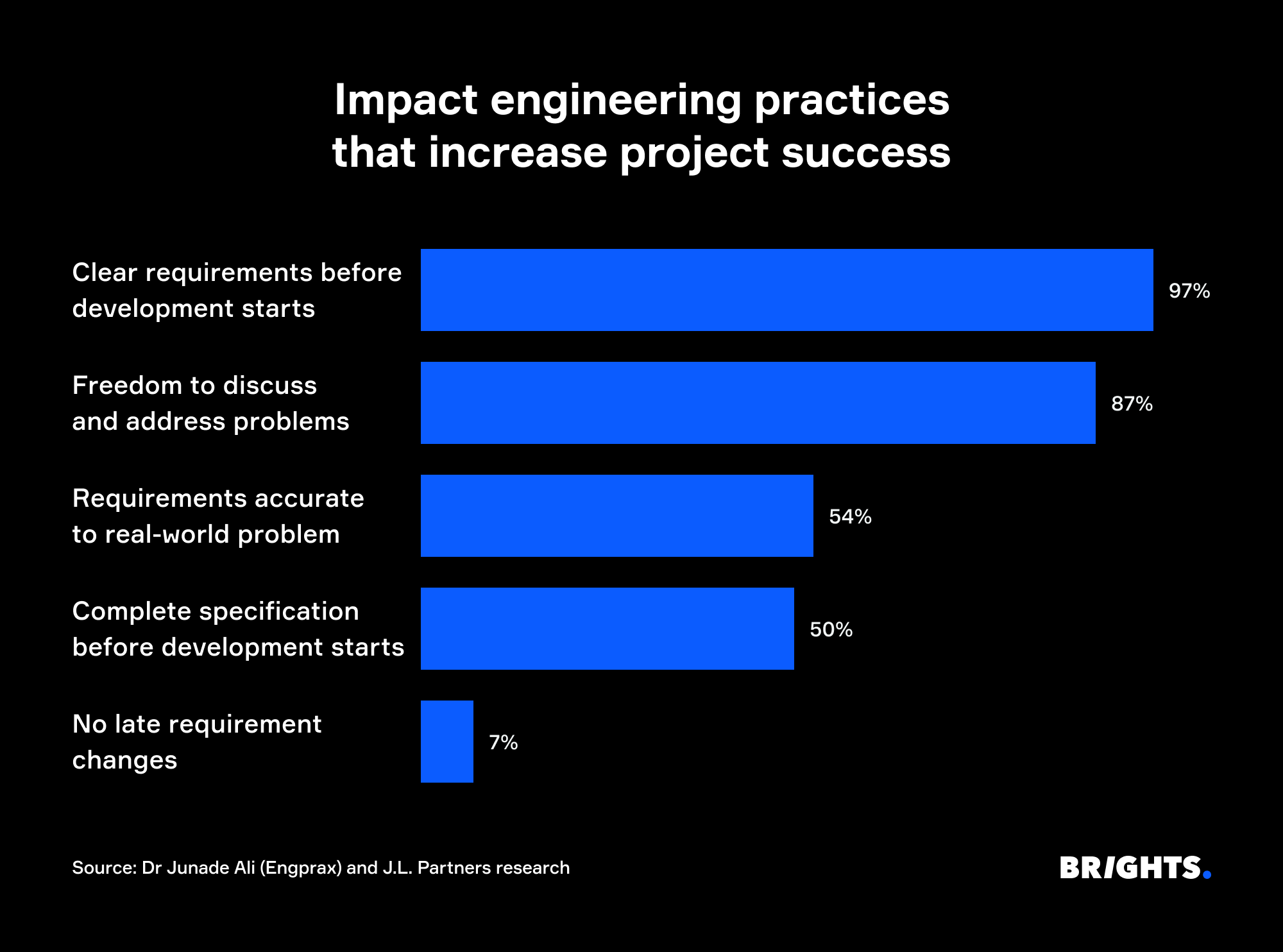
Insight: A 2024 study of 600 software engineers across the UK and US found that projects with clear requirements before development started were 97% more likely to succeed. Projects that began coding before requirements were settled failed 65% of the time — 268% more often than projects that avoided that pattern.
Yet, what if you’re a founder or a C-level executive from a non-technical background? Here is what Nata Shved suggests:
"Choosing a vendor should come down to either relevant experience or trusted recommendations. A reliable starting point is a verified platform like Clutch, where reviews go through a verification process.
An agency, compared to individual freelancers, offer something closer to a shared brain: a team with collective experience that takes responsibility for proper delivery.”
Data security & compliance risk
Outsourcing software development usually entails giving a vendor some level of access to systems, credentials, or data. What often gets missed is that responsibility doesn't move with the access: if something goes wrong on the vendor's side, the company whose name is on the product is the one users and regulators hold accountable. Here is what Nata says:
“If a company works in a heavily regulated industry, it can always work with a vendor using mock data. In the era of AI, generating a realistic mock database to work with, in whatever format is needed, is quite straightforward — without giving a vendor access to real user data.
Apart from checking your vendor’s certifications, look at their track record, specifically working with large enterprises. Corporations like McDonald's, Samsung, Philip Morris International, or Microsoft run large, demanding security departments, and they are very strict when choosing a vendor. Brights has worked with all of them, so we know what that bar looks like."
Ways to reduce this risk:
Certification check: SOC 2 Type II is a US-style attestation report on operational controls, while ISO 27001 (which Brights holds as well) is an internationally recognized certification of a full security management system.
Right-to-audit and least privilege: adding an audit clause and requiring least-privilege access means you can verify security claims directly and limit exposure to only the systems and data a vendor actually needs.
Data Processing Agreement: signing one for GDPR/UK GDPR compliance formalizes how data gets handled, but it doesn't transfer liability — you remain the data controller, and stay accountable, even when processing is outsourced.
Insights: Third-party involvement in breaches doubled from 15% to 30% year over year. The global average breach now costs $4.44 million, and supply-chain breaches specifically average $4.91 million and take 267 days to contain — longer than almost any other breach type, according to IBM Cost of a Data Breach Report 2025. Over a third of 2024 breaches traced back to a third party.
Vendor, communication & cultural risk
Miscommunication rarely sinks a project on its own. What actually does the damage is smaller and easier to miss: a question that remains unanswered for a day, a decision made without full context, a status update that lands after the moment it mattered.
Ways to reduce this risk:
Time-zone overlap: working within a 4–6 hour daily window keeps feedback and code review inside the same business day.
Paid pilot: running one with clear success criteria before scaling up, a two-sprint trial, for example, gives both sides real evidence of fit before either commits to a longer engagement.
Governance cadence: setting a check-in rhythm and escalation path in the statement of work means everyone already knows who to contact and how fast to expect a response before a problem shows up.
Protected sync time: reserving the shared overlap hours for design reviews and architecture discussions, and pushing routine updates to async channels, protects the limited synchronous time for decisions that actually need it.
Nata sees the earliest weeks of a project as the clearest window into how a vendor operates:
"For a client, this is a chance to see whether a vendor reacts proactively or reactively. The questions a team asks say a lot. So does how a client finds out something's off: after it's already happened, or while it's still developing, with solutions offered upfront.
One of the biggest red flags is when you can’t say for sure where a project stands at any given moment of time. That is why regular updates, progress reporting, and the opportunity to give feedback should be non-negotiable."
Intellectual Property (IP) protection risk
For an early-stage company, the product being built usually is the company’s primary asset. Yet, ownership of that product is often assumed rather than verified, based on the idea that paying for work automatically means owning what it produces. In reality, ownership depends entirely on what a contract actually says.
Ways to reduce this risk:
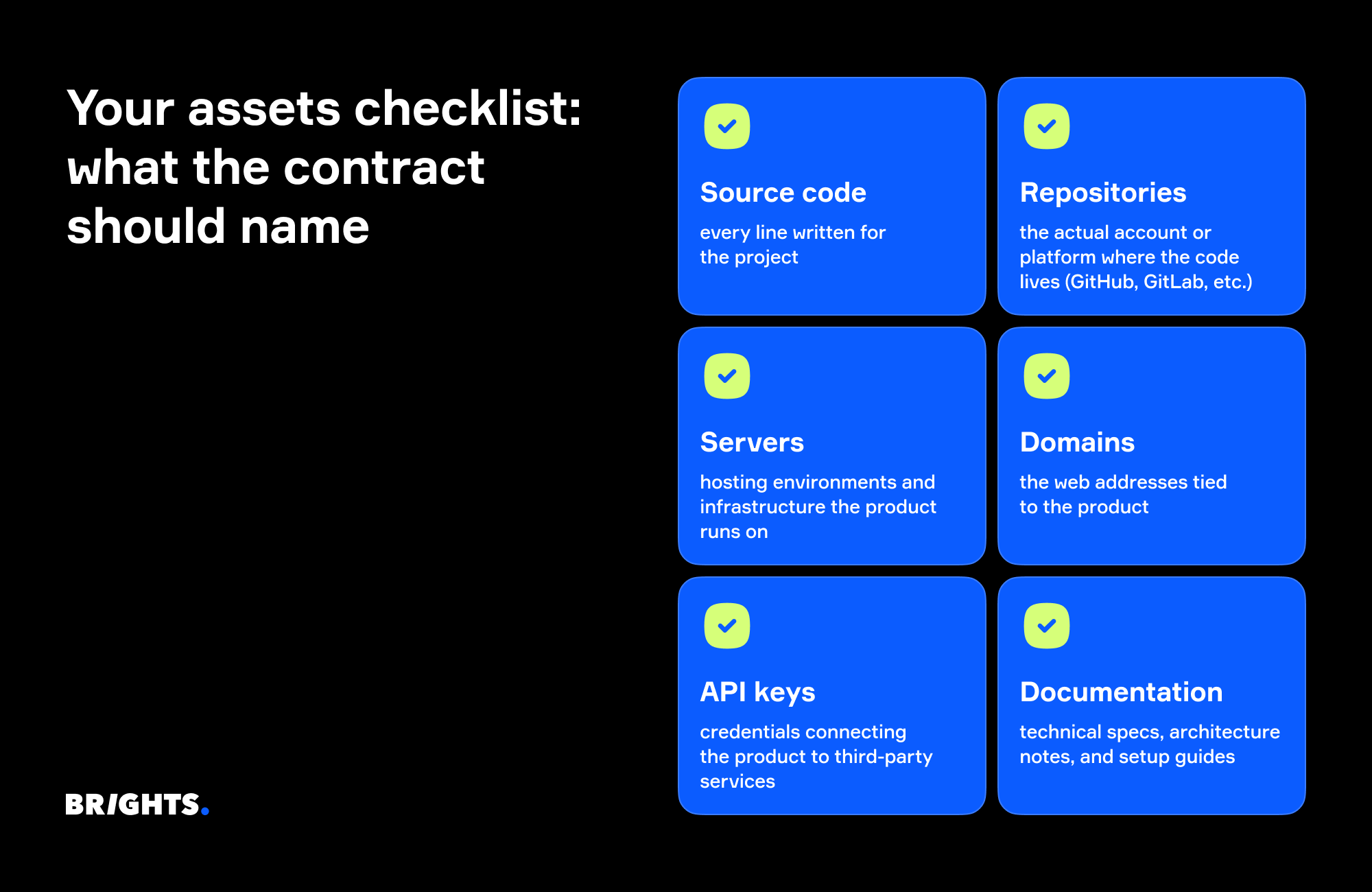
Named assets: listing every component explicitly in the contract — source code, repositories, servers, domains, API keys, and documentation — closes a gap founders often don't notice until they try to leave a vendor.
Source-code escrow: setting this up for critical systems means a neutral third party holds a copy of the code and releases it to you automatically if the vendor goes out of business or abandons the project.
NDA and non-compete: an NDA protects confidential information by default, while a non-compete clause is worth adding on top of it if you are concerned about a vendor building something similar using the same domain knowledge.
IP separation: distinguishing pre-existing IP from newly built IP in the agreement keeps a vendor's own internal tools and frameworks with the vendor, while everything created specifically for you becomes the your exclusive property.
Nata explains how Brights structures ownership from the contract itself:
"The contract needs to state clearly that anything built by the vendor belongs solely to the client, with intellectual property rights transferring at the point of payment. It's also worth checking whether the vendor has that same clause signed with its own employees. Access is usually structured the same way: every account used belongs to the client, and Brights is added as an admin or team member. Once the engagement ends, those credentials are simply removed."
Talent & team continuity risk
A vendor relationship can look stable on paper while carrying a quiet single point of failure: one engineer or designer who holds most of the context for how the product actually works. That person leaving doesn't just create a staffing gap. It can stall a project for weeks while a replacement gets up to speed on decisions that were never fully documented.
Ways to reduce this risk:
Attrition SLA: building turnover metrics into the SLA gives a client a way to hold a vendor accountable for team stability, with credits at risk if the vendor doesn't meet agreed thresholds.
Key-person clause: naming critical roles in the contract means the specific people running a project can't be swapped out without the client's knowledge and approval.
Ongoing documentation: treating it as a running requirement, rather than something written up at the end, means the knowledge behind a decision doesn't live only in one person's head.
Churn as a signal: watching for high personnel turnover matters because a vendor with high churn is often either underpaying its team or treating the account as a training ground for less experienced engineers.
As any reliable outsourcing software development company, Brights has exit clauses, and our employees can't quit in a day. But more importantly, when someone does leave, there's a structured offboarding and knowledge-transfer process.
Nata points to employee satisfaction as one more safeguard: "We invest in making Brights a place where people want to work at, keeping them engaged with challenging projects and room to grow. Average tenure at Brights runs three years and two months, and the median is 1 year 11 months. Our employee satisfaction backs that up too — Brights' eNPS sits at 87, well above the industry norm."
The pattern underneath all seven
Every risk category here traces back to the same handful of habits: clear terms up front, milestones instead of one long leap, and honesty when something drifts off track. Done well, risk management in software development projects rarely calls for exceptional technical skill — that's the whole point.
The teams that fail aren't usually the ones writing worse code. They're the ones skipping the planning, the governance, and the conversations that catch problems while they're still small. That is exactly what a discovery phase, a capped budget, and a documented handover process are built to prevent.
FAQ.
Most discovery phases run one to three weeks, depending on product complexity and how much documentation already exists. The output includes a scoped estimate, a proposed team structure, and often a working prototype of the riskiest technical piece.

