Agentic AI in Insurance: 6 Production Deployments and the Scoping Decision Behind Each

A severe storm cuts power across a region for 20 hours. Days later, a mid-sized insurer is sitting on 3,000–5,000 food-spoilage claims worth 200–400 each — every one needing a coverage check, a weather verification, and a fraud screen before it can pay.
Low severity, high friction: 600,000–2 million in exposure, and thousands of manual touches stacked on top of a market that already closed 5.3 million U.S. home claims in 2025. Behind that queue sit the losses that actually move the loss ratio — structural damage, business interruption, subrogation — waiting on the senior adjusters the spoilage queue is consuming.
That queue is why insurance is one of the two sectors furthest ahead on autonomous AI. S&P Global Market Intelligence and McKinsey put banking and insurance at ~47% agent deployment in production, against 18% in healthcare and 14% in government. Insurers had the workflows agents handle well — high-volume, document-heavy, rules-bound — and the cost pressure to justify building.
That queue is why insurance is one of the two sectors furthest ahead on autonomous AI. S&P Global Market Intelligence and McKinsey put banking and insurance at roughly 47% AI agent production deployment, compared with 18% in healthcare and 14% in government. Insurers had the high-volume, document-heavy, rules-bound workflows that agents handle well, and they had the cost pressure to justify the engineering effort.
The technology behind those deployments is agentic AI.
Key takeaways
Agentic AI reached production in claims first — 21% of disclosed insurance AI deployments in Q4 2025, more than half of those in claims.
The systems that shipped scoped hard — Allianz picked one claim type, one peril, one monetary ceiling, and went live in under 100 days.
Every production system withholds one action — none of Nemo's seven agents can authorize a payment.
Underwriting shows the sharpest numbers — CFC quotes in 5 minutes against 24 hours, at £0.50 against £5.
Governance is an evidence requirement now — EU AI Act high-risk obligations attach August 2, 2026.
What is agentic AI in the insurance industry?
Agentic AI refers to goal-oriented systems that plan multi-step tasks, execute them across multiple tools and databases, and adapt when inputs change. A single agent has a job, a set of tools, and a boundary. Several agents working under a coordinator can handle an entire workflow from intake to a decision-ready file.
The difference from the AI most carriers already run is worth setting out plainly.
| Generative AI copilot | Agentic AI system | |
|---|---|---|
| Trigger | A human asks a question | A submission, claim, or event arrives |
| Scope | One response at a time | A multi-step workflow |
| Systems access | Reads what it is given | Reads and writes to policy admin, claims, and billing via APIs |
| Output | Text a human can act on | Actions taken, plus an audit file for human sign-off |
| Failure mode | A bad answer | A bad action, which is why authority limits matter |
oth belong in a carrier. Assistive AI still dominates production volume across the industry, and the latest Q2 2026 review found insurers embedding copilots into core platforms for underwriting, rating, billing, and claims. Agents are the layer above that, doing the sequencing.
How agentic AI works in insurance
Inside a carrier, an agentic system does five things:
Reads unstructured evidence — broker emails, ACORD forms, statements of value, loss runs, repair invoices, police reports, call transcripts, damage photos
Cross-references that evidence against policy terms, underwriting guidelines, and third-party data such as meteorological records or cross-carrier claim histories
Makes decisions within an explicit authority limit, and only within it
Writes structured results back into the policy administration, claims, and billing systems
Assembles an audit summary and escalates anything outside its permitted scope to a named human
Allianz, an international service provider in insurance and asset management, built the clearest public example of this. Project Nemo, launched in Australia in July 2025 and fully operational in under 100 days, runs seven task-specific agents for food spoilage claims following severe-weather outages. A planner agent orchestrates the workflow and holds process state. A cyber agent enforces data security. A coverage agent confirms that the policy covers spoilage due to severe weather. A weather agent verifies that a matching event occurred. A fraud agent screens for anomalies. A payout agent calculates the amount. An audit agent documents every decision and its rationale, then hands the file to a claims professional.
The whole sequence takes under five minutes. Allianz reports an 80% reduction in processing and settlement time, moving eligible claims under AUD 500 from several days to hours.
Read the agent list again and notice what is missing. None of the seven agents can pay a claim. Maria Janssen, Chief Transformation Officer at Allianz Services, put it plainly: AI agents make recommendations, and ultimate responsibility rests with a claims professional. The payout gate is not a policy written in a governance handbook that a workflow can skip under deadline pressure. It is an absence in the architecture.
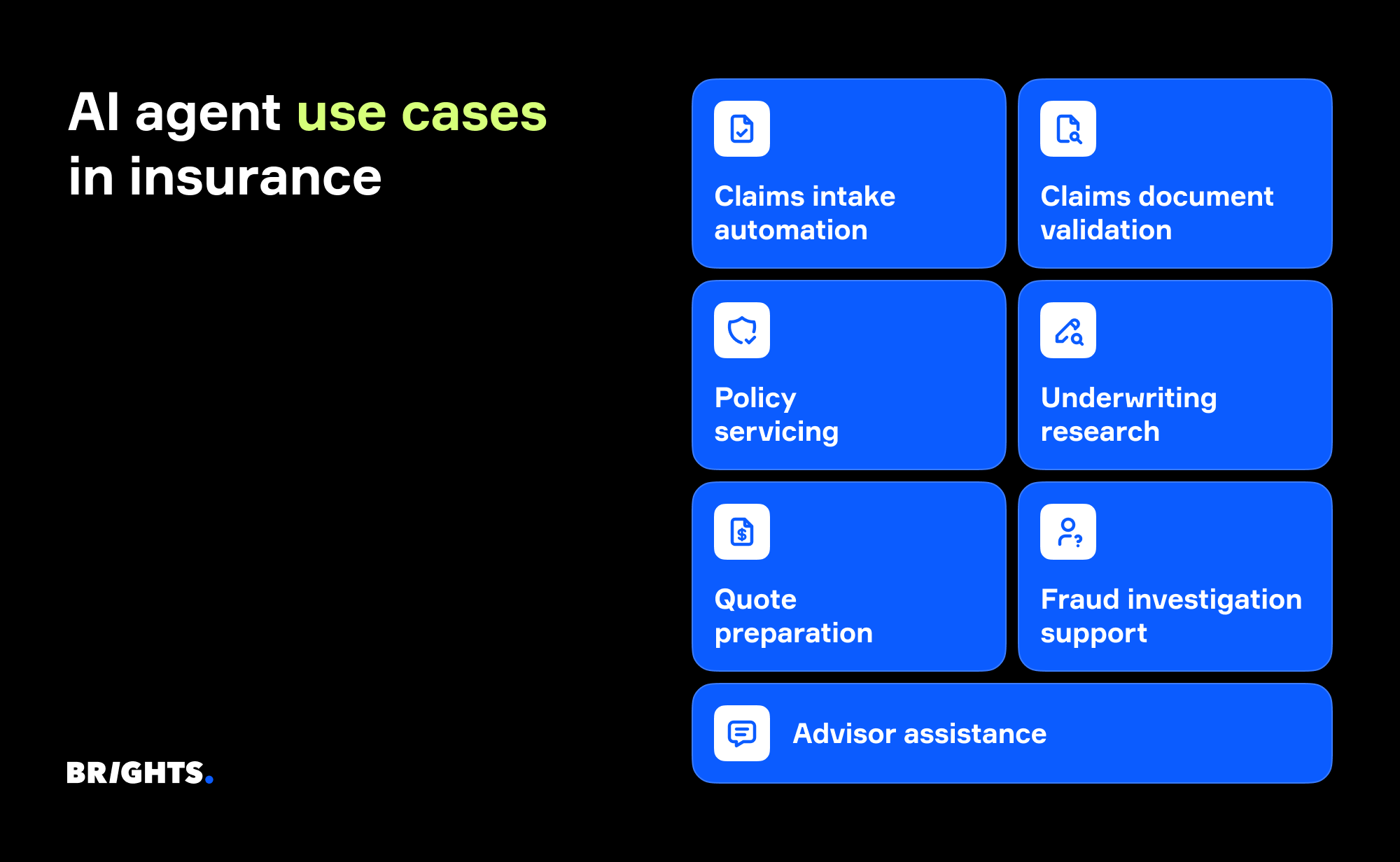
Agentic AI use cases in the insurance industry
Evident's Q4 2025 Insurance AI Use Case Tracker found that 68% of publicly disclosed insurance AI deployments were generative or agentic, with agentic AI at 21% of the total. Of those agentic deployments, 56% were in claims management. Underwriting and pricing took 21%, and customer engagement another 21%.
Here is where the named deployments sit.
| Function | Deployment | What the agents do | Reported result |
|---|---|---|---|
| Claims | Allianz Project Nemo (Australia, July 2025) | Coverage, weather, fraud, payout calculation, audit | 80% cut in processing and settlement time |
| Claims | Shift Claims with AXA Switzerland | Assessment, prioritization, handler guidance, and task automation across the lifecycle | 3% reduction in claims losses, 30% faster handling, 60% automation |
| Underwriting | CFC Lane Assist (April 2026) | Email submission to quote recommendation, using established underwriting rules | Quotes ready in 5 minutes against 24 hours, at £0.50 against £5 |
| Underwriting | QBE Cyber Underwriting AI Assistant | Initial review of broker submissions for completeness, appetite, risk control effectiveness | Over 60% faster initial risk assessment |
| Fraud and SIU | Covéa with Shift Technology (March 2026) | Risk surfacing, case synthesis and explanation, and action orchestration across underwriting, claims, and mid-term adjustments | End-to-end fraud view from inception to settlement |
| Distribution | IAG with OpenAI (announced July 2026) | Customer-facing voice agents for natural perils claims | Delivery expected in first half of FY27 |
Agentic AI applications in insurance underwriting
Underwriting is where the operational case is easiest to prove because the waste is measurable. QBE's cyber underwriting team spent about 40% of its time on manual administrative work before the assistant went in. Bold Penguin's 2026 analysis found that 60% of commercial submissions still require manual triage before eligibility is even confirmed, meaning a hidden tax on underwriter time that keeps growing as submission volume rises.
The strongest current example of agentic AI in insurance underwriting is CFC's Lane Assist, a pilot that went live with the company’s cyber team in April 2026. The system reads a new business submission from an email, extracts and structures the data, applies CFC's underwriting rules, and constructs a quote recommendation in seconds. Presenting at the Databricks Data + AI Summit, CFC reported trusted quotes ready in 5 minutes against a 24-hour baseline, at a cost of £0.50, down from £5.
McKinsey has described where this architecture goes next, a division of labour across five agents:
Intake — ingests submissions and clarifies gaps with brokers
Risk profiling — builds the profile against underwriting guidelines
Pricing and product — structures and prices the policy
Compliance and fairness — reviews the process
Decision orchestrator — aggregates the rest and decides whether to approve automatically or escalate to a senior underwriter
That orchestrator is the piece to be designed carefully. It is where a carrier encodes its actual risk appetite as a machine-readable authority, and where an auditor will look first.
Agentic AI in insurance policy management and servicing
Policy servicing generates the highest interaction volume for most carriers and the lowest value per interaction, making it a natural target. Agents in production here handle endorsement requests, certificate of insurance processing, renewal preparation, coverage questions, and proactive outreach when a policy needs attention.
EIOPA's February 2026 survey of 347 European insurers across 25 countries found that 36% had developed customer-facing generative AI applications, while autonomous agentic applications remained largely at the proof-of-concept stage Liberty Mutual's conversational quoting reached 7 US states by Q2 2026, with plans to expand beyond 40 states.
The pattern in servicing mirrors claims → Agents do the assembly → Anything that changes the policyholder's coverage or money goes to a person.
Fraud detection and SIU
Rules-only detection systems run at 60–85% false-positive rates, which jam SIU queues with claims that were never worth investigating. Agentic pipelines change the economics by working downstream of the flag: gathering the supporting evidence, checking cross-carrier claim history, writing the case brief, and routing to the right specialist.
Covéa selected Shift Technology in March 2026 to replace fragmented fraud tools with a single approach spanning underwriting, claims, and mid-term policy adjustments.
The pattern behind every deployment that shipped
Read those six deployments together, and the same decision appears in each one. The teams that reached production narrowed the scope until the workflow had a single clean regulatory surface, then withheld a specific action from every agent in the system.
Allianz picked one claim type, one peril, and one monetary ceiling: food spoilage, severe-weather outages, under AUD 500. Expansion into travel delays, simple motor claims, and property damage assessment comes after the bounded case proves out.
CFC picked one product line, one team, and a limited number of real submissions, with the underwriter approving every quote.
The pilots that stall have the opposite shape. Deloitte's 2025 Emerging Technology Trends study found that 30% of organizations are exploring agentic options and 38% are piloting them, with 14% having deployment-ready solutions and 11% running them in production. Gartner expects more than 40% of agentic AI projects to be canceled by the end of 2027, usually for unclear value, cost, or inadequate risk controls.
The failure profile is consistent:
One orchestrator pointed at claims, underwriting, and fraud simultaneously
No frozen evaluation set
No model card
A plan to add human oversight later
What the adoption numbers actually say
EXL's 2026 insurance survey, reported by Carrier Management in August 2026, found agentic AI advancing fastest in risk management at 54%, followed by actuarial, underwriting, and pricing at 46%, and customer experience at 45%. Of the agentic AI initiatives insurers had started, 45% were successful.
The same survey found something more useful for planning. While 76% of insurers believe they are ahead of the competition, only 6% qualify as leaders. Insurance holds the highest share of middle-tier followers of any industry surveyed, at 72%.
That gap between perceived and actual position is the practical risk. Leaders in the survey generated 40% higher revenue growth and 37% greater cost reductions than laggards in use cases where AI was applied, and were nearly three times as likely to adapt to market changes with agentic AI.
Governance is now an evidence problem
Two dates define the compliance work.
August 2, 2026 is when the EU AI Act's high-risk obligations attach under Annex III point 5(c), covering risk assessment and pricing in life and health insurance. That brings pre-deployment technical documentation, conformity assessment, Article 12 record-keeping on every high-risk decision, documented and tested Article 14 human oversight paths, and post-market monitoring. The maximum penalty is €35M or 7% of global turnover.
In the US, the NAIC Model Bulletin on the Use of Artificial Intelligence Systems by Insurers, adopted December 4, 2023, had been taken up by 24 states and the District of Columbia as of the NAIC's Spring 2026 National Meeting, with four more states issuing AI-specific insurance regulations. It requires a written AI Systems Program with a full inventory of AI tools, named senior-management accountability, documented testing for bias and error, and oversight of third-party AI where the insurer remains responsible for the model's behavior.
The operational development in 2026 is the NAIC's AI Systems Evaluation Tool, a structured examiner questionnaire piloting across 12 states through September 2026. State-level rules add another layer: Colorado's AI Act took effect June 30, 2026 after a delay from February 1, and Florida's HB 527 would require a qualified human professional to review and approve any claims denial involving AI or algorithms.
For an engineering team, this translates into concrete build requirements:
An AI system inventory tied to your existing configuration management, not a spreadsheet someone maintains manually
Per-decision audit records capturing inputs, model version, agent reasoning, and the human who signed off
Materiality-based escalation thresholds rather than confidence-based ones, because confidence scores drift and materiality does not
A frozen evaluation set of representative inputs labeled by senior adjusters or underwriters, which becomes your evidence base under examination
Vendor accountability documentation, since the insurer is responsible for a third-party model's behavior
Where to start
The sequencing that works follows the risk gradient.
| Sequence | Workflow | Why here |
|---|---|---|
| First | FNOL intake and triage, or SIU evidence assembly | High volume, clean regulatory surface, fast payback, no binding decisions |
| Second | Submission intake and appetite triage | Measurable waste, the underwriter approves every output |
| Third | Policy servicing and endorsement preparation | High interaction count, low value per interaction |
| Last | Autonomous underwriting decisions or payout authority | Highest regulatory exposure requires proven evaluation history |
Not every carrier needs agents. A queue that looks like an agentic problem is often an integration or data quality problem wearing a different hat, and adding an autonomous layer on top of either makes it harder to see. That is why we start with a discovery. Sometimes it ends with a recommendation to fix the data pipeline and revisit agents in a year, which is a cheaper answer than the one we were hired to give.
When discovery does point to agents, the build runs in this order:
Pick one workflow and write it down end to end. Including the exceptions your team handles informally and never documented. We look for a workflow with one clean regulatory surface.
Write the governance entry before the code. Inventory record, named accountable owner, escalation rules. Doing this first puts the compliance conversation where it can still change the design.
Freeze the evaluation set. Your senior adjusters or underwriters label a representative sample of real cases. That set becomes the pass mark for the build, and later, the evidence base you hand an examiner.
Build the integration layer. A typical carrier runs 15–20 legacy systems, and submissions arrive as broker emails, PDFs, spreadsheets, and phone calls. Getting that into a form an agent can reason over, and building the API paths to write results back safely, is most of the engineering.
Set the authority boundary in the architecture. We define what the agent may do as a materiality threshold rather than a confidence score, and the binding action stays out of reach.
Ship the audit trail with the workflow. Inputs, model version, reasoning, and the human who signed off, captured per decision.
Prove it, then extend. Once the bounded workflow holds in production, the integration layer, governance records, and authority model carry into the next one.
How Brights approaches this
Brights brings 15 years of software development experience, 120+ specialists, and ISO/IEC 27001 certification to projects in regulated industries. Our insurance portfolio spans established carriers and digital-first insurtechs, covering motor, property, health, and travel lines.
Our recent project in AI
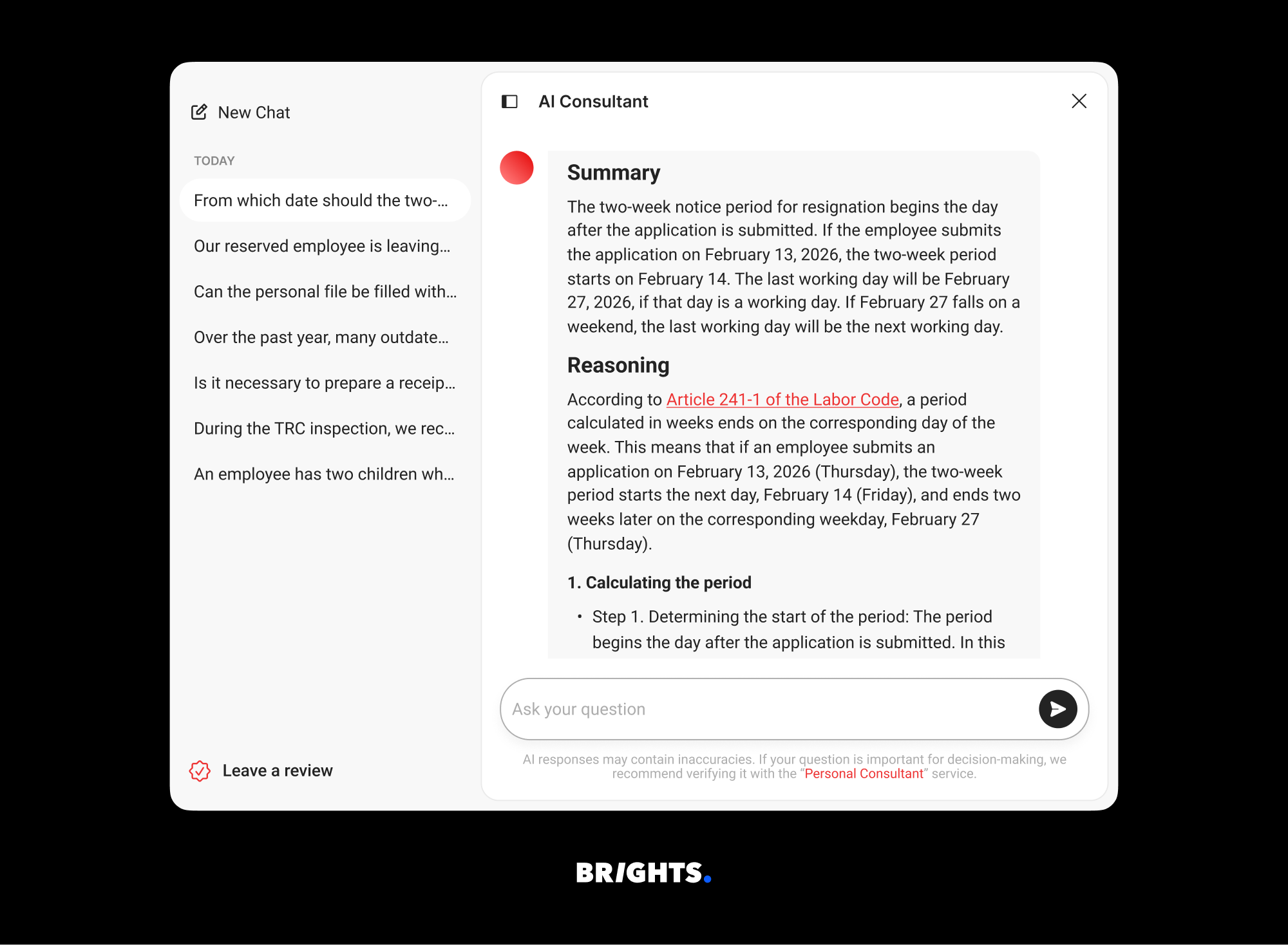
We built a multi-agent system with retrieval over a maintained knowledge base, routing different question types to specialized agents. Before any of it was written, their own experts scored a cheap messenger-bot prototype on 250 real tax and personnel law questions and rated 80% of the answers excellent against their professional standards. That score is what justified the build. The widget MVP reached both platforms in three months. Now, it answers in under 90 seconds with 99%+ availability, and human experts take over when someone needs advice specific to their situation.
References
Allianz, "When the storm clears, so should the claim queue" — allianz.com
Evident Q4 2025 Insurance AI Use Case Tracker, via Digital Insurance — dig-in.com
CFC, "CFC pilots agentic underwriting with launch of Lane Assist" — cfc.com
Databricks Data + AI Summit, "Reinventing Operational Scale through Agentic Underwriting" — databricks.com
QBE, "QBE scales Gen AI solutions across operations" — qbe.com
McKinsey, "The future of AI in the insurance industry" — mckinsey.com
Shift Technology, "Shift Technology Launches Shift Claims" — shift-technology.com
EXL 2026 insurance AI survey, via Carrier Management — carriermanagement.com
Deloitte, "Agentic AI strategy," Tech Trends 2026 — deloitte.com
NAIC, Model Bulletin: Use of Artificial Intelligence Systems by Insurers and state adoption map — content.naic.org
EIOPA, "Survey on Generative AI shows swift but cautious adoption among Europe's insurers," February 2, 2026 — eiopa.europa.eu
FAQ.
A chatbot or copilot responds when a person asks it something. An agent starts work when a claim or submission arrives, moves through several steps, and takes actions in your systems. The practical consequence is that agents need authority limits and audit records in a way copilots do not.


