How to Successfully Integrate AI into SaaS Platforms

AI integration in SaaS has become a defining question for companies in the sector. Some teams are moving quickly, adding features and iterating. Others are holding back, weighing the investment against unclear returns. But neither approach guarantees success.
The complexity often catches teams off guard. Deciding which AI capabilities align with your product roadmap takes research. Understanding whether to use APIs or build custom models requires technical evaluation. Demonstrating ROI before committing significant resources requires careful planning. And perhaps most challenging — ensuring what you build solves real problems rather than just checking an “AI-powered” box.
When AI integration is approached strategically, it can deliver tangible results: automation that reduces operational costs, personalization that improves retention, and predictive capabilities that strengthen your product's competitive position.
Our custom SaaS development agency helps companies navigate these decisions: from straightforward chatbot integrations to complex AI capabilities such as predictive analytics and computer vision. In this guide, we help you understand the technical and business decisions involved, avoid common pitfalls, and focus on implementations that create measurable value.
Key takeaways
Customers today expect software to anticipate their needs, not just respond to commands, making AI integration essential for staying competitive.
API-based integrations offer the fastest path to validate assumptions, with teams graduating to embedded or custom models once they've proven value.
A common implementation mistake is building AI features that look impressive in demos but don't solve user problems. Success depends on addressing genuine pain points.
Common challenges like data privacy, model bias, technical skills, and legacy integration are predictable and solvable with phased implementation and managed AI services.
Success metrics defined upfront, budget caps for experimentation, and willingness to kill underperforming features separate successful implementations from costly experiments.

AI functionality for AuraGlow app. Developed by Brights
Why are SaaS companies prioritizing AI integration now?
The short answer is that customer expectations have shifted. Users increasingly expect software to anticipate their needs, not just respond to commands. They want platforms that learn from their behavior, suggest relevant actions, and reduce manual work. Meeting these expectations without artificial intelligence means scaling human effort linearly — a model that breaks quickly.
AI integration in SaaS platforms addresses this by embedding intelligence directly into product workflows:
Automation handles repetitive tasks like data entry, ticket routing, and report generation.
Personalization adapts interfaces and recommendations based on individual usage patterns.
Predictive analytics surfaces risks and opportunities before they become obvious, identifying churn signals, forecasting demand, and flagging anomalies in real time.
The competitive pressure is tangible. According to McKinsey, 88% of organizations used AI in at least one business function in 2025. Moreover, 62% of respondents said their organizations are experimenting with AI agents. For SaaS platforms, it's all about remaining relevant as AI-native competitors enter the market with capabilities built from the ground up.
Want to know more about the role of this technology? Read our article on the impact of AI on SaaS products.
Core AI technologies in SaaS

Not every AI capability makes sense for every product. Understanding which technologies address which pain points helps you prioritize development and avoid building features that look impressive in demos but don't get used in production. Here's what's proving valuable across SaaS products.
Machine learning & predictive analytics
These models identify patterns in historical data to forecast outcomes, including churn risk, demand spikes, lead scoring, resource allocation, and anomaly detection. They help teams move from reactive to proactive decision-making by surfacing insights before they're obvious. The value compounds over time as models learn from new data, becoming more accurate at predicting behaviors specific to your user base.
Natural language processing (NLP) & chatbots
NLP enables software to understand, interpret, and respond to human language in text or speech. This powers customer support bots, sentiment analysis, document processing, voice interfaces, and automated content moderation. The technology has matured to the point where conversational AI can handle complex, multi-turn interactions, understand context and intent, and escalate appropriately when human judgment is needed.
Generative AI & intelligent agents
Generative models create new content — emails, code, reports, images, summaries — based on user prompts and context. Intelligent agents take this further by executing multistep workflows autonomously: researching topics, drafting proposals, coordinating between systems, or managing approval processes without constant human input.
Recommendation systems
These systems analyze user behavior, preferences, and contextual signals to suggest relevant content, products, features, or actions. The technology adapts recommendations in real time based on how users interact with your platform, driving engagement, conversion, and feature discovery. The most effective systems balance personalization with serendipity, showing users what they're likely to want while introducing them to valuable features they haven't discovered yet.
AI-powered automation tools
Automation tools handle repetitive tasks like data entry, categorization, routing, compliance checks, and workflow orchestration. Unlike traditional rules-based automation, AI-powered tools adapt to variations and exceptions, learning from corrections over time. They reduce manual work while maintaining accuracy, freeing teams to focus on tasks that require human judgment and creativity.
Key artificial intelligence integration strategies

Integrating AI in SaaS requires choosing an approach that matches your technical capacity, timeline, and business goals. Here's how each strategy works in practice.
API-based integration
Connect to third-party AI services through REST APIs—no model training required. This is the fastest path for AI integration in SaaS, letting you add capabilities like text generation, image analysis, or sentiment detection in weeks rather than months.
The approach involves connecting to third-party AI services through REST APIs — no model training required. It's the fastest path to AI integration in SaaS, which enables you to add capabilities such as text generation, image analysis, and sentiment detection in weeks.
Tip from Brights: Start with a single, high-value use case to validate the approach before expanding. Test different providers to find the best balance of cost, latency, and accuracy for your needs.
Potential pitfall: Vendor lock-in and unpredictable pricing as usage scales. API rate limits can also become bottlenecks during traffic spikes.
Embedding pre-trained AI models
This approach relies on deploying open-source or licensed models directly in your infrastructure. It gives you more control over costs, latency, and data privacy than APIs while avoiding the complexity of training from scratch.
Tip from Brights: Use model quantization and optimization techniques to reduce compute costs. Monitor performance closely during the first month to right-size your infrastructure.
Potential pitfall: Infrastructure costs can exceed API pricing at low volumes. You'll also need DevOps services for SaaS to handle deployment, scaling, and updates.
Custom AI model development
Custom AI software entails building proprietary models trained on your data when competitive differentiation requires capabilities that no off-the-shelf solution provides. It demands significant investment but delivers features competitors can't replicate.
Tip from Brights: Assemble clean, representative training data before starting development. Bad data quality is the top reason custom models underperform.
Potential pitfall: Long development cycles (6-12 months) and ongoing maintenance costs. Many teams underestimate the effort required to keep models accurate as user behavior evolves.
Hybrid approaches
Here, you will combine multiple strategies, using APIs for general tasks and custom models for differentiated features. The SaaS AI integration steps involve more planning upfront, but deliver better economics and performance at scale.
Tip from Brights: Document which components use which approach clearly. This prevents confusion as your team grows and simplifies future migrations.
Potential pitfall: Increased system complexity makes debugging harder when issues span multiple AI services.
When considering how to integrate AI into existing SaaS, it comes down to where you are now and what you're trying to accomplish. Teams with tight budgets or timelines often start with APIs to validate their assumptions, then move to embedded or custom models once they've proven the feature brings value. The pattern that works: start small with one well-defined use case, track what actually improves, and let those results guide whether you stay with APIs or invest in more sophisticated approaches.
How to deal with the common challenges of AI implementation in SaaS?
Most SaaS teams know they need AI. The real obstacle lies in figuring out how to implement it without derailing current operations or burning budget on features that don't deliver. The SaaS AI integration challenges that actually slow teams down are predictable — here's how to address them.
Data privacy and compliance concerns
Challenge: AI models need data to function, but customer data comes with regulatory constraints. GDPR, HIPAA, and SOC 2 requirements get more complex when you’re using AI. In fact, according to a recent IBM report, 97% of organizations surveyed reported an AI-related security incident.
Solution: Build data governance frameworks before implementing AI features. Define which data types can be used for training, establish clear consent mechanisms, and implement data anonymization where possible. For sensitive industries, consider on-premise or private cloud deployments where data never leaves your infrastructure. Document everything because regulators will ask.
Model bias and output reliability
Challenge: AI models trained on historical data can perpetuate existing biases or generate incorrect outputs with complete confidence. This is especially problematic in domains like hiring, lending, or healthcare where biased decisions have legal implications.
Solution: Establish human-in-the-loop workflows for high-stakes decisions. Don't let AI make final calls on sensitive outcomes — use it to surface recommendations that humans review. Test models against diverse datasets, monitor outputs for bias patterns, and build feedback loops where users can flag problematic results.
Technical skill gaps and resource constraints
Challenge: SaaS teams don't often have AI specialists on staff, and hiring them is expensive. This impacts both the cost of to develop a SaaS product with AI capabilities and the ongoing maintenance burden.
Solution: Start with managed AI services (OpenAI API, Google Vertex AI, AWS SageMaker) rather than building models from scratch. These platforms handle infrastructure, model training, and scaling, letting your existing engineers integrate AI through APIs. Also, invest in training your current team on prompt engineering and AI integration patterns.
Integration with legacy systems
Challenge: Unless you launched your product in the last couple of years, chances are your SaaS infrastructure architecture isn’t designed for AI workloads. Legacy databases, monolithic codebases, and tightly coupled systems might make it difficult to add AI features without major refactoring.
Solution: Take a phased approach. Identify one high-impact area where AI workflow automation for SaaS delivers clear value, be it support ticket routing, churn prediction, or content generation. Build it as a standalone microservice that communicates through APIs. This lets you validate ROI before committing to broader architectural changes. Once you prove value, gradually expand AI capabilities while aligning with your SaaS implementation roadmap.
Cost and ROI uncertainty
Challenge: AI features increase infrastructure costs (compute, storage, API calls), but the return isn't always obvious upfront. Teams worry about spending heavily on experimentation without guaranteed payoff.
Solution: Define success metrics before building anything. What does “working” look like? Reduced support tickets? Higher conversion rates? Faster task completion? Build minimum viable implementations, measure impact against your defined metrics, and scale only what delivers ROI. Set budget caps for experimentation and kill features that don't hit targets within defined timeframes.
Real-world AI integrations that delivered measurable results
AI integration doesn't always require building complex systems from scratch to see impact. Whether you're deploying a straightforward chatbot or sophisticated predictive models, the results depend less on technical complexity and more on solving problems your customers and team actually face.
The two implementations below show how different approaches both delivered substantial ROI by addressing genuine operational pain points.
Klarna's GPT-powered assistant
Klarna, a global “buy now, pay later” fintech platform, deployed an OpenAI GPT-4 powered customer service assistant, integrating it directly into their mobile app across 23 markets and 35+ languages.
According to Klarna, in its first month, the assistant handled 2.3 million conversations (two-thirds of all customer service chats), equivalent to 700 full-time agents. Resolution time dropped from 11 minutes to under 2 minutes (82% reduction), with a projected $40 million profit improvement.
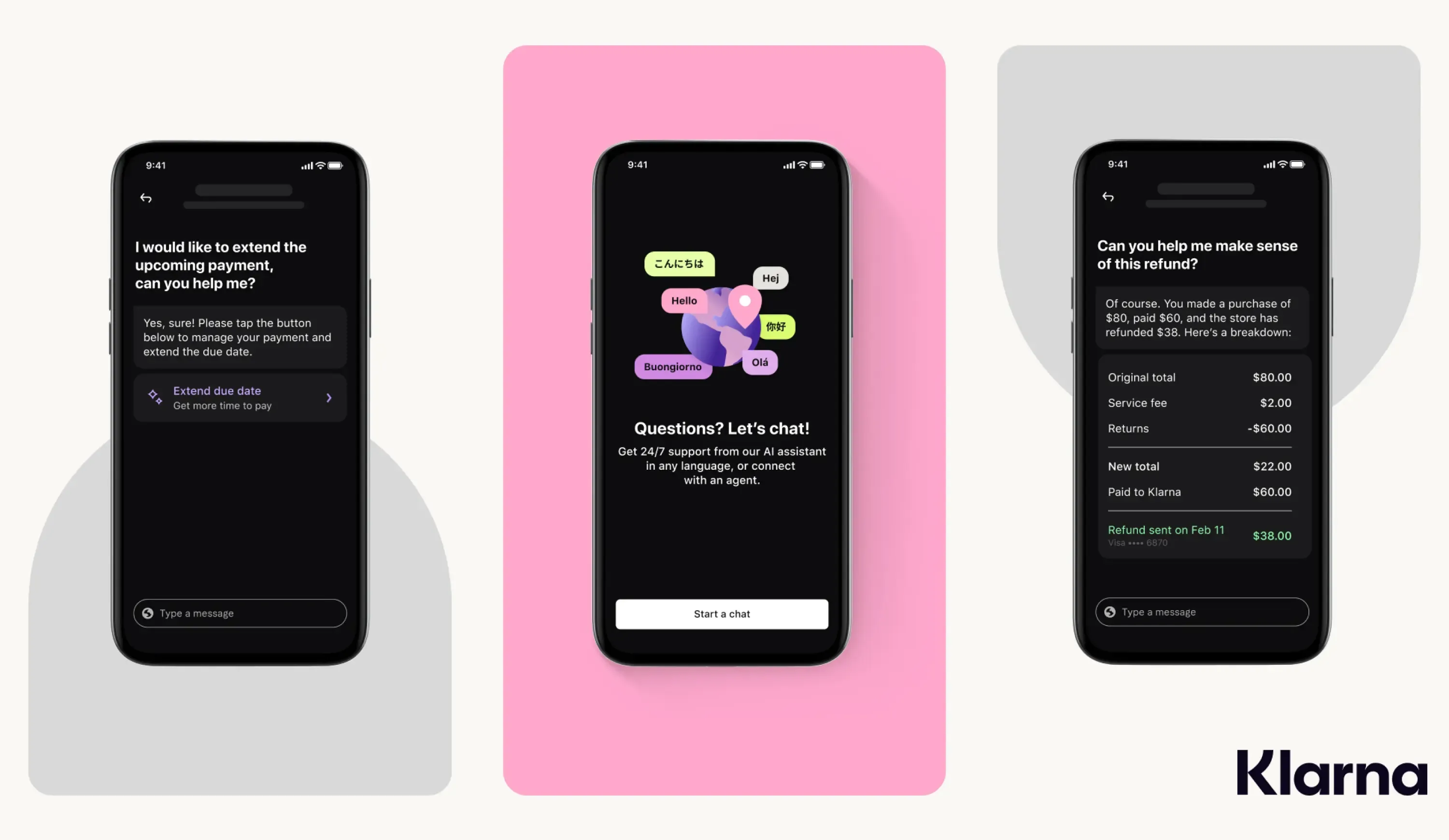
Source: Klarna
Predictive analytics for Hydrant
Hydrant, a DTC wellness brand, partnered with Pecan AI to build churn prediction and win-back models. The implementation integrated Pecan's automated ML platform with their Snowflake data warehouse and Klaviyo marketing automation, deploying a production model in just 2 weeks.
The models achieved 83% accuracy in identifying churning customers, drove 260% higher conversion rates in win-back campaigns, and delivered 310% higher revenue per customer from targeted promotions versus control groups.
Conclusion
Integrating AI in SaaS delivers clear benefits when approached strategically: lower operational costs through automation, stronger retention via personalization, and competitive advantages from predictive capabilities. The technical path — whether API-based, fine-tuned, or custom models — matters less than matching AI to genuine user needs and proving value before scaling.
The implementation steps are straightforward. Start by identifying one high-impact use case where AI addresses a clear pain point. Choose tools that fit your timeline and budget: most teams begin with API integrations before considering custom development. Define success metrics upfront so you can measure ROI and make informed decisions about expanding your AI features.
If you feel like you’re drowning in doubt, don’t hesitate to look for the expertise you need outside your organization. As SaaS software consulting partners, we help companies navigate these decisions, from evaluating which AI capabilities make sense for their platform to implementing them alongside their existing architecture.
FAQ.
The primary AI integration challenges in SaaS platforms include data quality and availability (models require clean, relevant training data), technical complexity in choosing between APIs and custom models, and ensuring AI features integrate smoothly with the existing architecture without disrupting performance. Security and compliance concerns also intensify when AI processes sensitive customer data, requiring careful implementation of access controls and monitoring.


