Who Owns Technical Debt Management in Agile Teams?

Roadmaps that looked achievable in planning slow to a crawl by execution, and the reason is rarely talent or effort. Your “why” most likely comes down to the accumulated weight of shortcuts, workarounds, and aging code that the team keeps pushing to the next sprint.
So, who owns that technical debt? Ownership is shared, but shared only means something once it is differentiated. The development team makes debt visible and answers for code quality. The product owner ranks paydown against business value. Engineering leadership keeps that trade-off sustainable over time.
Below we share what each role owns, and how to keep debt on the board, ranked in one backlog, with capacity protected to pay it down.
Key takeaways
Technical debt ownership only works when the shared-responsibility principle is paired with a specific accountability for each role: development team for quality and visibility, product owner for prioritization, and engineering leadership for sustainable capacity.
A single prioritized backlog, with debt items ranked by impact next to feature work, is what forces the trade-off into the open instead of letting debt hide in a separate list.
Protecting a standing share of sprint capacity for paydown matters more than the exact percentage chosen.
Ownership that works informally on one team has to become structural governance, with shared standards and a portfolio-level owner, once an organization scales past a handful of teams.
The short answer, and why "everyone" is not good enough
Ask 10 agile teams who owns technical debt, and most will give the same answer: the whole team owns it. That is correct, and it is also where the trouble starts. When ownership belongs to everyone, accountability belongs to no one. Debt becomes a collective good intention that no single person is measured on, and collective good intentions lose every sprint to a dated feature commitment.
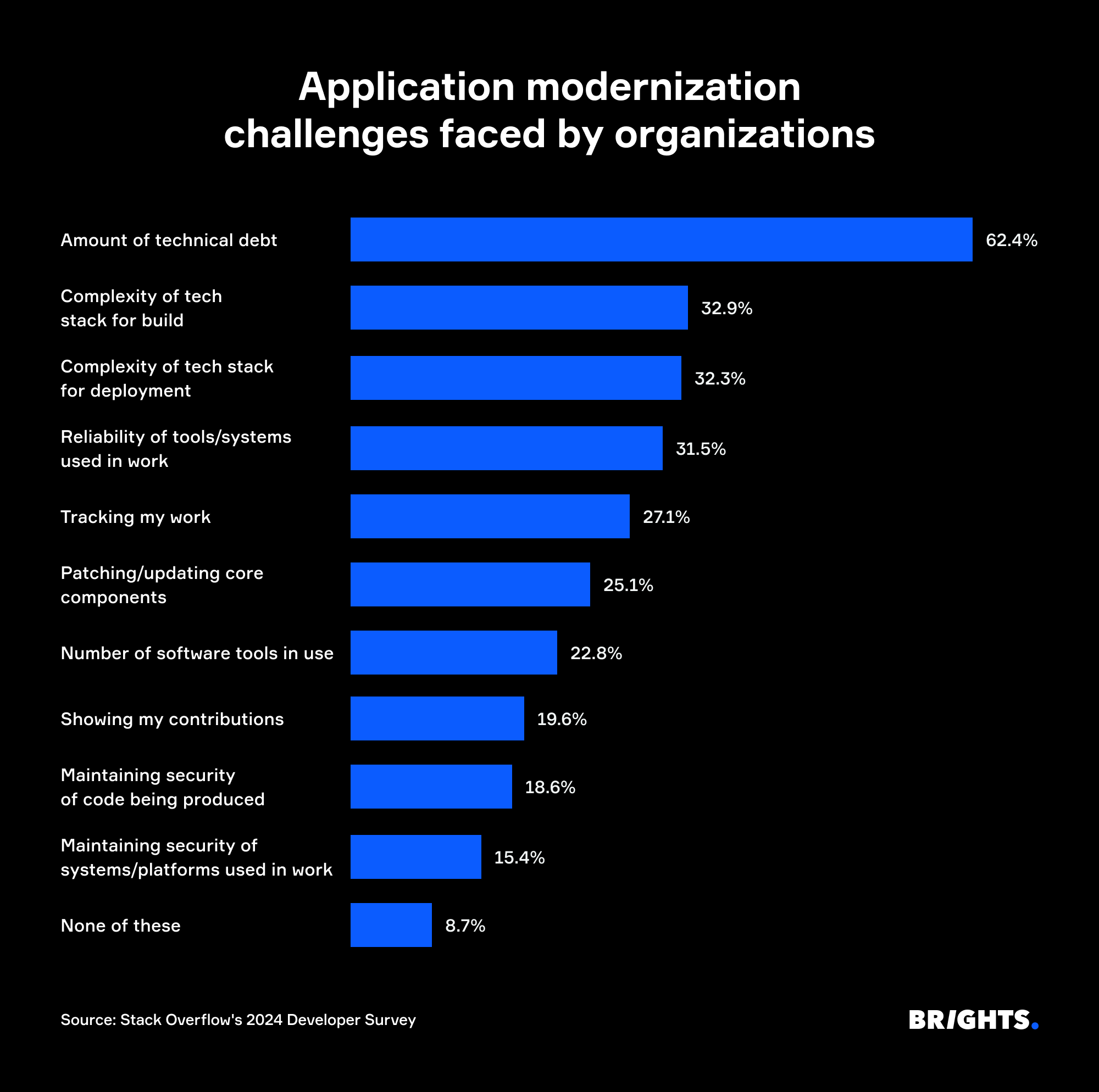
The cost of getting this wrong is not abstract. In Stack Overflow's 2024 Developer Survey of more than 65,000 developers across 185 countries, technical debt ranked as the single biggest workplace frustration for professional developers, cited by 62.4 percent of respondents.
A 2025 peer-reviewed study of 25 software professionals across seven countries found accountability works best when it is built into how the team operates, rather than assigning it after something goes wrong. It concludes that technical debt accountability should be "enacted democratically, not bureaucratically" (Ghanbari, Ahuja, Lee & Gaskin, Information and Organization, 2025).
That is the model this piece follows. Keep the shared-responsibility principle, then assign specific accountability to each role. That specificity is what moves debt off the board.
What technical debt is in an agile context
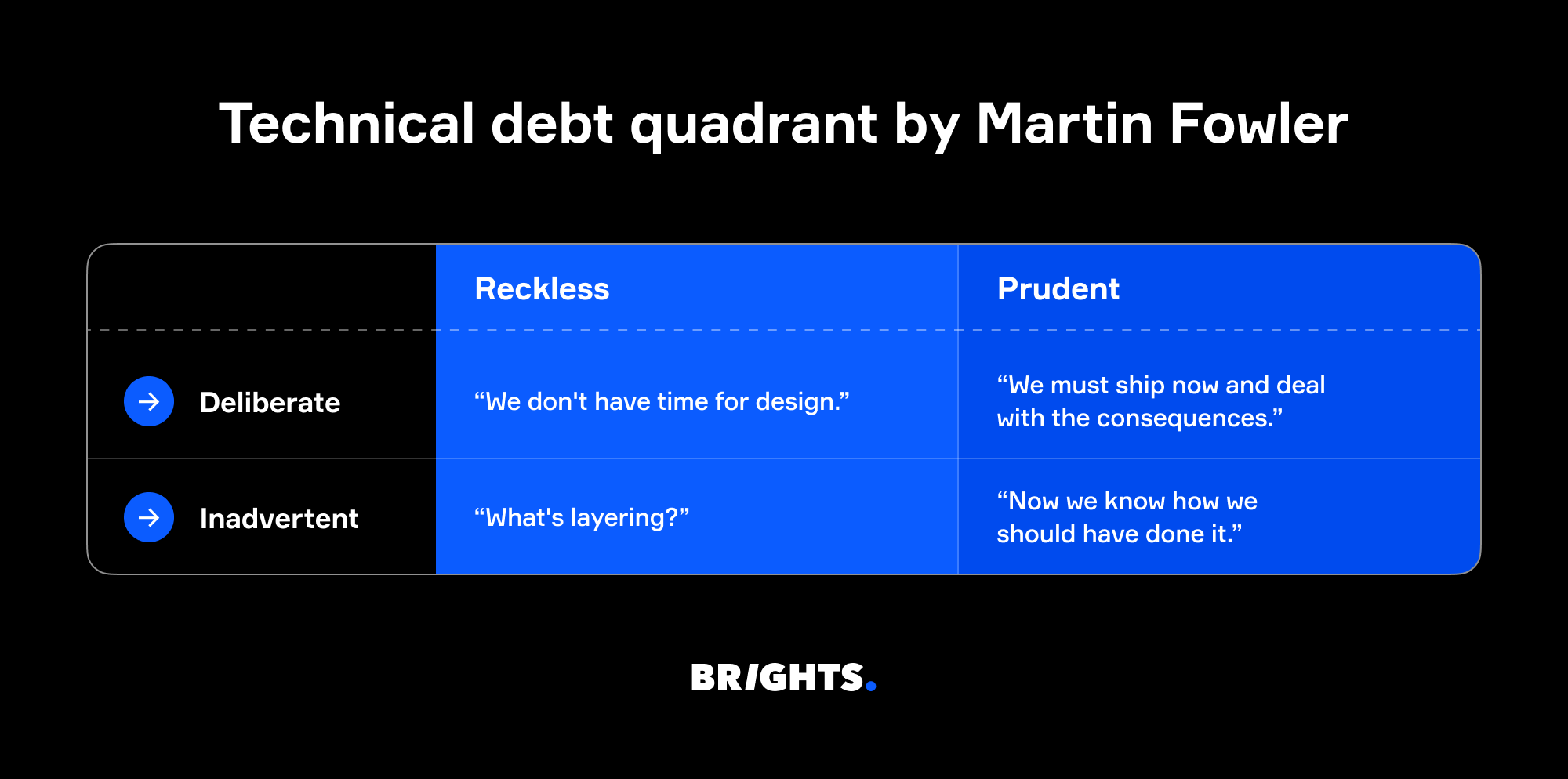
Technical debt is the implied cost of future rework incurred when a team chooses a faster, easier solution now rather than a better approach that would take longer. Whether that shortcut was deliberate or accidental matters, because it determines who owns the fix. A known trade-off made to hit a launch date is a business decision, and someone should sign off on it. A workaround born from not yet knowing a cleaner pattern is different: it's a visibility problem, and the team has to surface it.
The ownership model: who is responsible for what
Here is the entire model in a single table, followed by the reasoning behind each role. This is technical debt ownership expressed as accountability.
| Role | Accountable for | What that looks like in practice |
|---|---|---|
| Development team | Quality and visibility | Surfaces debt, estimates its "interest," keeps it on the board |
| Product owner | Prioritization | Ranks debt against features in one backlog |
| Scrum master / agile coach | Process | Keeps debt a standing item in planning and retros |
| Engineering leadership (EM / CTO) | Sustainability | Sets capacity policy and the definition of done, defends paydown to the business |
| Architecture / tech lead | The big calls | Decides when deliberate debt is worth taking on |
The development team, accountable for quality and visibility
No one can impose technical debt on a development team, and no one outside it can see it as clearly. That makes code quality the team's to own, fully. Developers are the ones who know which module is held together with workarounds and which test suite everyone is afraid to touch.
Their job has three parts: surface debt as it is created, estimate its interest so leaders can weigh it, and keep it visible on the board. A debt item that lives only in a senior engineer's head is invisible to everyone who allocates capacity.
The product owner, accountable for prioritization
The product owner owns the backlog, which means they make the trade-off between shipping features and paying down debt. This is the accountability most teams get wrong, because debt paydown does not demo well and rarely has a customer asking for it by name.
The reframe that helps: treat the development team as a quality stakeholder the PO has to manage like sales or support. Product owner technical debt decisions are really capacity decisions, and someone has to rank them. A PO who refuses to put debt in the backlog has still made a decision, in favor of accruing more of it.
The scrum master or agile coach, accountable for the process
Someone has to keep debt from disappearing between sprints, and that is the scrum master or agile coach. Their accountability is procedural: make debt a standing agenda item in sprint planning and retrospectives, and protect the capacity set aside for it from being quietly eaten by scope creep.
It is a small role on paper and a decisive one in practice. When technical debt in Scrum falls off the planning agenda, it does not resurface until it causes an incident. The coach keeps the conversation on schedule, before the debt forces it.
Engineering leadership (EM and CTO), accountable for sustainability
This is the role the framework blogs skip, and it is the one that decides whether any of the above holds. Engineering leadership sets the policy the team operates inside: how much capacity is reserved for debt, what the definition of done includes, which architectural standards are non-negotiable. Then leadership defends that paydown capacity to the business when a VP asks why the team is not shipping faster.
This accountability belongs specifically to EMs, VPs of Engineering, and CTOs. Developers can surface debt, and a PO can rank it, but only leadership can make paying it down a permanent line item. Sustainable technical debt management is a matter of leadership policy first.
The architect or tech lead, accountable for the big calls
Some debt is worth taking on deliberately, and someone senior has to make that call with eyes open. That is the architect or tech lead. When the team faces a choice about whether to ship a known shortcut for a real business reason, the tech lead owns the recommendation, and the product owner confirms it against the business value.
This keeps deliberate debt honest. It turns cutting a corner into a documented, sponsored decision with a name attached, which is exactly what makes it payable later.
AI-assisted coding is raising the stakes
The ownership question is getting more urgent. A large-scale empirical study looked at more than 300,000 commits written by AI coding assistants, including GitHub Copilot and Claude. Every tool introduced at least one code issue in more than 15 percent of its commits. Close to a quarter of those issues were still sitting unresolved in the codebase months later (Liu, Widyasari, Zhao, Irsan & Lo, preprint).
Google's DORA research team found a related pattern at the delivery level: every 25 percent increase in a team's AI adoption correlated with a 7.2 percent drop in delivery stability (DORA, Accelerate State of DevOps 2024).
Neither finding means AI-assisted coding is bad. Both point to the same thing this piece has been arguing from a different angle: work nobody is explicitly accountable for reviewing tends to sit unresolved. When a tool can generate code faster than a team can review it, the visibility and named ownership components of the operating model stop being optional.
Why shared ownership breaks down, and how to fix it
Shared ownership fails in three predictable ways. Each has a fix, and you can start on those on Monday.
Debt is invisible. If it is not on the board, it does not exist to anyone allocating capacity. Fix: require that debt is written down as work items, in the same system as everything else, with an estimate of its cost.
Debt has no owner in the backlog. If no one is accountable for ranking it, it never competes with features and always loses. Fix: the product owner places debt items in the one prioritized backlog and ranks them by impact, right beside feature work.
Debt has no protected capacity. If paydown depends on a quiet week that never comes, it never happens. Fix: reserve a fixed share of every sprint for debt, and make protecting that share the scrum master's job.
Each failure maps to a role from the model above, which is no accident. Broken shared ownership is almost always a missing accountability, and naming the accountable role is the repair.
An operating model that makes ownership real
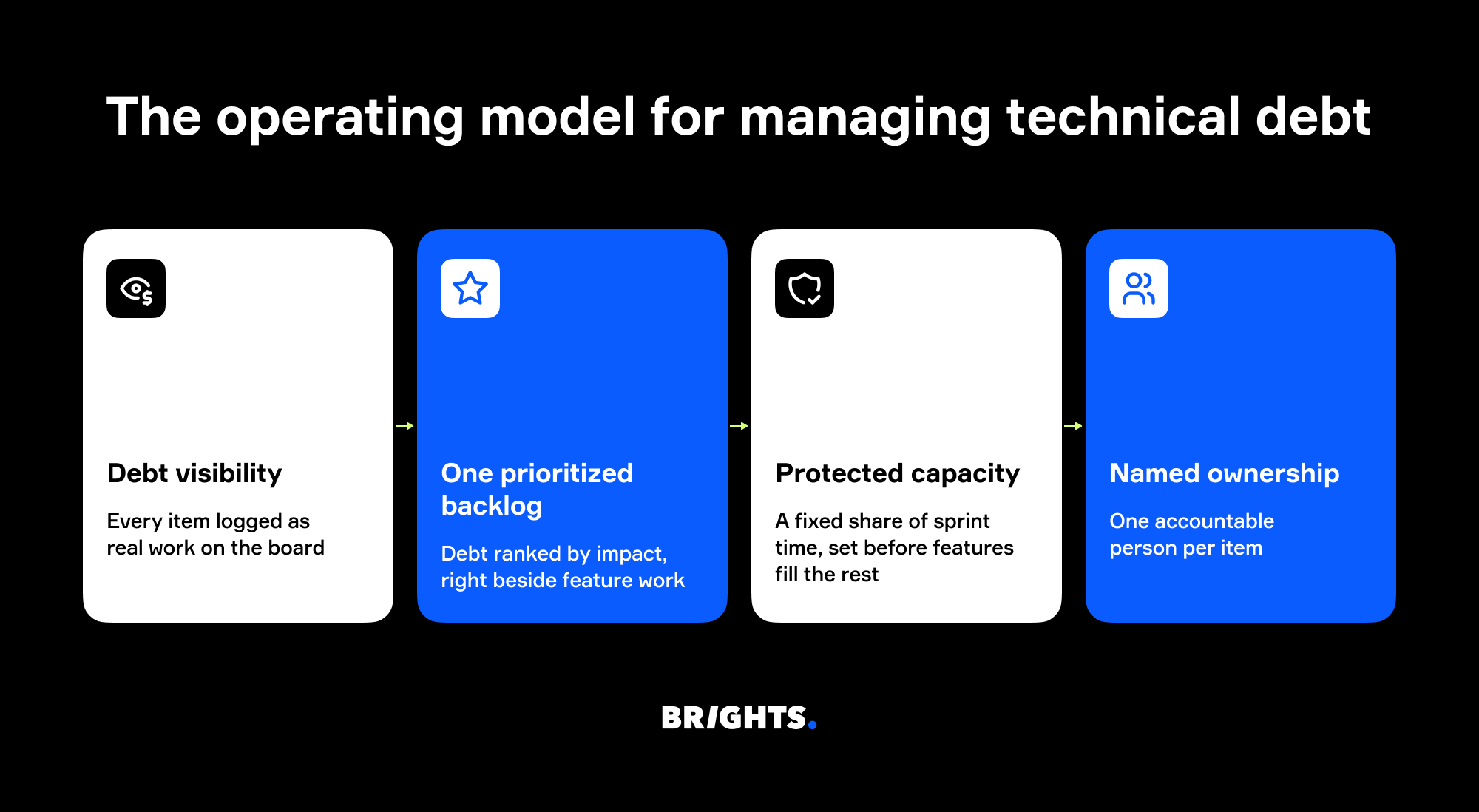
Principles do not pay down debt. Here is the operating model for managing technical debt in agile that turns the ownership map into a running system. It is deliberately boring, because boring is what survives a busy quarter.
Make debt visible. Give technical debt its own label, epic, or swimlane in Jira or Linear, separate from feature work so that you can report on it. If you cannot see how much debt you are carrying, you cannot defend the time to reduce it.
Prioritize it in one backlog. Score each debt item by impact, risk, and interest rate, then rank it in the same backlog as features. Two backlogs let debt hide. One backlog forces the trade-off into the open, which is where it belongs.
Protect the capacity. Reserve a standing share of sprint capacity for paydown. Most teams land between 10 and 20 percent, and the research points to roughly 15 percent as the practical sweet spot before returns flatten. Build that share into tech debt sprint planning as a fixed input, scheduled before the sprint fills up with features. Add a periodic debt audit so nothing rots quietly.
Assign a name. This is the one most teams miss. Every debt item gets one accountable owner, a named person who answers for it. Accountability that belongs to a group tends to belong to no one, which is why shared ownership breaks.
How this changes when you scale or bring in a partner
Everything above assumes one team that can hold its accountabilities in its collective head. At two teams, that starts to strain. At ten, tribal knowledge becomes a liability. Multi-team and enterprise environments need explicit governance for debt: shared standards, a visible cross-team debt register, and a leadership owner who tracks it at the portfolio level. Ownership that was cultural at small scale has to become structural.
There is also a point where debt outgrows the team's capacity to pay it down at all. A decade of a legacy platform, a stalled migration, a roadmap frozen because every new feature fights the old architecture. At that point, modernizing a legacy codebase becomes a program of work in its own right, and trying to absorb it inside normal delivery tends to stall both the cleanup and the roadmap.
This is where a dedicated engineering partner can take on the paydown in parallel, so your in-house team keeps shipping while the debt gets cleared. Strong DevOps practices that reduce delivery risk make that parallel work safer.
Conclusion
Who owns technical debt in agile teams? Everyone, and that answer only works once you make it specific. Shared ownership sets the expectation. Differentiated accountability, backed by visible debt, a single prioritized backlog, and protected capacity, is what turns the expectation into paid-down debt.
The one line to take back to your team: debt is everyone's responsibility and someone's accountability. Put a name next to every item, protect the capacity to clear it, and defend that capacity like it is roadmap work, because it is.
And when the debt has grown past what your team can clear on its own, tell us what you are building, and we will help you modernize without stalling the roadmap.
Sources
DORA / Google, Accelerate State of DevOps 2024
Martin Fowler, Technical Debt Quadrant
Atlassian, What is Technical Debt?
FAQ.
The whole team is responsible for technical debt in Scrum, but responsibility is differentiated. Developers own code quality and make debt visible, the product owner prioritizes it in the backlog, and the scrum master keeps it on the planning agenda. For sustainability over time, engineering leadership owns the capacity policy. Scrum.org frames this as a shared responsibility; in practice, each role carries a specific piece of it.

