AI-Driven Application Modernization: A Practical Guide for Enterprise IT Leaders

Your legacy estate is not going anywhere on its own. AI-driven application modernization has moved from vendor pitch to a real planning option for most enterprise IT programs. The harder question most IT leaders face: can it make a program that was previously unaffordable or too disruptive finally worth starting?
McKinsey found that one large European bank spent 70% of its IT capacity just keeping legacy systems running. That pattern compounds every year across industries. AI changes where the budget goes — not by eliminating complexity, but by compressing the groundwork that has made large programs unaffordable.
Brights has embedded AI across our development practices, including modernization. In this article, you’ll find what we've learned: from what AI actually changes in the lifecycle, to the 6Rs, a readiness self-assessment, and the risks worth raising before a program starts.
Key takeaways
AI compresses the assessment phase that has historically priced modernization programs out of the planning cycle, turning months of discovery work into days.
Every AI-generated output (discovery maps, translated code, test suites) is a first draft, not a final deliverable. The programs that treat it otherwise find out why in production.
A blanket strategy applied across your entire portfolio is the wrong default. The right modernization approach depends on each application's business value, technical debt density, and risk profile.
The organizations that capture AI's efficiency gains without losing engineering rigor arrive on the other side with genuinely better systems.
What is AI-driven application modernization?
AI-driven application modernization applies machine learning, large language models (LLMs), and intelligent automation across the full modernization lifecycle: discovery, dependency mapping, code analysis, refactoring, translation, testing, and migration validation. It does not replace engineering judgment but compresses the groundwork that has historically made modernization too slow and too expensive to justify.
Most programs fail at assessment, not execution. Discovery is where scope grows, timelines slip, and budgets escalate before a single line of production code has moved. A bank that spent 14 months manually mapping dependencies across a COBOL core banking system is not unusual.
AI-powered discovery tools produce an equivalent map in days, with a prioritized risk register flagging integration density and undocumented business logic. That changes the math on whether a program is worth starting. For a long time, that assessment cost alone priced many programs out of the planning cycle. AI removes that obstacle.
Why traditional application modernization keeps failing
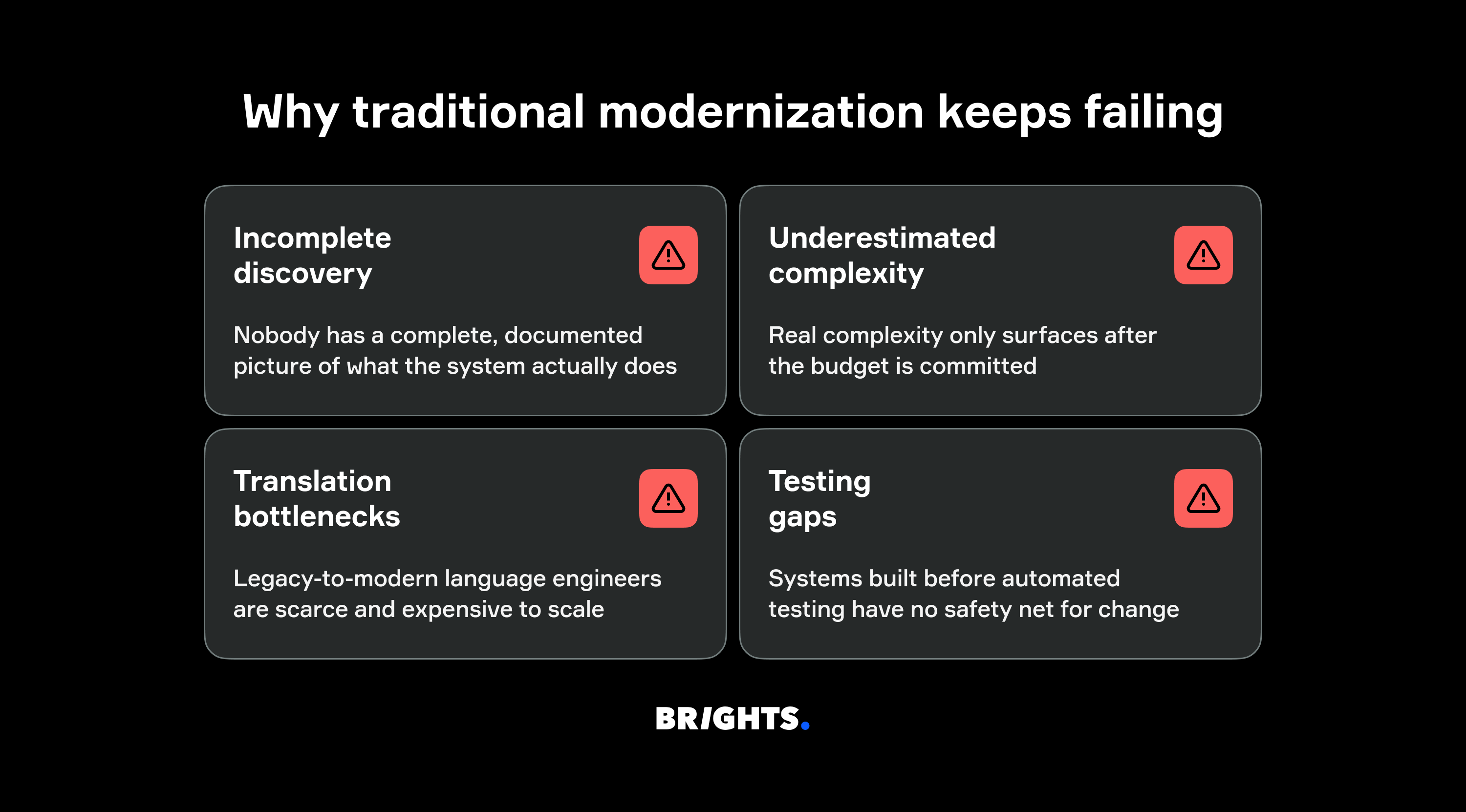
Traditional application modernization fails for four structural reasons. AI compresses or removes the labor cost behind each.
Incomplete discovery
Manual dependency mapping relies on documentation that is decades out of date and engineers who remember what they can. AI-powered code analysis parses entire codebases, traverses call graphs, and surfaces integrations that no documentation captures. This produces a prioritized register of which components carry the most downstream dependencies and which integrations exist nowhere except in runtime behavior.
Underestimated complexity
McKinsey research on large-scale IT projects found that cost overruns and blown timelines are the norm rather than the exception — and that 17% of large IT projects go badly enough to threaten the company's existence.
The problem is not poor estimates. It’ that complexity only becomes visible during the work. AI quantifies complexity at the component level before work begins, giving program governance something to act on before scope expands.
Translation bottlenecks
Engineers fluent in both legacy and modern stacks are scarce across every language pair — COBOL-to-Java, RPG-to-.NET, PL/SQL-to-modern frameworks. LLM-based translation produces a working first draft for review. According to McKinsey, AI-assisted modernization can accelerate timelines by 40–50% while reducing costs by more than 40%.
The critical qualifier is the first draft. Treating AI-generated output as final without a review step is the most common and expensive mistake in this space.
Testing gaps
Legacy systems predate automated testing. AI infers expected behavior from production logs, historical data, and static analysis, then generates test cases covering scenarios the system has handled for years without formal coverage. That test infrastructure, built during the assessment phase, carries over into every subsequent program phase.
The core applications of AI in modernization
AI applies non-uniformly across the modernization lifecycle. Its strongest value sits in four areas.
Intelligent code analysis and discovery
The output of an AI-powered discovery pass is a risk register rather than a diagram. It tells you which components have the most downstream dependencies, which carry the highest business logic density, which integrations are undocumented, and which parts of the codebase are candidates for early retirement. A program that treats this as a checkbox activity pays the price in Phase 2.
Automated code refactoring and translation
AI-generated translations are first drafts for review. The teams that treat them otherwise discover rounding errors in payment logic weeks after go-live. Every AI-generated translation should be reviewed by an engineer who understands the source system and validated with behavioral tests before it progresses.
Architecture design
This is where generative AI in application modernization delivers a specific advantage: LLM-based tools can analyze a large monolith, identify natural seams for decomposition, flag circular dependencies, and generate candidate service boundaries at a speed that manual architecture review cannot match.
The decision about which boundaries to enforce and how to sequence the work still requires experienced engineers — but that is not a limitation, it is the point.
Intelligent test generation
AI infers expected behavior from production logs, historical transactions, and static code analysis. The resulting test suites cover scenarios that that the legacy system has handled for years without a formal specification. For systems that predate test automation entirely, this is where the most asymmetric value sits.
AI-based modernization strategies: the 6Rs
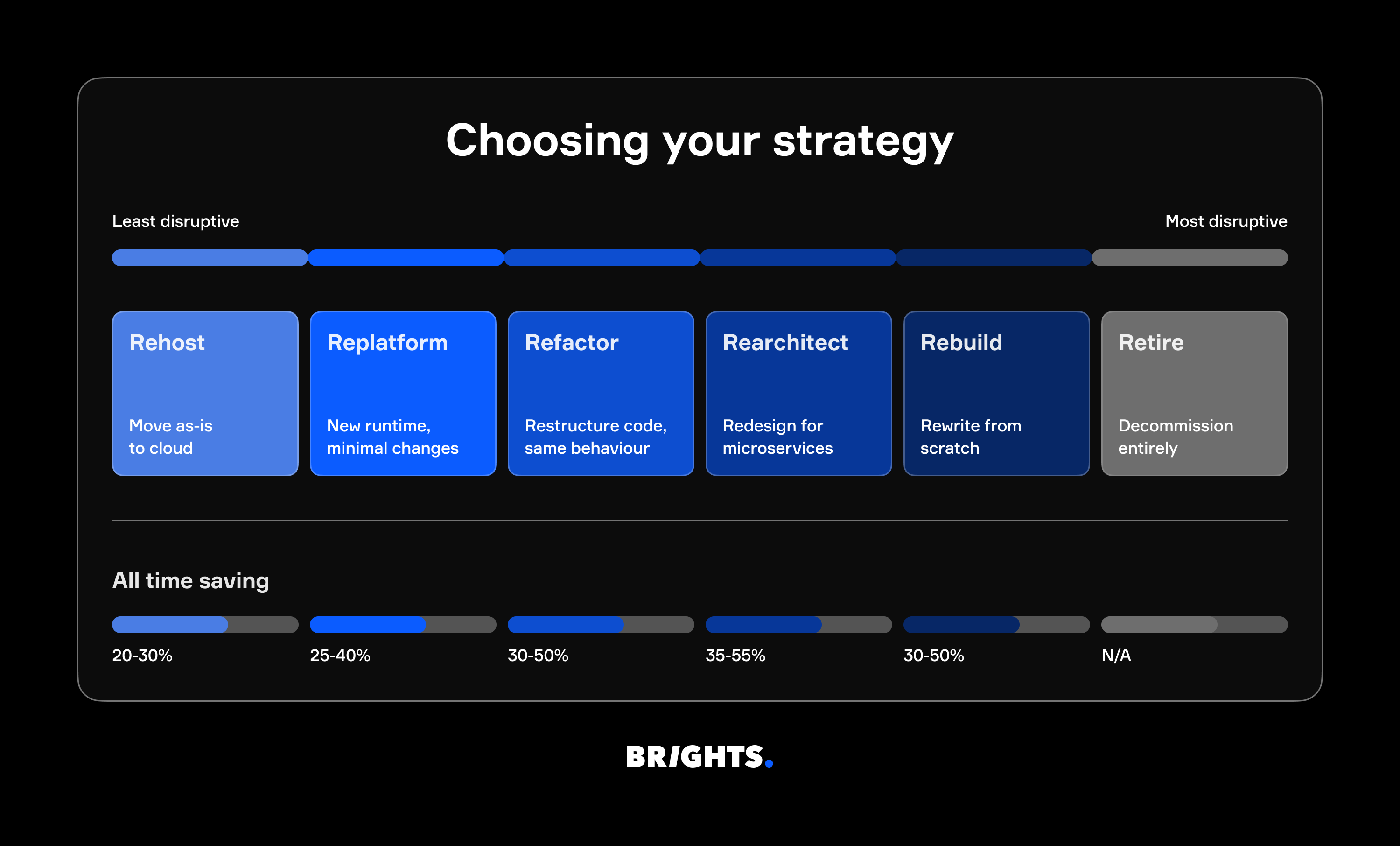
AI does not change the strategic options available in application modernization: rehost, replatform, refactor, rearchitect, rebuild, or retire. It changes which strategies are achievable within a given budget and timeline.
The strategic choice for each application depends on business value, technical debt density, and risk profile.
| Strategy | What it means | Where AI adds value | Typical AI time saving | Best fit |
|---|---|---|---|---|
| Rehost (lift-and-shift) | Move to cloud without code changes | Migration tooling, infrastructure config generation | 20–30% | Cloud-economics goal, code quality acceptable |
| Replatform | New runtime, minimal code changes | Dependency analysis, config translation | 25–40% | Solid business logic on an outdated runtime |
| Refactor | Restructure code, behavior unchanged | Code quality analysis, test generation | 30–50% | High business value, core logic is salvageable |
| Rearchitect | Redesign toward microservices or event-driven | Architecture analysis, service boundary detection, API generation | 35–55% | Monoliths with clear domains and scale requirements |
| Rebuild | Rewrite from scratch | Requirements extraction from legacy code, documentation generation | 30–50% | Codebase too degraded to refactor safely |
| Retire | Decommission | Usage analysis, data migration validation | n/a | Declining usage or functionality already replaced |
Most legacy estates contain applications that warrant different approaches. A blanket replatform or rebuild policy is the wrong default. The assessment phase exists to make the right call at the application level.
How to run AI-powered application modernization: 3 phases
"How to run AI-powered modernization: 3 phases" A horizontal timeline with three labeled phases, each containing 3–4 bullet outcomes and a timeframe label. Could include a "what AI is doing at this phase" callout beneath each stage to reinforce the throughline.
Large programs default to big-bang delivery: one budget, one scope, one go-live two years out. AI-driven modernization makes incremental delivery achievable by compressing discovery, translation, and validation. A structured program runs in three phases.
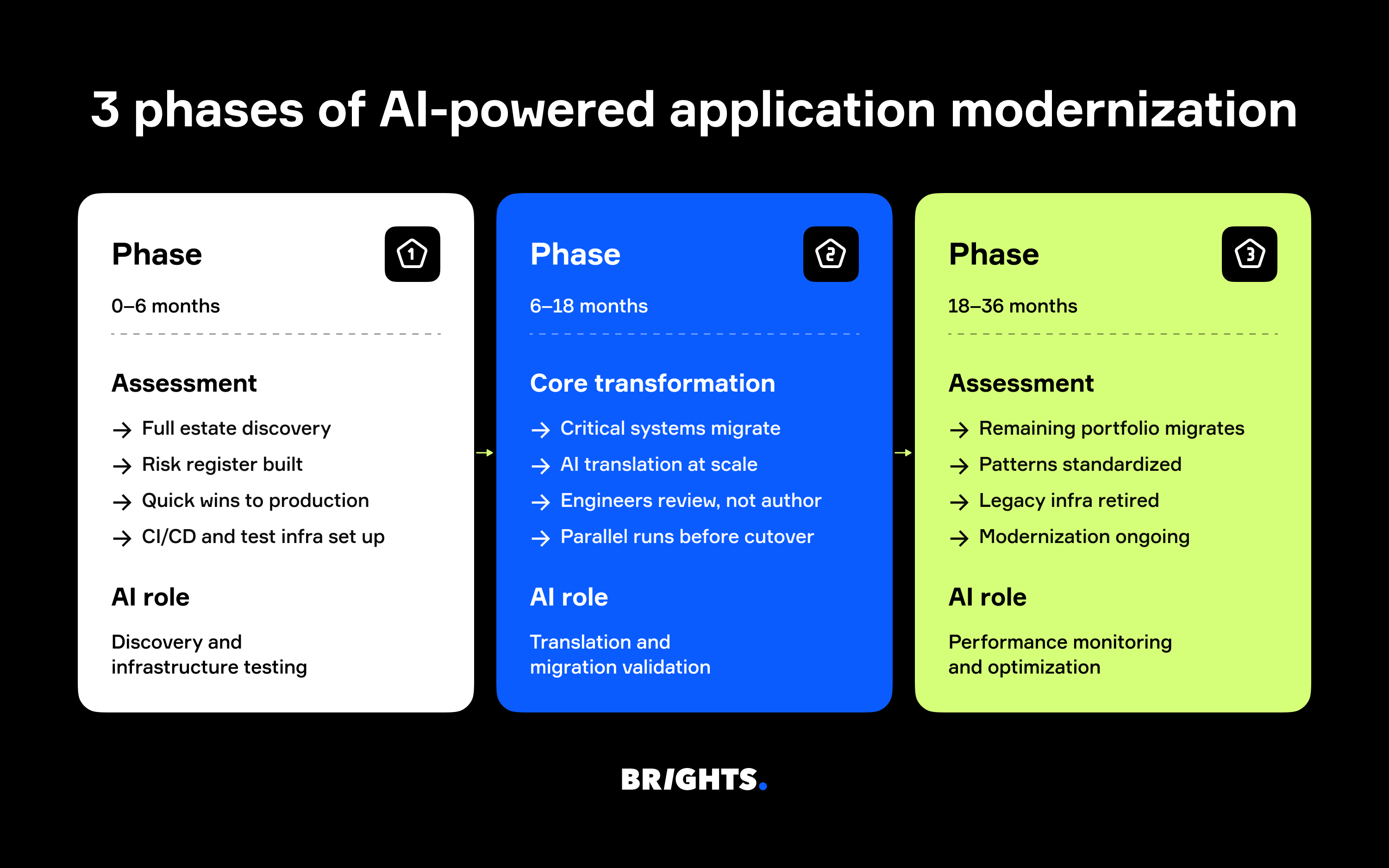
Phase 1: Assessment and quick wins (0–6 months)
AI-powered discovery runs against the full estate, producing a risk register across four dimensions: business value, technical debt density, integration complexity, and operational and compliance risk.
Quick-win applications are identified here: clear business value, low technical risk, straightforward scope. Getting these into production in Phase 1 proves the program delivers before the full budget is committed and stress-tests tooling and governance before they are applied to business-critical systems. The CI/CD pipelines and test infrastructure built here are program infrastructure, not Phase 1 deliverables.
Phase 2: Core system transformation (6–18 months)
Business-critical systems move in Phase 2. AI translation operates at scale, with engineers reviewing and validating rather than authoring from scratch. For high-criticality systems — core banking, order management, claims processing — parallel-run periods are non-negotiable. The governance call in Phase 2 is when to cut over. AI validation augments human sign-off; it does not replace it.
Phase 3: Optimization and standardization (18–36 months)
The remaining portfolio extends into Phase 3. Platforms and patterns from earlier phases are standardized across the estate. Legacy infrastructure that has been replaced is retired. AI monitoring shifts from migration validation to ongoing performance optimization. Teams that treat Phase 3 as the end find themselves back in the same position in five years.
Is your organization ready? A self-assessment
Score each dimension from 1 (not in place) to 5 (fully in place).
Legacy estate visibility. Do you have a current, accurate map of your application portfolio, including dependencies, integration points, and ownership? If that map lives primarily in the heads of senior engineers, score 2 or below.
Technical debt awareness. Is your technical debt quantified at the component level? Vague awareness that systems are old and fragile is a 1. A scored risk register per application is a 5.
Data readiness. Is your data documented, accessible, and clean enough to support migration and testing? If you have not audited schema evolution and legacy constraints, assume they exist.
Governance and compliance. Are legal and compliance teams involved before architecture work begins? If they arrive after the design is set, the program will be redesigned around their requirements anyway.
Organizational authority. Is there a named owner with budget authority and the mandate to enforce decisions? Programs without a named decision-maker stall on organizational problems, not technical ones.
| Total | Reading | Where to focus |
|---|---|---|
| 5–10 | Not yet ready | Run a full AI-powered portfolio assessment first |
| 11–16 | Partially ready | Address the lowest-scoring dimension; it becomes the bottleneck |
| 17–21 | Ready to start | Begin Phase 1 discovery; close gaps in parallel |
| 22–25 | Well positioned | Move directly into a structured program |
A self-score is a starting point. The gaps that derail programs are the ones overestimated in planning. An external assessment closes that gap before it becomes a Phase 2 problem.
Pros and cons of AI in legacy system modernization
Understanding the trade-offs of AI in application modernization directly determines whether a program captures the efficiency gains or regresses in production.
What AI does well
Discovery at scale. In large legacy estates, manual dependency mapping stretches over months: outdated documentation, undocumented integrations, institutional knowledge that lives only in people's heads. AI-powered tools produce the same map in days — and catch what manual review misses.
Translation economics. AI removes the specialist engineer scarcity constraint, making code translation at scale operationally feasible.
Test coverage generation. For systems that predate test automation, AI-generated suites provide regression baselines that would otherwise take years to build manually.
Incremental delivery. AI-assisted modernization can accelerate timelines by 40–50%, meaning programs can deliver production value within months rather than waiting years for a single go-live event.
Where AI in app modernization introduces risk
Subtle code errors that pass testing. AI-translated code can compile and pass initial tests while harboring logic errors that only surface under specific production conditions. Manageable only through disciplined human review.
Bounded discovery. AI code analysis is limited to what is in the codebase. Integrations that exist only in documentation, runtime configurations maintained outside version control, and informal data format dependencies will not appear in the AI-generated map.
Governance pressure. Faster development cycles create pressure to compress review gates. Programs that reduce governance to manage schedule pressure tend to find out why the gates existed in a production incident.
Data migration underestimation. Legacy data models contain decades of schema evolution and undocumented constraints. AI does not automatically surface these.
How to manage the risks
Over-reliance on AI-generated code. A payment processing team once once discovered a rounding error in financial calculations three weeks after go-live — present in the legacy system for years, never triggered until the modernized system ran at higher volume. A 30-minute review would have caught it. The rule is, every AI-generated translation should be reviewed by an engineer who understands the source system and validated with behavioral tests before progressing.
Incomplete dependency discovery. AI code analysis is bounded by what is in the codebase. Validate discovery outputs with engineers and operations staff who carry institutional knowledge — particularly around runtime configurations maintained outside version control and informal data dependencies between systems.
Governance that has not kept pace. Faster development creates pressure to compress review gates. The correct response is faster review processes, not fewer of them.
Data migration as an afterthought. Legacy data models carry decades of undocumented constraints that AI will not surface automatically. Data migration planning runs in parallel with application transformation from Phase 1. Starting it in Phase 2 means discovering those constraints under deadline pressure.
Compliance requirements in regulated industries. AI translation tools processing regulated data must meet the same standards as the production systems they work on — review logs may become compliance artifacts, and data residency requirements constrain which cloud regions data can move through. Account for this in the program architecture from Phase 1.
The organizations that get the most out of AI in app modernization are the ones that treat AI output as a first draft across every use case (discovery, translation, testing) and build review and validation into the program architecture from day one.
How to choose an AI-driven modernization partner
AI tooling transparency. Can the vendor name the tools they use for code analysis, translation, and test generation? Generic references to "AI-powered tooling" signal an immature methodology. Ask for the specific tools in use and the trade-offs of each. Vendors who can discuss trade-offs understand the tools; vendors who cannot are reselling a category.
Dual-language engineering depth. For COBOL-to-Java or COBOL-to-.NET work, how many engineers hold production-level fluency in both the source and target language? How is that capacity allocated across concurrent programs?
Parallel-run methodology. How does the vendor handle high-criticality systems during cutover? A vendor who cannot describe a specific parallel-run protocol for core banking or claims processing has not run one.
Governance integration. Where does legal and compliance enter the program — before architecture design or after? The answer tells you more about the vendor's delivery model than any case study.
Post-migration model. A vendor whose engagement ends at cutover leaves you managing a modernized estate with no retained knowledge of the transformation decisions made. Ask how the Phase 3 handoff is structured and what ongoing optimization support looks like.
Pro tip: Ask any modernization vendor for a failure case alongside the success stories. How they describe a program that went wrong tells you more about their engineering culture than their highlight reel.
Wrap-up
Legacy systems are still complex, business-critical, and tightly coupled. AI does not change that. What AI in application modernization does change is the discovery effort, the economics of translation, and the test coverage problem that has made large programs so expensive to justify.
The organizations that capture those gains without eroding engineering rigor arrive on the other side with genuinely better systems — faster, more maintainable, and actually suited to the workloads they carry, rather than merely relocated to a newer runtime.
Brights is a custom software development agency with modernization practices in financial services, retail, and manufacturing. Our programs combine LLM-based tooling with dual-language engineering depth to deliver incremental production value from Phase 1 rather than waiting for a single go-live event.
FAQ.
AI-driven application modernization delivers the most value on mainframe systems, large Java monoliths, legacy .NET applications, and Oracle-heavy platforms. The larger the codebase and the denser the integrations, the more AI compresses the cost of assessment and translation. Smaller, lower-complexity applications with clean codebases are often more efficiently handled with conventional refactoring, where the overhead of AI tooling setup outweighs the time savings.


