Key App Development Trends in 2026: What Actually Matters for Mobile and Web

The most important app development trends for 2026 are AI as a core foundation, on-device (edge) AI, cross-platform development as the standard, security and privacy built in from the start, and progressive web apps narrowing the gap between web and native experiences. Other trends like 5G, XR, voice, and low-code are important, but they follow from these main five. With the global mobile app market expected to reach about $378B in 2026 and $626B by 2030, understanding which of these trends actually shape the products people use is worth the effort.
Each year, there are new lists of 'must-have' technologies and popular trends. Most of these lists aren’t helpful for founders or CTOs because they catalog what's technically possible. Few help you decide where to head.
Here’s our take on the latest trends in mobile and web app development: what’s happening, why it matters, how it affects your plans, and how to choose which trends are worth investing in.
Key takeaways
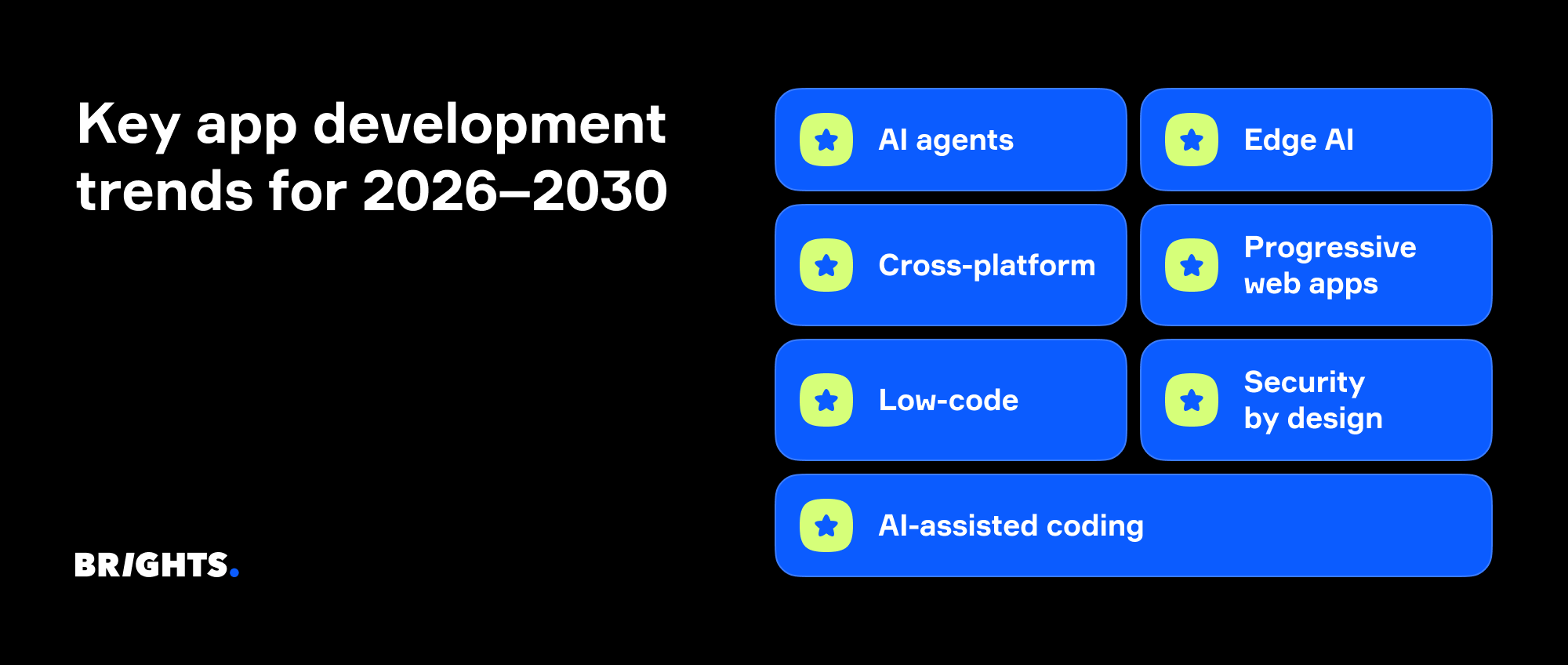
AI leads the app development trends of 2026 — 40% of enterprise apps will run task-specific agents by year-end, up from under 5% in 2025.
AI coding tools help less than advertised — 84% adoption, but 46% distrust, and only ~5.5% measured productivity gain. Review capacity is the bottleneck.
Cross-platform development is the default for building a mobile app on iOS and Android — 30–40% less engineering effort.
Progressive web apps win wherever the install step kills conversion: retail, finance, government.
Low-code and no-code app tools power 62% of new projects — right for internal tools, wrong for core product logic.
Security and accessibility are architecture, not launch-phase tasks.
Sequencing beats adoption — the future of app development belongs to teams that pick a few trends and pick them well.
The state of the app development industry in 2026
Before the trends, the numbers. Context matters because a trend inside a growing category behaves very differently from the same trend inside a shrinking one.
Market size and growth
The global mobile app market was valued at roughly $285.7B in 2023 and is projected to reach $626.39B by 2030, a compound annual growth rate of about 14.3% (Grand View Research).
The 2026 estimate sits near $378B.
Asia Pacific leads with about 33% of the market, followed by North America (30%) and Europe (27%).
The AI mobile apps segment grew 74% from 2024 to 2025, reaching $5.13B — the fastest-moving slice of the industry.
Generative AI apps alone pulled 1.7B downloads and $1.9B in revenue in the first half of 2025 (Sensor Tower) — a category that barely existed three years ago.
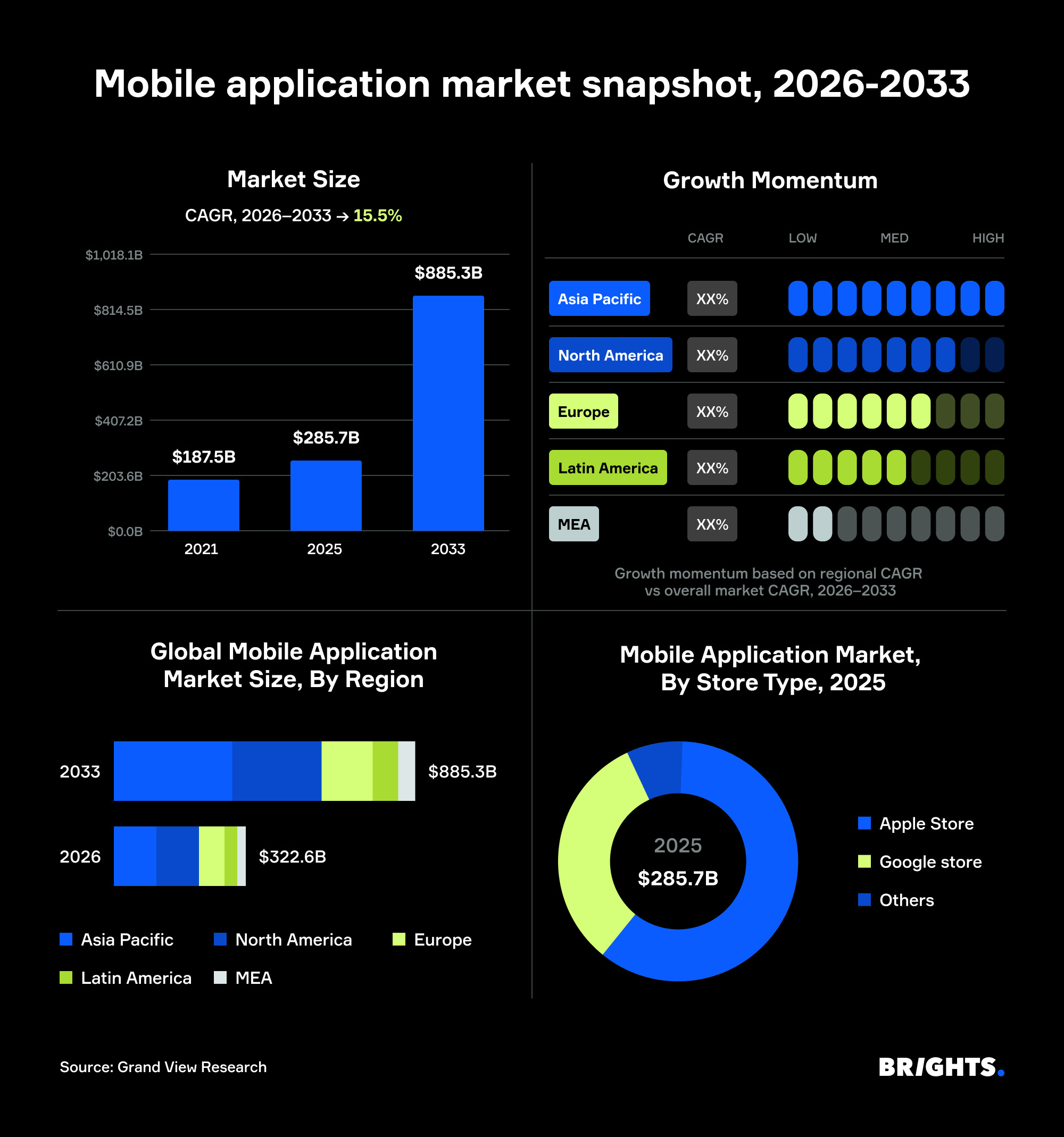
Source: Grand View Research
Key app categories in 2026
| Where the downloads are | Where the downloads are going | ||
|---|---|---|---|
| Category | Downloads (2025) | Category | Projections (2030) |
| Games | 21.17B | Utility & Productivit | 33.7B |
| Entertainment | 8.09B | Entertainment | 16.7B |
| Finance | 6B | Social Media | 12.1B |
That last table is the strategically interesting one. Games still dominate today according to Airship’s research, but utility and productivity are the genres projected to grow fastest — apps that save people time or replace a manual process. If you’re a SaaS company, a marketplace, a fintech agency, or an internal tools provider, that’s your category, and it’s expanding.
Spending
Consumer spending reached $41B in Q2 2025 alone, an 11.5% increase year over year. Per-device spend is projected to hit $99.88 in the US and $73.34 in Japan by 2030. Wellness apps are growing at a 14.9% CAGR through 2030.
Downloads are up, and so is spend per user.
Mobile app development trends
1. AI moved from feature to foundation
Two years ago, “AI-powered” was a differentiator you put on the landing page. In 2026, it’s closer to HTTPS: users don’t reward you for having it, they penalize you for not having it.
What’s actually changing inside apps:
Predictive personalization. Apps no longer wait for the user to tell them what they want. They model behavior and reorder the interface accordingly, content feeds, product recommendations, notification timing, even navigation order. Generic experiences now read as dated.
Task-specific AI agents. Agents perform multi-step work inside the product: reconciling an invoice, drafting a shipment plan, triaging a ticket queue. Gartner projects that 40% of enterprise applications will feature task-specific AI agents by the end of 2026, up from under 5% in 2025. That’s an eightfold jump in eighteen months, which tells you something about competitive pressure.
Generative AI as infrastructure. More than 80% of enterprises are expected to have deployed generative AI APIs or AI-enabled applications by the end of 2026. The build-vs-buy question has largely settled in favor of buy-the-model, build-the-workflow.
2. Edge AI: processing moves onto the device
Cloud-first inference is giving way to on-device processing, and there are three unglamorous reasons why: privacy, latency, and unit economics.
Running inference on the device means sensitive data, such as health metrics, financial records, camera input, or voice, never leaves the phone. That simplifies your compliance story enormously. It also removes the round trip, so interactions feel instant. And it removes a cloud cost you'd otherwise pay per request, for every user, forever. That's the cost problem that has quietly capped a lot of AI-heavy consumer apps just as they started to grow.
In practice, hybrid architecture works best. Run small, fast, and privacy-sensitive tasks on the device, while sending more complex processing to the cloud. Plan this division early in your architecture, since changing it later often means reworking your entire data setup.
3. Cross-platform development is now the default
For years, the honest advice was: build native for iOS and Android if you can afford it. That advice has narrowed considerably.
Today’s cross-platform tools offer performance close to native apps for most categories. The benefits are clear: one codebase, one team, one release cycle, and about 30–40% less engineering time to achieve the same features on both iOS and Android.
Note:
Go native when: you’re building something graphics-intensive, you’re deep in platform-specific hardware (advanced camera pipelines, ARKit/ARCore-heavy experiences, complex background processing), or milliseconds of frame time are your product.
Go cross-platform when: you’re building a business app, a marketplace, a fintech client, a booking product, an internal tool, or an MVP, which is most products.
A single codebase lets you release updates twice as fast. In a fast-moving market, being able to iterate quickly is often more valuable than squeezing out extra performance.
4. Security and privacy became a design constraint
Security has moved from “hardening sprint before launch” to a constraint that shapes architecture from the first diagram. The drivers are user expectation, regulatory pressure, and the plain fact that a breach in a mobile app is a company-level event.
What’s now table stakes:
Biometric authentication — Face ID, fingerprint, voice recognition. Users increasingly treat a password-only login as a red flag.
Data encryption at rest and in transit — non-negotiable for anything touching personal or payment data.
Multi-factor authentication and behavioral analytics — 2FA and OTP are standard in finance and banking apps, with behavioral fraud detection layered on top.
Data minimization — the cheapest way to protect data is not to collect it. Regulators, app stores, and users have all converged on this.
Finance, healthcare, and government carry the heaviest requirements, but the baseline has risen everywhere. This is why Brights holds ISO/IEC 27001:2022 certification for our software development activities.
5. 5G finally has applications worth the bandwidth
5G has been “coming” for so long that people stopped noticing it arrived. With coverage now broad enough to design for, it makes it practical for mobile devices: real-time interaction with genuinely low latency, streamed AR/VR experiences that don’t need to be downloaded, high-fidelity mobile gaming, and dense IoT connectivity.
We always advise clients to design apps that work well even when 5G isn’t available. Coverage is wide but not everywhere. If your app only performs well on 5G, it will struggle in places like basements, trains, or other areas with weaker signals.
6. AR, VR, and XR moved from demo to line item
Extended reality has quietly crossed from marketing experiment into measurable ROI in specific verticals:
Retail — virtual try-on and product visualization, which measurably reduces return rates and improves user experience.
Education — interactive learning and remote classrooms for subjects that benefit from spatial understanding.
Industrial training and maintenance — augmented instructions overlaid on equipment, simulation-based training.
These examples show that XR works best when it replaces costly alternatives, like product returns, training equipment, or travel.
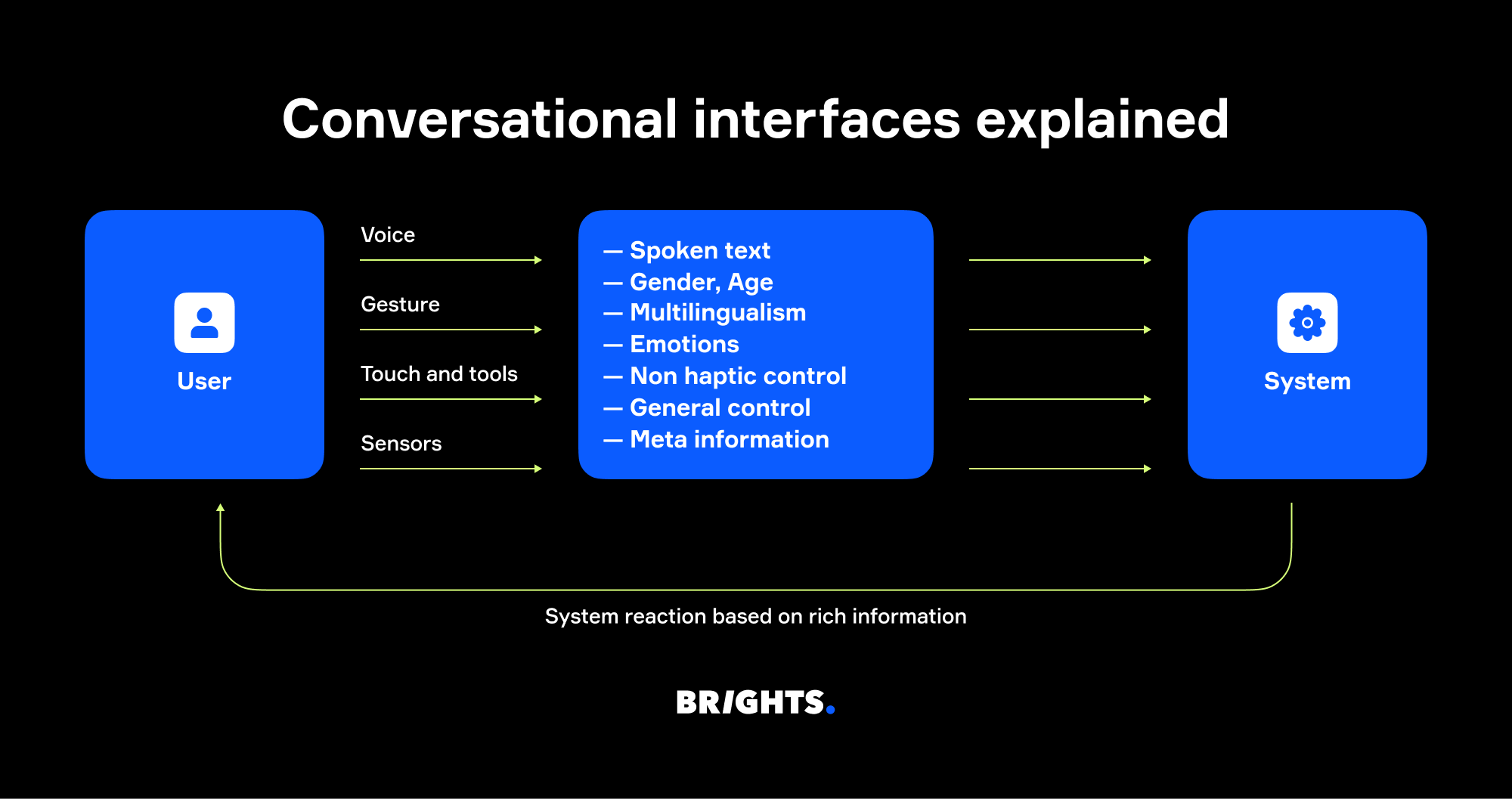
7. Voice-first and conversational interfaces grew up
Voice has moved past setting timer, largely because LLMs made conversational interfaces actually conversational. The relevant developments: voice commerce, touchless UI (an accessibility win, and a hygiene one in medical and food-service contexts), and voice control layered over IoT and smart home devices.
The practical framing: voice is now a legitimate secondary interface for most apps and a primary one for hands-busy, eyes-busy, and accessibility-first contexts.
Web app development trends
Mobile gets the headlines, but web development is where several of the most consequential shifts are happening and where the boundary between “website” and “app” has all but dissolved.
8. Progressive web apps close the gap
PWAs and instant apps deliver the strongest argument in web app development trends right now: an app-like experience with zero install friction. However, PWAs aren’t new web development technologies.
The benefits are concrete, especially in the near web development future. PWAs skip app store gatekeeping and the download step entirely. They also load faster, run from one codebase across platforms, and update instantly, no review cycle required. Adoption is strongest in retail, government, and finance, where the install step is the single biggest conversion killer.
Note:
When a PWA is the right call: transactional and content-heavy products, low-frequency use cases, emerging markets with storage-constrained devices, anything where “install our app” is the point at which users leave.
When it isn’t: deep hardware integration, heavy offline-first workloads, or when push notification behavior and store distribution are core to your business model.
9. AI-assisted development changed the development process itself
This is the mobile and web app development trend that gets discussed least in articles and matters most to your timeline and budget.
AI coding assistants are now standard equipment.
84% of developers are using or planning to use AI tools in their workflow, according to Stack Overflow’s 2025 Developer Survey. Near-universal adoption. Here’s the part almost nobody quotes: in the same survey, 46% of developers said they don’t fully trust the accuracy of AI-generated code.
Hold that number next to a second one. A Cornell University study measuring actual developer output found a 5.5% productivity gain from AI tooling, real, worth having, and roughly an order of magnitude below what the marketing implies.
These numbers tell the story: almost everyone uses AI tools, but trust is mixed, and the productivity boost is real but modest. This makes sense, AI speeds up repetitive tasks like boilerplate, test generation, and documentation. At Brights, we pair the speed of AI-accelerated development with senior expertise to deliver working software much faster.
10. Low-code and no-code: real, and frequently misapplied
Gartner projects that 75% of new application development will use low-code tools by 2026, up from 40% in 2021, and 87% of enterprise developers already use low-code platforms in some form. Measured adoption is tracking close behind the projection: low-code and no-code tools now power roughly 62% of new app projects.
All three figures are true for both mobile and website development trends, and all three are widely misread. “Uses low-code tools” is not the same as “was built entirely in a no-code app builder.” What’s actually happening is that professional teams are using low-code for the parts of the system where it’s genuinely faster — internal admin panels, back-office workflows, forms, dashboards, integration glue — while custom-coding the parts that constitute the product.
Note:
Where no-code genuinely wins: validating a concept before you commit budget, internal tools that cut manual steps out of operations, and letting non-technical teams manage workflows without a developer in the loop.
Where it reliably fails: complex business logic, custom UX at scale, data-heavy performance, integration depth, and anything you’ll need to migrate later. The classic failure mode is the “80% problem” — a no-code build reaches 80% of requirements in two weeks and never reaches 100%, and the eventual rewrite costs more than the custom build would have.
We recommend a practical approach: use no-code tools to prototype, build the final product with code, and rely on low-code for ongoing internal tools.
11. Accessibility became a legal requirement
The European Accessibility Act’s obligations came into force in June 2025, and comparable pressure exists in most major markets. Accessibility is now a compliance line item for a large share of EU consumer-facing digital products.
The upside is that accessible design is basically good design. Features like strong contrast, keyboard navigation, semantic markup, screen-reader support, and clear focus states help all users and boost SEO. The downside is that adding accessibility to an existing front end is costly, and the compliance deadline has already passed.
What do these trends mean for the industry
| Industry | Trends that matter most | Concrete use cases |
|---|---|---|
| Healthcare | AI, IoT, edge processing, security | Remote patient monitoring, secure health records, on-device analysis of sensitive data |
| Retail & e-commerce | AR/VR, PWAs, AI personalization | Virtual try-on, personalized recommendations, install-free storefronts |
| Finance & fintech | Security, biometrics, analytics, touchless UI | Biometric login, real-time fraud detection, behavioral risk scoring |
| Education | XR, cloud-native, AI tutoring | Interactive learning, adaptive assessment, remote classrooms |
| Government and insurance | PWAs, accessibility, security | Digital citizen portals, install-free mobile services |
| Manufacturing & logistics | IoT, 5G, AR maintenance | Real-time equipment tracking, augmented maintenance instructions |
| SaaS & B2B | AI agents, API-first, low-code internal tools | Workflow automation, embedded analytics, integration ecosystems |
The trend traps we see most often
Building the AI feature nobody asked for. Users want their problem solved. AI that surfaces inside an existing workflow outperforms AI that adds a new one.
Choosing a stack for the CV. The most exciting technology and the right technology overlap less often than engineers like to admit.
Treating security as a phase. It’s an architectural property. Bolted-on security is expensive security.
Skipping validation because building is cheap now. AI-accelerated development made building the wrong thing faster, while requiring more expertise. Discovery matters more than it used to.
Don’t overlook ongoing maintenance. Every trend comes with costs after launch. Plan for these expenses now, or you’ll end up paying more later.
What the future of app development looks like from here
Three shifts we expect to define the next 24 to 36 months, based on 15+ years of experience and 300+ projects shipped.
Apps become interfaces to agents
The unit of interaction moves from screen to intent. Users state outcomes; the app orchestrates the steps. This changes UX design more than it changes engineering; designing for delegation is a different craft than designing for direct manipulation.
The line between web and native keeps thinning
PWA capability, cross-platform maturity, and edge rendering are converging on a single answer to “build for web or mobile?”: build for both, from one system.
Distribution stops running exclusively through app stores
AI assistants, embedded experiences, and instant apps become meaningful discovery surfaces. Being findable and parseable by machines becomes as strategically important as ranking in the App Store was a decade ago.
Where to start in 2026
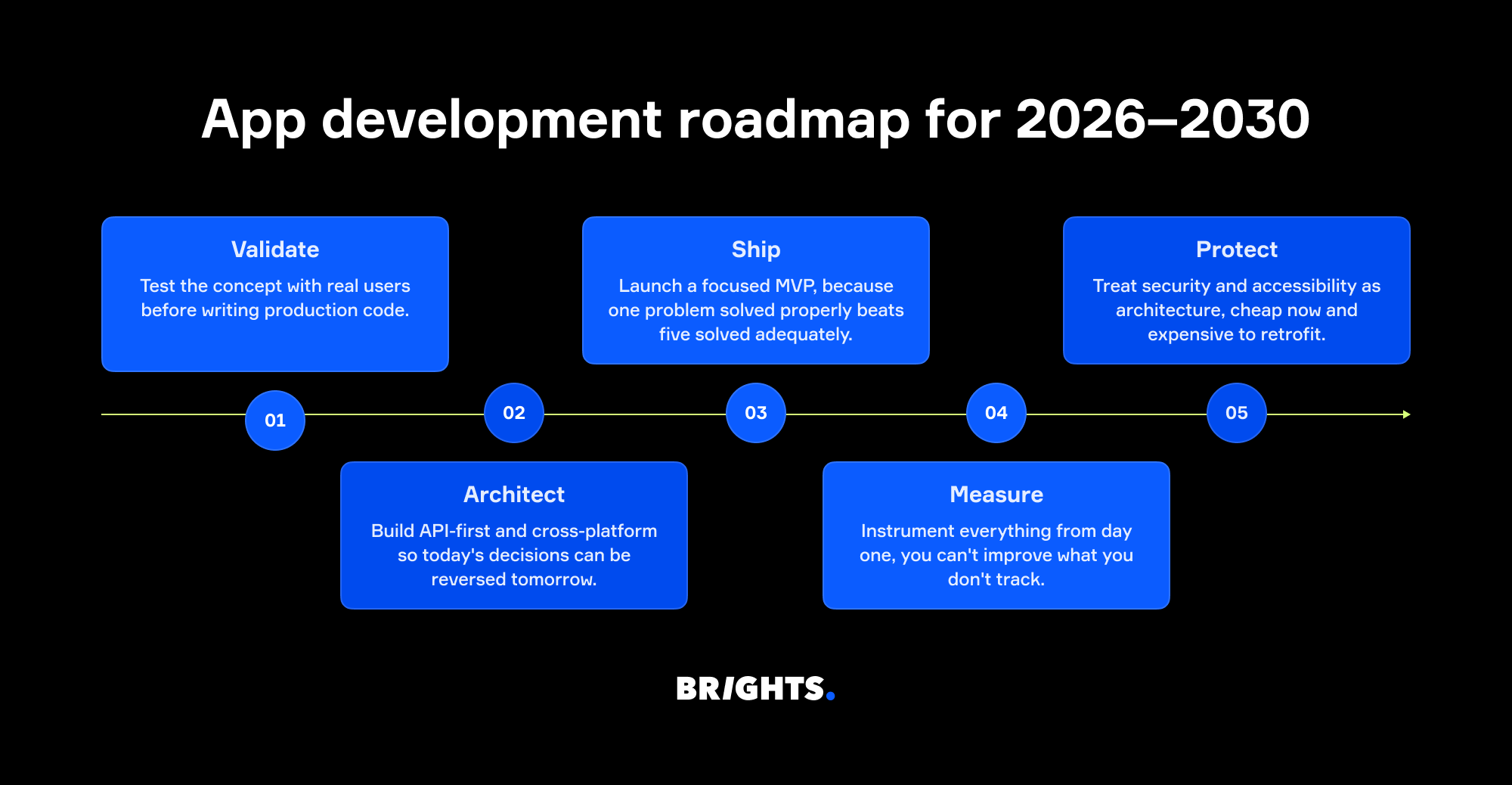
The apps that win in 2026 won't adopt every trend here. They'll evaluate which ones fit their product, and time the ones that do.
The pattern that consistently works for the teams we build with:
Validate before you build. Test the concept with real users. AI made building cheap; it didn’t make building the wrong thing valuable.
Choose an architecture that keeps options open. API-first, cross-platform, model-agnostic, edge-aware. Optionality is the asset in a fast-moving market.
Ship a focused MVP. One problem, solved properly, beats five solved adequately.
Track everything you build. You can’t improve what you don’t measure, and AI features especially need evaluation tools that many teams forget to include in their budget.
Treat security and accessibility as architecture. Both are cheap at design time and expensive at retrofit time.
At Brights, we’ve spent years building custom web platforms, native and cross-platform mobile apps, MVPs, and AI features for clients across fintech, healthcare, e-commerce, and B2B SaaS from discovery and UI/UX through cloud, DevOps, and post-release support.
If you’re unsure which trends to include in your roadmap and which to skip, book a free consultation. We’ll give you honest advice on what will work, what won’t, and why.
Sources:
Grand View Research (market sizing)
Gartner (enterprise AI and low-code projections)
FAQ.
AI integration (particularly task-specific agents), edge AI for on-device processing, cross-platform development, security and privacy by design, progressive web apps, AI-assisted development workflows, and API-first composable architecture are current trends in mobile app development.


