Neobank vs Challenger Bank vs Digital Bank: A License Guide for Fintech Founders

A banking product can be a neobank in its pitch deck and an e-money institution in the regulator’s register. The distinction isn't always obvious from the customer experience, especially when banking increasingly happens through an app.
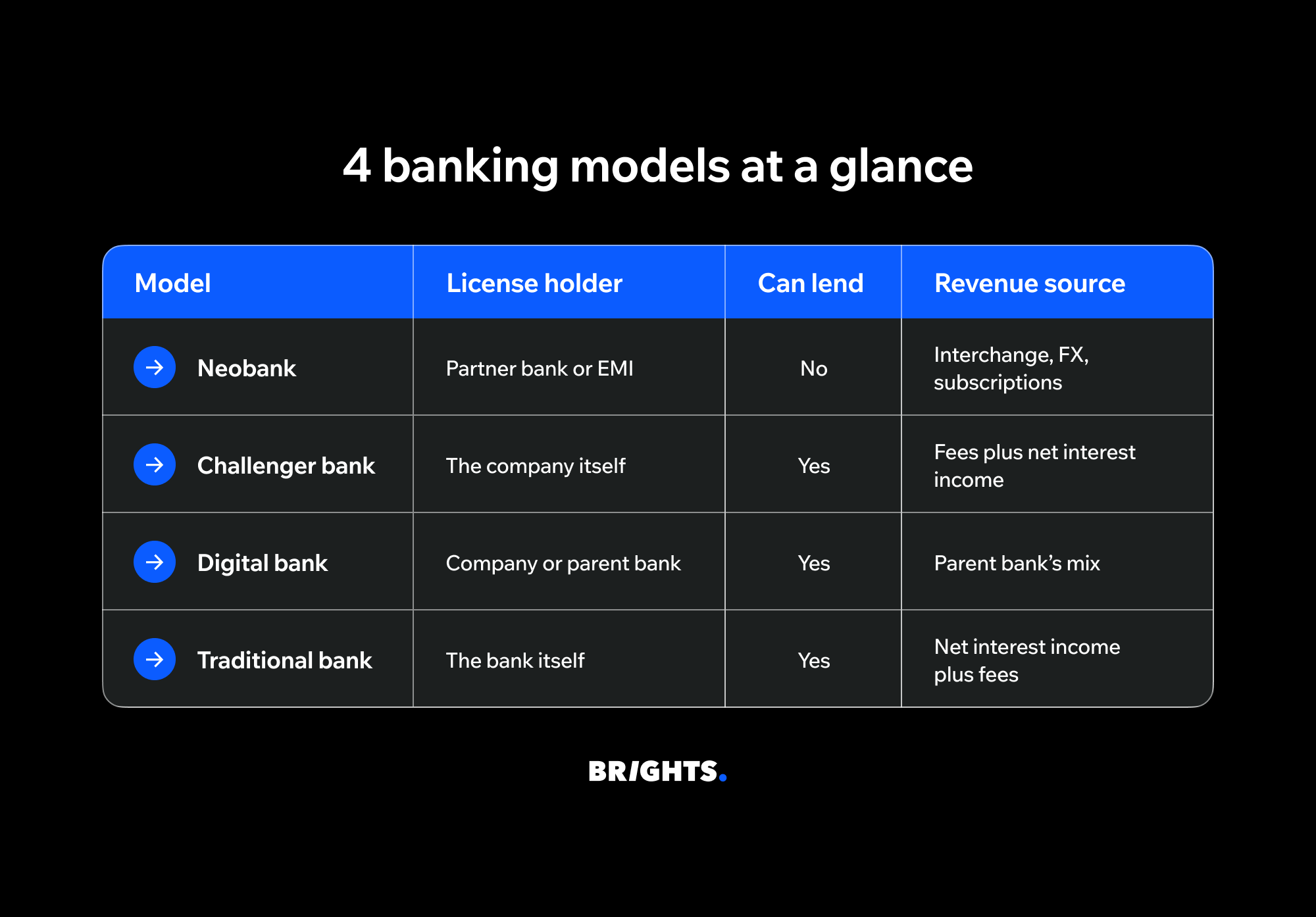
The labels shift by country, so the top results for “neobank vs challenger bank” can contradict each other. One question sorts all four models (neobank, challenger bank, digital bank, and traditional bank): who holds the banking license. It decides whether deposits are insured and whether the company can lend.
The definitions and a side-by-side table come first. Then come the questions a team building one has to answer early: who owns compliance day to day, whose ledger is the record of truth, what the product can offer, and how much a later move to a license of its own will cost.
Key takeaways
One question sorts the labels: who holds the banking license. Deposit protection, lending, revenue, and who the regulator calls when something breaks all follow from the answer.
A neobank usually has no banking license of its own. In the US, it runs on a partner bank. In the UK and EU, it typically holds an e-money license.
"Challenger bank" is a UK term for newer licensed banks. Most are app-only, but the term also covers branch-based Metro Bank.
A digital bank is a licensed bank that operates online. Often it is an incumbent's digital brand. In Singapore and Malaysia, it is a formal license type.
The labels describe a stage. Revolut, Varo, SoFi, Monzo, and Nubank all moved toward their own license. If that move is on your roadmap, design the stack for it from day one.
What is the difference between a neobank, a challenger bank, and a digital bank?
A neobank offers app-based banking services, either under its own license or through a partner bank or e-money license. A challenger bank is typically a newer, licensed bank competing with established players. A digital bank operates primarily online, independently or as part of an existing bank. A traditional bank is licensed and typically operates both branches and digital channels.
| Neobank | Challenger bank | Digital bank | Traditional bank | |
|---|---|---|---|---|
| Typical model | App-first financial services provider; may be licensed or partner with a bank | Newer bank competing with established players | Digital-only bank or banking brand | Established bank with physical and digital channels |
| Who holds the banking license | The provider itself, a partner bank, or no banking license if operating under an e-money or payment license | Typically the bank itself | The bank itself or the institution behind the brand | The bank itself |
| How customer money is protected | Depends on the model: deposit insurance through a licensed bank, or safeguarding for e-money | Deposit insurance, subject to local limits | Deposit insurance if funds are held as eligible bank deposits | Deposit insurance, subject to local limits |
| Can lend using customer deposits | Only if operating as a licensed bank; partner banks may lend | Generally yes, subject to banking regulations | Yes, if the underlying institution is a licensed bank | Generally yes, subject to banking regulations |
| Branches | Usually none | Usually none, but some operate branches | Typically none under the digital brand | Usually has a branch network |
| Main revenue sources | Interchange, payments, FX, subscriptions, and potentially lending income | Net interest income, payments, and fees | Interest income, payments, and fees; depends on the operating model | Net interest income, fees, and other financial services |
| Examples | Chime (US) | Monzo, Starling (UK) | Chase UK, GXS Bank (Singapore) | JPMorgan Chase, Barclays |
The features people usually compare, like app-only access and low fees, no longer separate anyone. In the American Bankers Association's 2025 survey, 54% of US bank customers named their bank's mobile app as the way they bank most often. A traditional bank with a good app looks a lot like a neobank from the customer's side of the screen. The difference sits underneath, in who holds the license.
Why the labels get mixed up
The labels get mixed up because none of them is a separate license category in the US, UK, or EU. Regulators license banks, e-money institutions, payment institutions, and, in the US, money transmitters. "Neobank," "challenger bank," and "digital bank" are market labels, and their meanings vary by country and context.
Open five tabs for these terms and you get five definitions. One says a challenger bank is licensed and a neobank is not. Another says a digital bank is the online arm of an existing bank. A third says challenger banks keep branches. Each is partly right, because each describes one market.
Here is where the terms come from:
"Challenger bank" became popular in the UK. It described newer banks competing with the Big Four (Barclays, HSBC, Lloyds, and NatWest) after the 2008 financial crisis. It covers app-only banks like Monzo and Starling, but also Metro Bank, which launched in 2010 with high-street branches.
"Neobank" is the more common term in the US, where most app-first account providers work through a partner bank instead of holding a charter of their own.
"Digital bank" is a real license in some markets. Singapore awarded its first digital banking licenses in December 2020, paving the way for GXS Bank, MariBank, ANEXT Bank, and Green Link Digital Bank. Malaysia announced five successful digital bank license applicants in April 2022. In 2024, Hong Kong announced that its "virtual banks" would be renamed "licensed digital banks."
Using the word "bank" without a license has consequences. In 2021, Chime agreed to stop calling itself a bank after California's Department of Financial Protection and Innovation objected. Today its site says Chime "is a financial technology company, not a bank," with banking services provided by The Bancorp Bank and Stride Bank.
One note on vocabulary: in the US, a banking license is called a charter. This article uses "license" throughout, and in the US sections the two words mean the same thing.
Neobank vs challenger bank
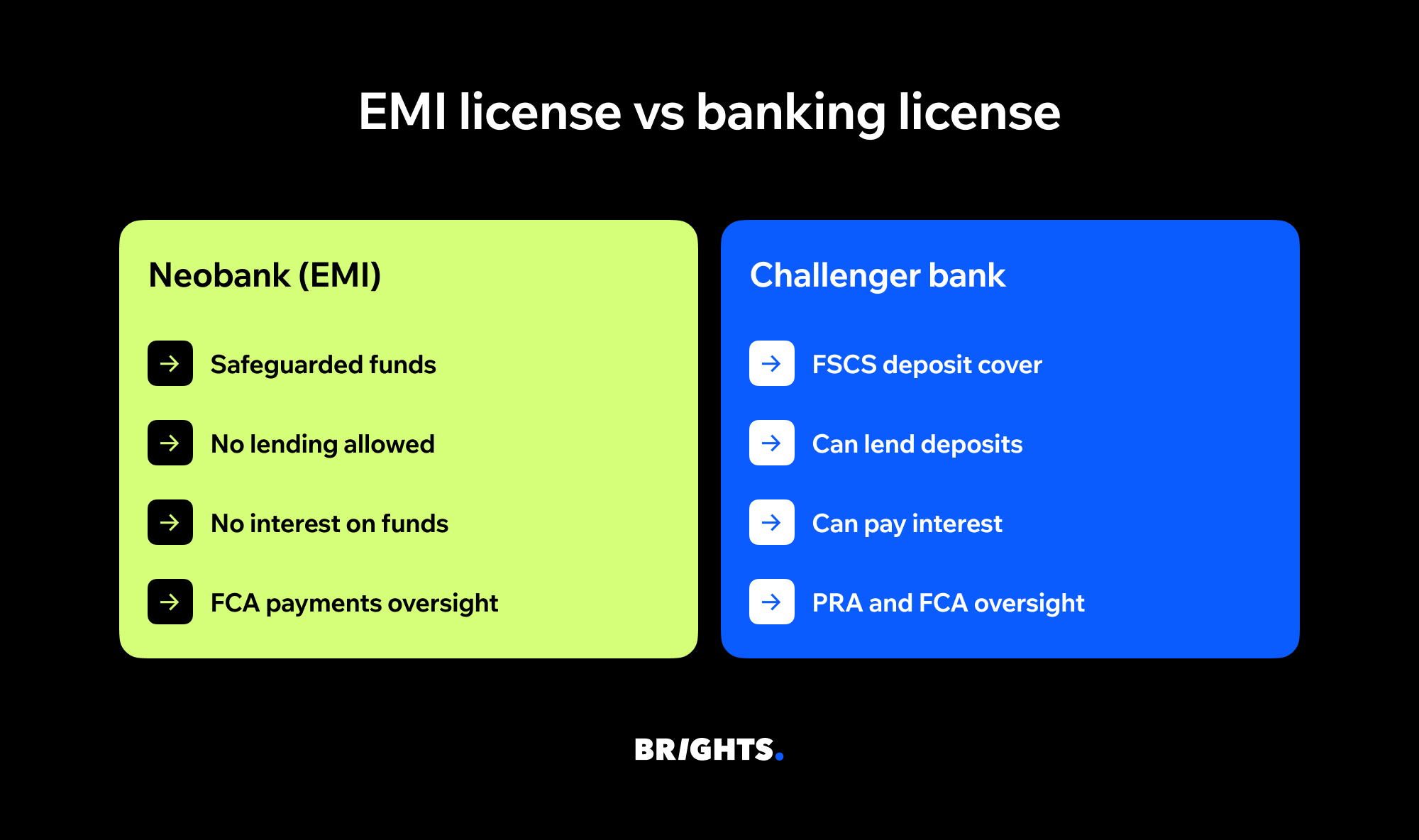
The difference between a neobank and a challenger bank is the license. A challenger bank typically holds its own banking license, so it can accept insured deposits and use them to fund lending. A neobank may operate under a partner bank's license or an e-money license, although some hold full banking licenses themselves. An e-money license allows a firm to hold and move customer funds, but not use those funds for lending or pay interest on e-money balances.
In the UK and EU, one useful comparison is between two licensing models: an electronic money institution (EMI) and a licensed bank. Here's what changes between them:
| Neobank with an EMI license | Challenger bank with a banking license | |
|---|---|---|
| Customer money protection | Funds are safeguarded, typically kept separate from the firm's own money. Not covered by deposit insurance | Eligible deposits covered by the FSCS up to £120,000 per person per authorized institution in the UK, or up to €100,000 under EU deposit guarantee schemes |
| Lending | Cannot use customers' e-money funds to finance lending | Can use deposits to fund lending |
| Interest | Cannot pay interest linked to holding e-money | Can pay interest on deposits |
| Supervision | Regulated as an e-money institution (in the UK, by the FCA) | Regulated as a bank, with capital and liquidity requirements (in the UK, by the PRA and FCA) |
Revolut shows both sides of the line.
In the EU, the Bank of Lithuania granted Revolut a specialized bank license in December 2018 and a full banking license in December 2021.
In the UK, Revolut operated as an EMI for years. It received a banking license with restrictions in July 2024 and entered mobilization, the phase in which a new bank builds out its operations under limits on deposits. It left mobilization with a full UK license on March 11, 2026, about 20 months later.
Same app, same brand, different category depending on the market and the year. A UK customer in 2023 was using an e-money account. A Lithuanian customer in 2022 was banking with a licensed bank. For both of them, the practical difference was the protection row in the table above.
So when someone on your board raises challenger bank vs neobank, the fastest honest answer is a question back: whose license?
Neobank vs digital bank
A digital bank is a licensed bank that serves customers primarily online, either as the digital brand of an existing bank or as a new digital-only institution. A neobank may operate through a partner bank, under an e-money license, or with its own banking license. In a neobank vs digital bank comparison, the key distinction is who holds the license and operates the banking infrastructure.
Two forms of digital bank show up most often:
An incumbent's digital brand. JPMorgan launched Chase UK in September 2021 as an app-only bank run by its UK banking entity. By the end of 2025, it had reached 2.8 million customers and over $35 billion in balances.
A new digital-only bank with a digital license. GXS Bank in Singapore operates under a digital full bank license from MAS. It has no branches and was built for mobile from the start.
For product teams, the difference is inheritance. An incumbent's digital bank inherits a core banking system, a compliance function, and a deposit base. It also inherits the constraints that come with them: release cycles tied to the core, approval chains built for a branch network, and a brand that has to stay consistent across dozens of products. A neobank starts with a clean stack and speed, and it rents the license.
We saw the incumbent side of this in the Digital PUMB redesign for FUIB, an established Ukrainian bank. The visible job was the business internet banking site, including an online account-opening flow for entrepreneurs. The harder problem was the design system behind it, which had to work for this product and carry over to FUIB's other services. It did: the new corporate style now runs across other FUIB products.
That is typical of digital banking work inside an incumbent. The new channel has to launch fast and still fit everything the bank already runs. For most founders, the digital bank vs neobank question only becomes real when a bank is the one building.
Neobank vs traditional bank
A traditional bank holds a banking license, runs branches, and earns most of its revenue from lending. A neobank usually holds no banking license, has no branches, and earns mainly from card interchange, foreign exchange, and subscription fees. Neobank customers report higher satisfaction, and traditional banks still earn most of the revenue.
| Neobank | Traditional bank | |
|---|---|---|
| License | Partner bank, e-money license, or own banking license | Its own |
| Branches | Typically none | Usually yes |
| Customer money protection | Depends on the license: deposit insurance for eligible bank deposits or safeguarding for e-money | Deposit insurance for eligible deposits |
| Lending | Through a partner bank or directly if licensed | Core business |
| Main revenue | Often interchange, FX, and subscription fees; licensed neobanks may also earn interest income | Net interest income plus fees |
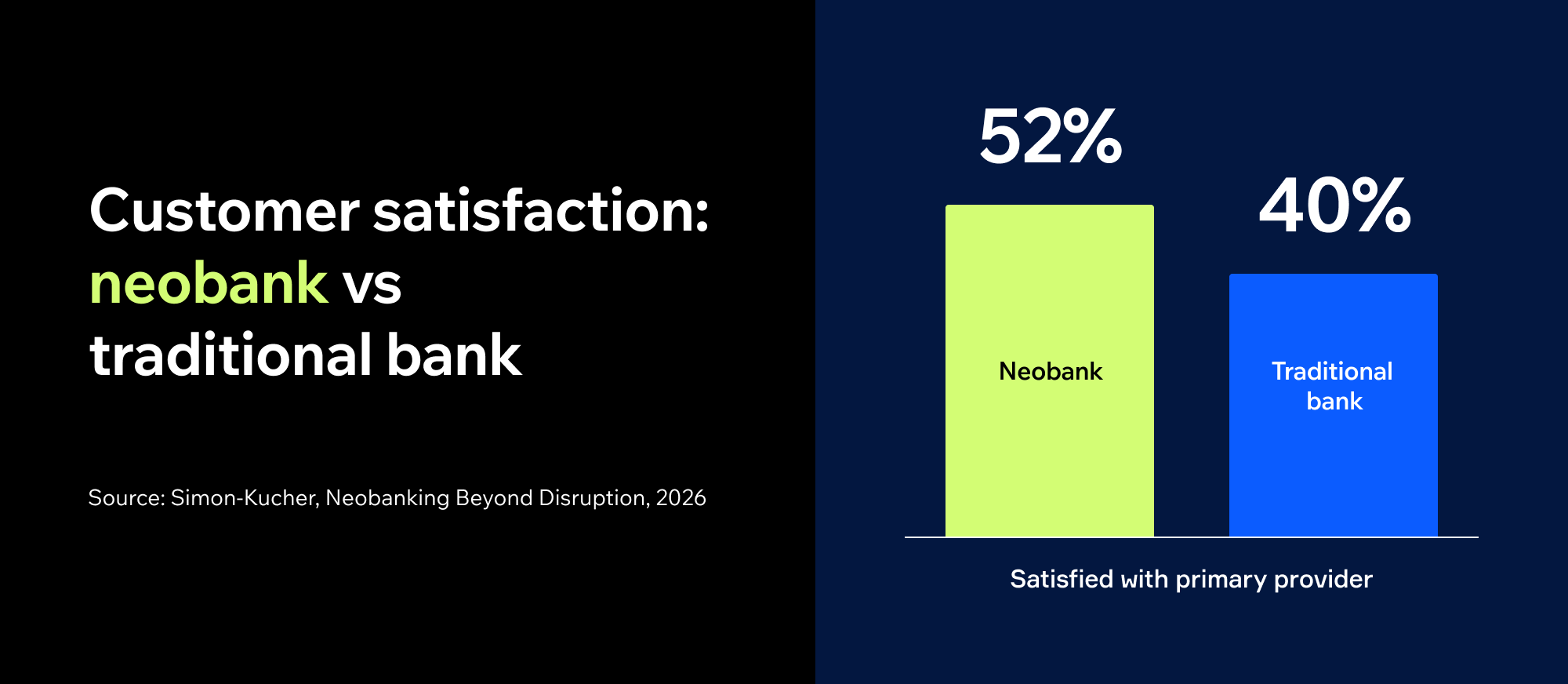
| Customers satisfied with their primary provider | 52% | 40% (large and national banks) |
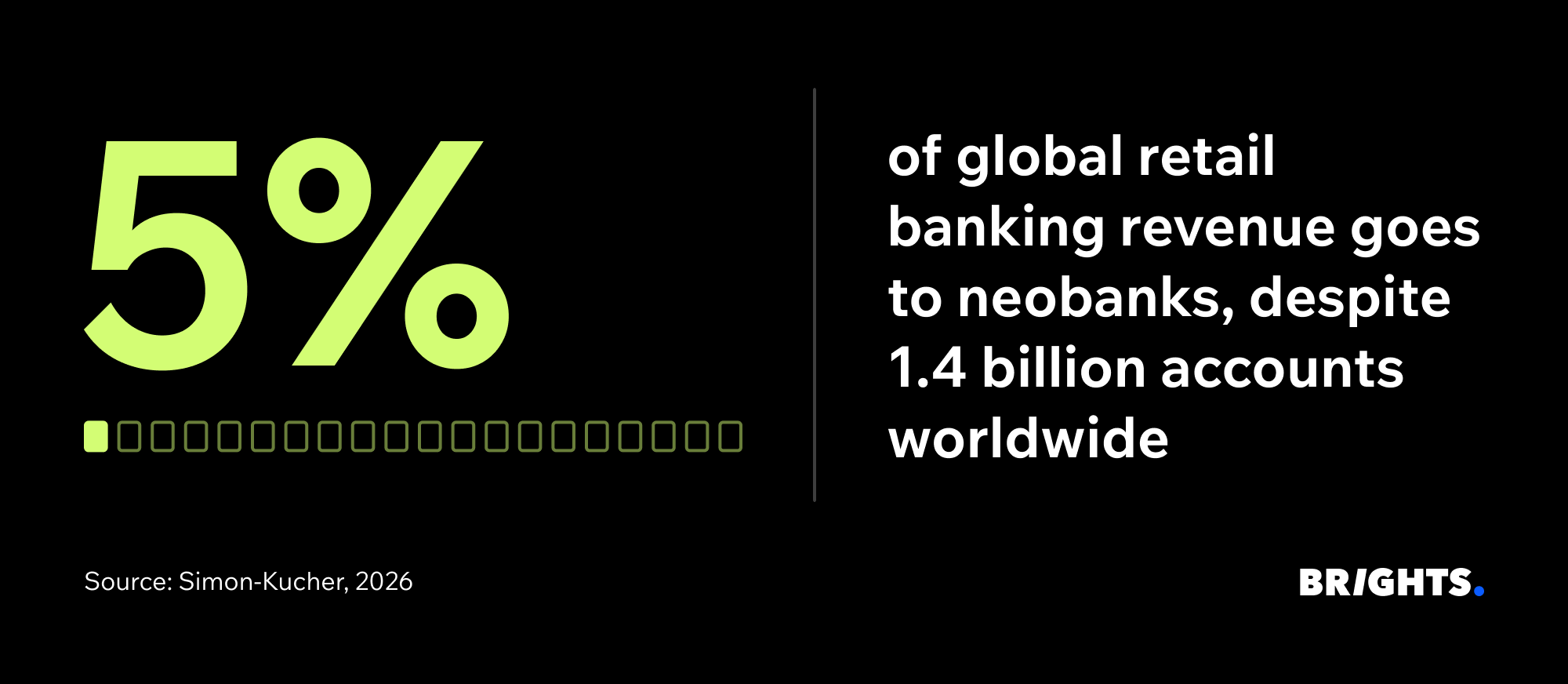
| Share of global retail banking revenue | About 5% | Most of the rest |
Source for the last two rows: Simon-Kucher, Neobanking Beyond Disruption, March 2026.
Simon-Kucher's 2026 study counts 1.4 billion neobank accounts worldwide. More customers are satisfied with their primary neobank (52%) than with their large or national bank (40%). Yet neobanks earn about 5% of global retail banking revenue, and in the US the average neobank customer brings in $70 to $80 a year.
Two findings explain the gap. First, 72% of consumers bank with two or more providers, so a neobank account is often one of several a customer keeps. Second, most banking revenue comes from lending, and lending from deposits needs a balance sheet and a license.
That second point helps explain why some neobanks eventually seek their own banking licenses.
Fintech vs neobank
Fintech is the broad category of companies that use technology to deliver financial services: payments, lending, investing, insurance, compliance, and banking infrastructure. A neobank is one type of fintech, offering app-first banking services directly to customers, typically including accounts and cards. Every neobank is a fintech; most fintechs are not neobanks.
| Fintech category | What it does | Example |
|---|---|---|
| Payments processing | Moves money between merchants, customers, and banks | Stripe |
| Buy now, pay later | Lets customers split purchases into installments | Klarna |
| Open banking data | Connects apps to customers' bank accounts with their permission | Plaid |
| Banking as a service (BaaS) | Provides banking infrastructure that lets other companies offer financial products | Solaris |
| Neobank | Offers app-first banking services, typically including accounts and cards | Chime |
The distinction has a practical side. A neobank is usually a customer of other fintechs. A typical US neobank stack combines a partner bank, a card processor, a KYC provider, and often a BaaS platform and an open banking connector. The neobank is the layer the customer sees.
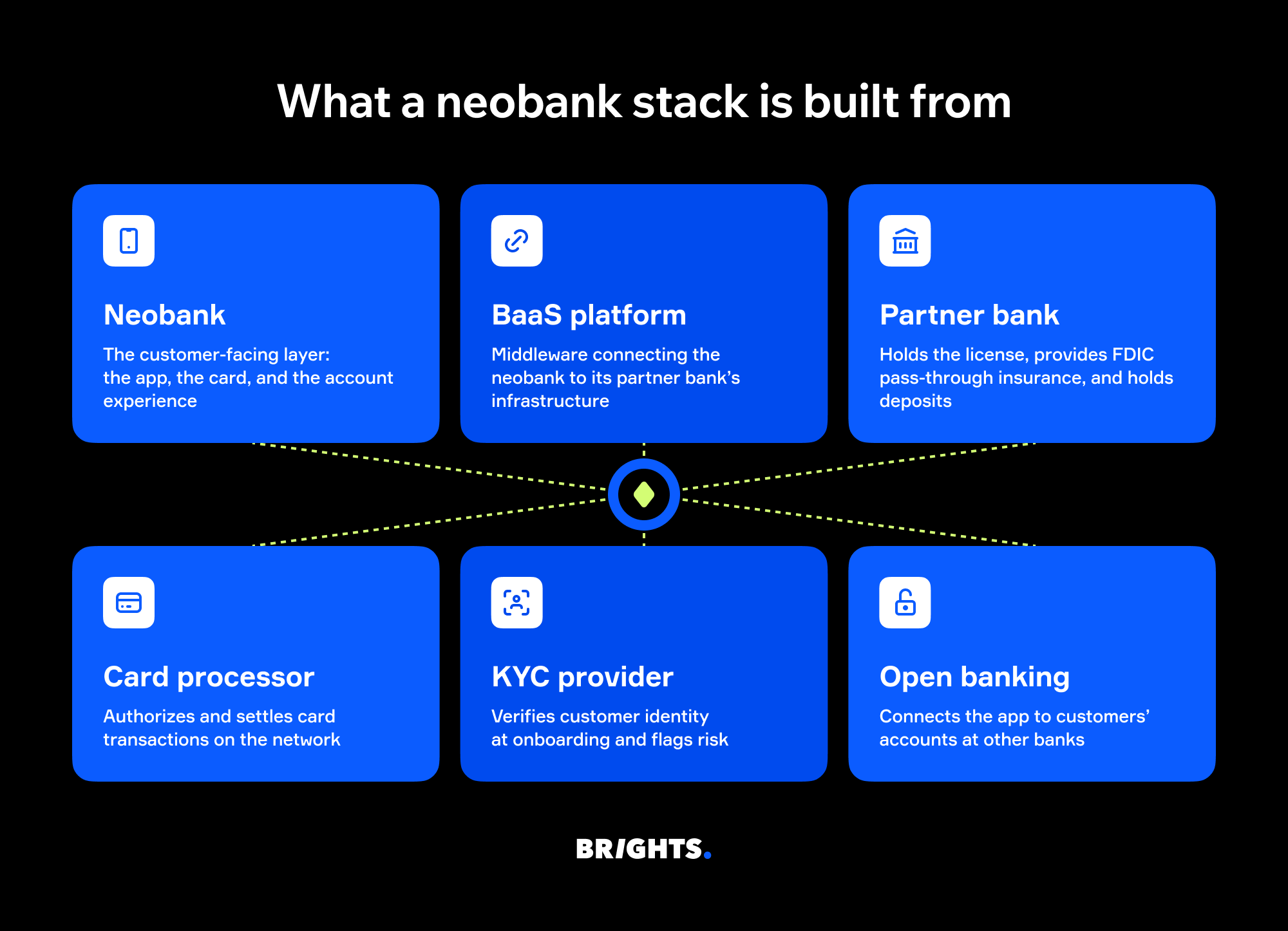
Every one of those layers is a place where something can break, which is what the next section is about.
What each model means if you are building one
Building a neobank on a partner bank, building under an e-money license, applying for your own banking license, and launching an incumbent's digital bank are four different projects. They differ in who holds the license, who owns KYC and AML compliance, whose ledger is the record of truth, what products you can offer, and how long it takes to launch.
| Neobank with a partner bank (BaaS) | Neobank with an e-money license (UK, EU) | Challenger bank (own license) | Digital bank of an incumbent | |
|---|---|---|---|---|
| License holder | Partner bank | Your company, as an EMI | Your bank | Parent or group banking entity |
| Time to launch | Often months | Several months to over a year, including authorization | Often years (Varo: about 3) | Depends on the parent's core system |
| Who owns KYC and AML | Responsibilities shared by agreement; bank retains regulatory accountability for its obligations | Your company | Your bank | Parent's compliance function |
| Ledger of record | Yours, and it must match the partner bank's records daily | Your records, reconciled with safeguarded funds | Your bank's ledger | Parent's or dedicated banking core |
| What you can offer | Products supported and approved by the partner bank | Payment accounts, cards, transfers; no lending from e-money funds or interest on e-money balances | Full banking services, including deposits and lending | Banking services permitted under the relevant license |
| Main risk | Partner dependency, recordkeeping failures, and changing terms | Safeguarding failures and product restrictions | Capital requirements, licensing costs, and delays | Integration complexity and existing governance processes |
This section is general information, not legal or financial advice.
Compliance: shared on paper, yours in practice
On a partner bank model, the bank holds the license and answers to regulators. In practice, a large share of the compliance work lands on you.
In 2024, US regulators issued enforcement orders against several banks involved in banking as a service, including Blue Ridge, Lineage, Sutton, Piermont, Mode Eleven, and Thread. The orders cited problems ranging from BSA/AML compliance to third-party oversight and risk management.
Expect a partner bank to push those requirements down to you by contract: KYC at onboarding, transaction monitoring, and audit trails a bank examiner can follow. In the business banking and payment platform for SMBs we built, identity verification runs through Persona, wired into onboarding so every account opens with a KYC record attached.
The ledger: the lesson from Synapse
Synapse was a middleware company connecting fintech apps to partner banks. It filed for bankruptcy in April 2024, leaving thousands of customers unable to access their money for weeks or months. The court-appointed trustee estimated a $65 million to $95 million shortfall between customer balances and funds held by partner banks. In November 2025, the CFPB allocated $46.2 million from its Civil Penalty Fund to affected customers, followed by another $9 million in May 2026.
The FDIC has been explicit about why pass-through insurance did not help: FDIC insurance "does not protect against the default, insolvency, or bankruptcy of any non-bank entity." In the Synapse case the partner banks stayed solvent and the middleware collapsed, so there was no bank failure for the insurance to respond to.
Regulators on both sides of the Atlantic responded:
FDIC (US). In 2024, the FDIC proposed requiring banks holding certain pooled custodial accounts for fintechs to maintain individual customer records and reconcile balances daily.
FCA (UK). New safeguarding rules came into force on May 7, 2026. Payment and e-money firms must reconcile customer funds daily, report monthly, and meet applicable annual safeguarding audit requirements. The reason: payment firms that failed between 2018 and 2023 left customers with average shortfalls of 65% of their funds.
What this means for your system: it has to show every customer's balance at any moment and reconcile it against the bank's records every day. If a partner fails, that ledger is what lets customers be made whole quickly.
Product scope and revenue
An e-money license caps the product. You cannot lend from customer funds, and you cannot pay interest on e-money balances. That pushes neobank revenue toward card interchange, FX margins, and subscription tiers. Lending income needs a banking license somewhere in the chain.
Two of our builds show what fits inside that cap:
The SMB banking and payment platform gives businesses unlimited virtual debit cards with per-card budgets, accounts payable automation, invoice recognition with Azure Form Recognizer, and QuickBooks sync. It runs on AWS and handles tens of thousands of transactions a month.
The NextWallet multicurrency payment system offers a card that holds 5 currencies, EUR and GBP accounts, transfers, and currency exchange, built to GDPR and PCI DSS requirements.
Every feature on both lists earns from payments, cards, or FX, which is the revenue a model without lending depends on.
Why neobanks become banks
Neobanks apply for banking licenses to gain more control over deposits, lending, and their products. Deposits can be a cheaper source of funding than borrowing, and lending is a major source of banking revenue. A license also reduces dependence on partner banks, though it brings additional capital and regulatory requirements.
| Company | Milestone | Date | What it took |
|---|---|---|---|
| Varo | First US consumer fintech to get a national bank charter | July 2020 | About 3 years and nearly $100 million |
| Revolut | Full EU banking license (Lithuania) | December 2021 | A specialized bank license first, in December 2018 |
| SoFi | Regulatory approval to operate a national bank through its Golden Pacific acquisition | January 2022 | At least $750 million in initial bank capital |
| Monzo | EU banking license from the Central Bank of Ireland | December 2025 | Already held a UK banking license |
| Nubank | Preliminary conditional OCC approval for a US national bank | January 2026 | Further regulatory approvals and pre-opening requirements |
| Revolut | Full UK banking license | March 2026 | About 20 months in mobilization |
SoFi's CEO, Anthony Noto, gave the reason plainly when the charter was approved: it lets SoFi "lend at even more competitive interest rates." Deposits can fund loans more cheaply than wholesale borrowing, improving lending margins. That helps explain the revenue gap in the Simon-Kucher numbers above.
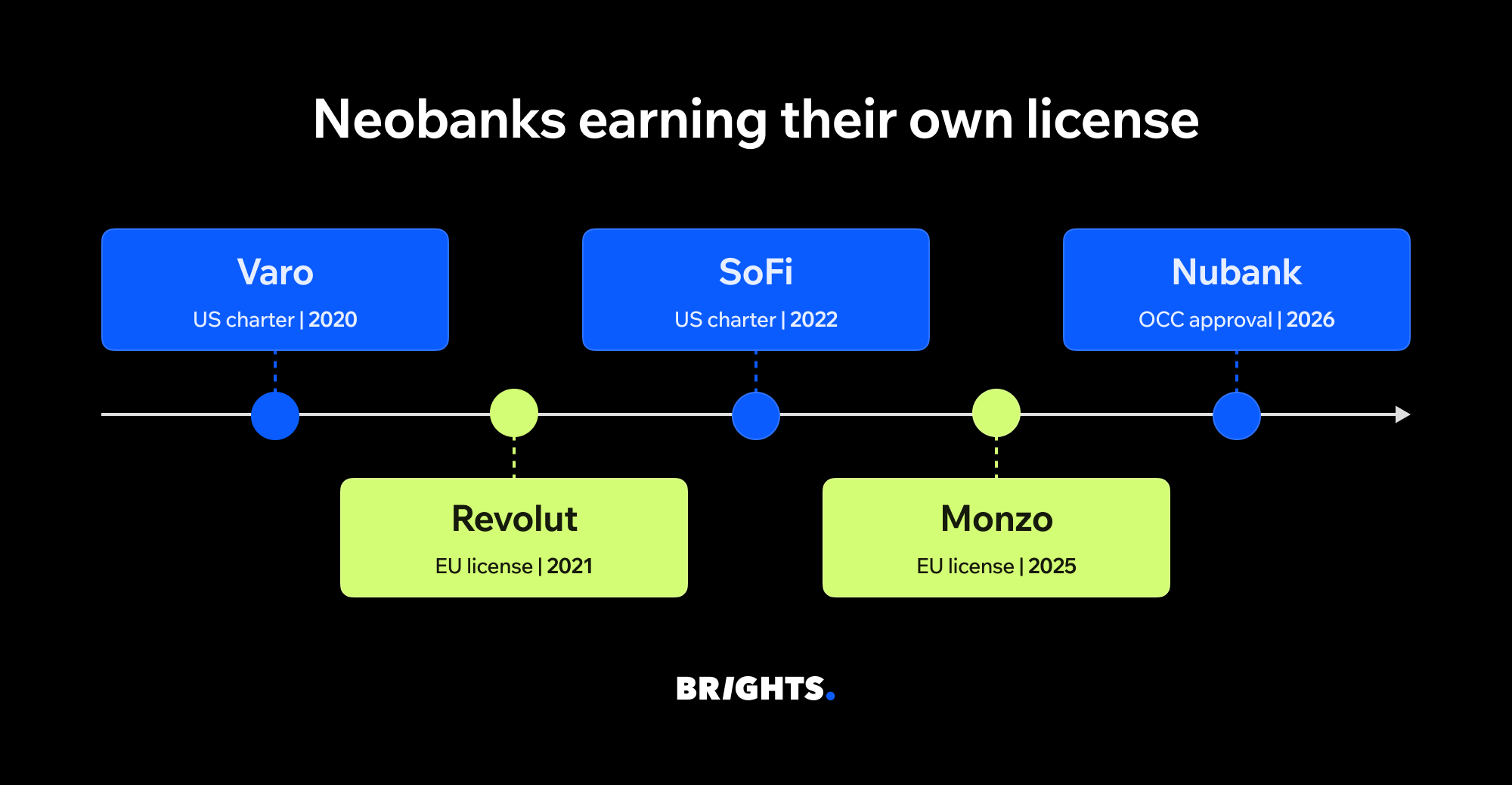
The path keeps moving. On September 26, 2026, Bloomberg and Sky News reported that Nubank was in early talks to acquire Monzo at a valuation of £8 billion to £10 billion. No deal had been announced in those reports. Whatever the outcome, the reported discussions illustrate the industry's consolidation potential: a Brazilian neobank pursuing a US banking charter looking at a UK bank that started as an app.
Our view: design for the possibility of changing banking partners from day one. If your roadmap includes a license, or even a second partner bank, a few decisions made at the start set the cost of that move:
Maintain reliable customer-level ledger records. Keep an accurate record of balances and transactions, reconciled against the bank's records. That gives you the data needed for a migration, though balances and accounts still need to be transferred through the appropriate banking processes.
Maintain access to customer data and KYC records. Store verification results in a form you can securely share with a new bank or regulator where permitted. A new partner may still require additional checks.
Put partners behind your own API layer. Your app talks to your services, and your services talk to the bank, card processor, and KYC vendor. That can limit the changes needed when switching providers, though integrations and compliance workflows may still need updating.
Retrofitting these after launch is close to a rebuild. It is the part of fintech software development where early architecture choices cost the most to reverse.
How to choose which model to build
The right model depends on five things: whether you need to lend or pay interest, how soon you need to launch, which markets you serve, who owns compliance day to day, and whether you are already a bank. Startups may begin with a partner bank or an e-money license and pursue their own banking license as their product and funding needs grow.
Do you need to lend from deposits or pay interest? If yes, you need a banking license in the chain, either yours or a partner bank's. An e-money license alone will not cover it.
How soon do you need to be live? Partner-bank models can launch in months, while e-money institution (EMI) authorization may take longer. Obtaining a banking license often takes years. If speed decides your next round, start with a partner, design for a possible switch, and scope the first release tightly with an MVP development approach.
Which markets will you serve? An EU e-money or banking license can support passporting across the European Economic Area, subject to the applicable rules. Since Brexit, a UK authorization no longer passports into the EU, which is why Monzo, already licensed in the UK, sought a separate banking license in Ireland.
Who owns compliance day to day, and do you have those people? On a partner-bank model, the bank answers to regulators for its obligations but may assign much of the operational KYC, monitoring, and audit work to you by contract. With your own license, you take on direct regulatory accountability, even if some tasks are outsourced.
Are you an existing bank? Then the choice is between a digital brand on your current license and a separate entity. The real constraint is usually your core system, and application modernization services often come before the new brand does.
Wrapping up
The labels get easier once you ask who holds the license. A neobank borrows one or works under an e-money license. A challenger bank holds its own. A digital bank is licensed and online, often as an incumbent's brand, and a traditional bank is licensed and branch-based. Whichever side of the neobank vs challenger bank line you launch on, build as if you will cross it later.
How Brights helps
Brights has built on three sides of this comparison: a business banking and payment platform for SMBs, the NextWallet multicurrency payment system, and the digital banking redesign for FUIB, an established Ukrainian bank.
We are ISO/IEC 27001 certified, we build to PCI DSS and GDPR requirements, and we have built KYC flows on providers such as Persona. Behind that are 15 years of delivery and a 5.0 rating on Clutch.
If you are deciding between a partner bank, an e-money license, or your own, our fintech software development and mobile banking app development teams can help you choose the model and build a stack that lets you change it later.
References
American Bankers Association. "ABA survey: Bank apps continue to be most popular option among customers." ABA Banking Journal, November 2025.
Bank Negara Malaysia. Announcement of five digital bank licenses, April 29, 2022.
Bank of Lithuania. "Banking licence granted to Revolut Bank UAB," December 2021.
Banking Dive. "A running list of BaaS banks hit with consent orders in 2024," 2024.
Banking Dive. "Varo becomes first challenger bank to get OCC charter," July 2020.
Banking Dive. "Nubank gets conditional OCC approval for charter," January 2026.
Chime. "Is Chime a bank?" April 2026.
CNBC. "Revolut acquires full UK banking license after years-long wait," March 11, 2026.
European Commission. E-Money Directive (2009/110/EC), frequently asked questions.
Financial Conduct Authority. "Changes to payment safeguarding rules," August 7, 2025.
Financial Services Compensation Scheme. Deposit limit change to £120,000, effective December 1, 2025.
Federal Deposit Insurance Corporation. "FDIC proposes deposit insurance recordkeeping rule for banks' third-party deposit relationships," 2024.
Monetary Authority of Singapore. Digital bank licence, 2020.
PYMNTS. "Synapse victims get $46 million repayment from CFPB," December 2025.
RTÉ. "Monzo gets full banking licence from Central Bank," December 17, 2025.
Simon-Kucher. "Neobanking Beyond Disruption," via Business Wire, March 25, 2026.
SoFi Technologies. "SoFi receives regulatory approval to become a national bank," January 18, 2022.
South China Morning Post. "Hong Kong's monetary authority to replace 'virtual bank' with 'licensed digital bank'," May 6, 2024.
TechCrunch. "Chime has agreed to stop using the word 'bank' after a California regulator pushed back," May 5, 2021.
Axios. "Nubank in talks to acquire British digital bank Monzo," September 28, 2026.
This article is general information, not legal or financial advice.
FAQ.
The license. A challenger bank holds its own banking license, so it takes insured deposits and can lend from them. A neobank usually runs on a partner bank's license or holds an e-money license, which does not allow lending from customer funds or paying interest. In any challenger bank vs neobank debate, "who holds the license?" settles it.

