How AI Helps Reduce Software Development Costs

Software development is one of the largest expenses on any technology budget, and for many business leaders, the return never feels proportional to the invoice. AI automation cost reduction in software development is often presented as the fix, but most of the ROI claims come from vendors, which makes them difficult to trust without context.
We've integrated AI tools into how we deliver software at Brights, so we see how they affect timelines, costs, and rework across projects. But for this article, we’ve looked into independent research (large-scale field experiments, enterprise studies, and industry reports) to answer a practical question:
Does AI reduce software development costs, or does it shift them somewhere else?
Key takeaways
Most software development budgets go toward testing, documentation, code review, and onboarding, not feature development.
Independent research shows AI tooling reduces time spent on these tasks by 26–80%, depending on the area.
The cost savings are real, but they require engineering discipline: teams that skip review gates and test coverage turn productivity gains into rework.
AI assistance has the strongest impact on junior developers and recent hires, which is where onboarding costs are highest.
Where development budgets actually go
It’s no surprise that software development costs are mostly labor costs. The question is how engineering time gets spent.
Writing new features takes less time than stakeholders expect. The Google Cloud DORA report shows that developers use AI mainly for writing tests, debugging, documenting, and refining code. These are the tasks eating up engineering hours without adding visible product value. Necessary, yes, but not the reason you hired a senior developer.
There’s also work that doesn't show up as its own line item:
Code review cycles that stretch across multiple sprints
Regression fixes left over from previous releases
Onboarding new engineers to existing systems
Keeping documentation accurate enough to be useful
DORA's research also found that rework rate — unplanned deployments to fix user-facing bugs — is one of the more reliable indicators of delivery stability, and a cost that compounds sprint over sprint.
What you end up with is a budget where a large share of engineering time goes into work that follows clear rules and repeats across cycles. It doesn't require senior-level decision-making, yet it takes up senior-level time.
What the research shows
The benefits of AI in software development are well-documented, but the more credible picture comes from studies that look at how work changes inside teams.
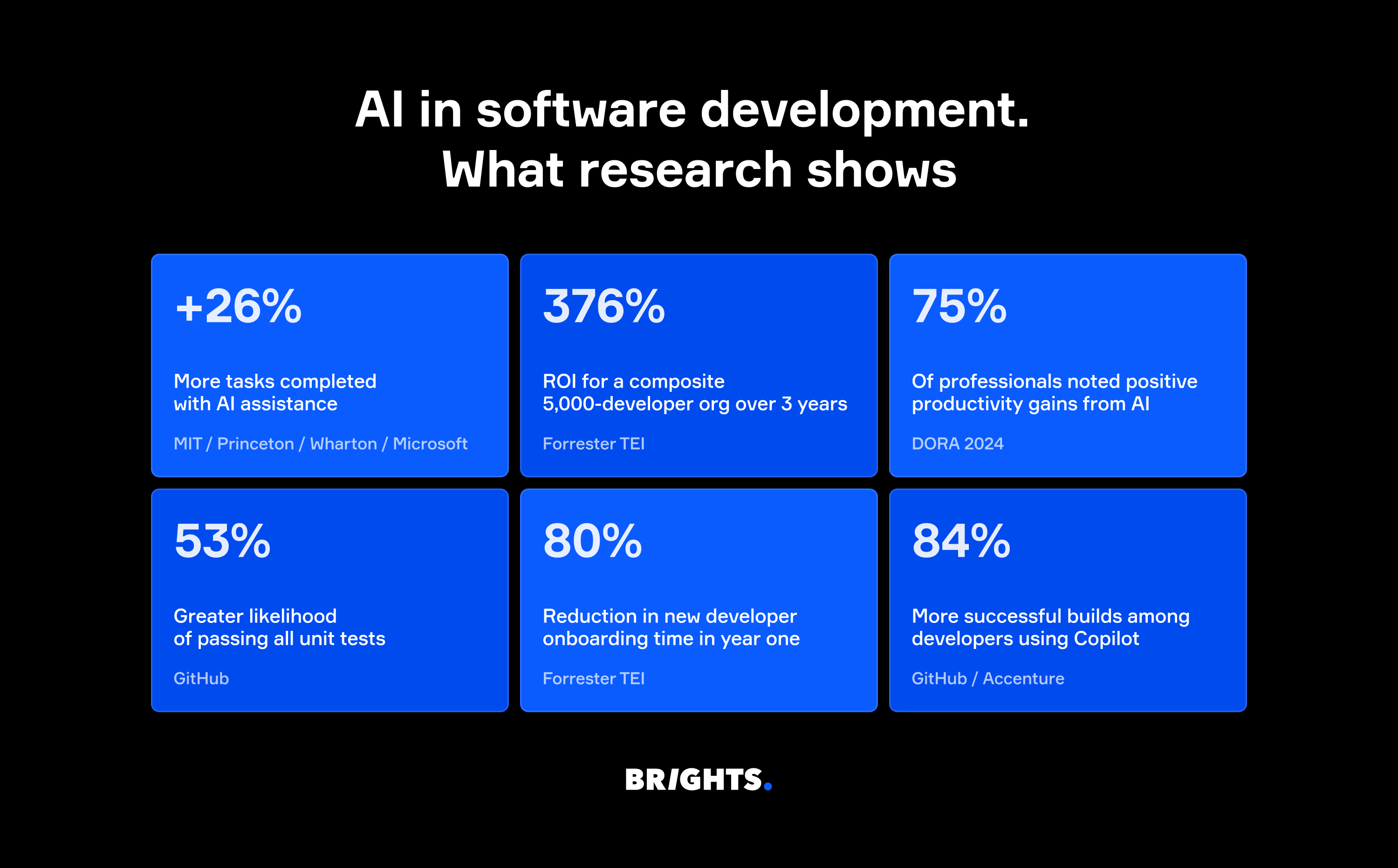
A joint study by researchers from MIT, Princeton, Wharton, and Microsoft ran randomized controlled trials across nearly 4,900 developers at Microsoft, Accenture, and a Fortune 100 manufacturer. They found a 26.08% increase in completed tasks among developers using an AI coding assistant. Interestingly, the gains were strongest for junior developers and recent hires — the groups that typically slow teams down during onboarding and ramp-up phases.
McKinsey's study with 40+ developers found that AI assistance cut documentation time roughly in half, reduced time spent on new code by nearly half, and trimmed code refactoring time by close to two-thirds.
Enterprise data shows a similar pattern. In a randomized controlled trial with Accenture developers, GitHub found an 8.69% increase in pull requests per developer and a 15% increase in the pull request merge rate. This means that more code was produced and more of it passed human review and test automation.
A separate GitHub study on code quality, involving developers with at least five years of experience, found that those using Copilot had a 53.2% greater likelihood of passing all unit tests, and their code was rated as more readable, reliable, maintainable, and concise.
At the business level, a Forrester TEI study based on interviews with four organizations found that a composite 5,000-developer organization realized $85.9 million in benefits over three years against $18.1 million in costs. That works out to an ROI of 376%, with payback in under six months. When you look at the impact of AI on software development costs in 2026, results like these are becoming more common.
Finally, the DORA report found that 75% of the 39,000+ professionals surveyed noted positive productivity gains from AI in the preceding three months, with more than a third describing those gains as moderate or extreme.
Where AI delivers the most cost savings
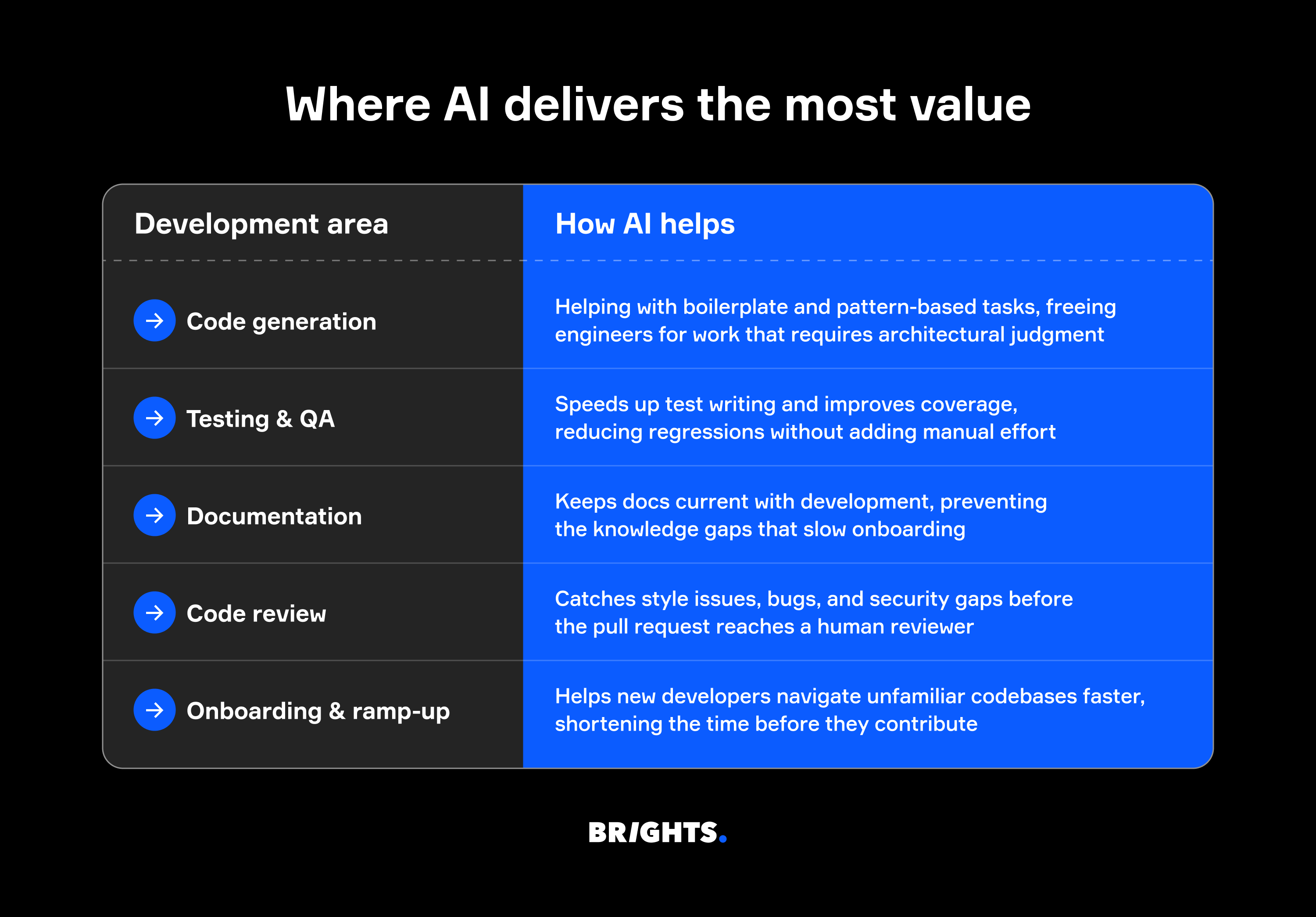
Using AI for software business operational efficiency works best when the focus is on the parts of development where engineers spend time on repetitive, predictable work instead of genuinely creative problem-solving.
Code generation and boilerplate
AI coding assistants speed up the parts of coding that don't require architectural judgment: filling in standard functions, completing statements, and setting up standard project structures. McKinsey's research found that developers using AI tools could write new code in nearly half the time compared to those without.
This productivity improvement comes with an important caveat: every line of AI-suggested code still goes through human review. The assistant speeds up output, but engineers are still responsible for what gets built. Treating code generation as something you can fully hand off to AI is how teams quietly rack up technical debt.
Testing and QA
Test writing is one of the most time-consuming parts of a sprint — and one of the clearest targets for AI assistance. The DORA report found that 59.6% of developers whose responsibilities include writing tests rely on AI for that task, at least in part.
The cost impact is direct: faster test creation shortens QA cycles, and better coverage reduces regressions in production. In the GitHub/Accenture study, successful builds increased by 84% among developers using Copilot, suggesting that AI-assisted development produces code that holds up under automated testing when paired with proper review practices.
Documentation
While obviously an important part of development, documentation is easy to deprioritize. But when it slips, onboarding slows, and institutional knowledge walks out with every departure. McKinsey claims that AI assistance cuts documentation time roughly in half. The DORA report found that a 25% increase in AI adoption correlated with a 7.5% improvement in documentation quality — the largest single workflow improvement measured in the study.
Code review
AI tools can flag style inconsistencies, potential bugs, and security issues before a pull request reaches a human reviewer. That shortens the cycle and raises the baseline quality of what reviewers see. GitHub's controlled study of 202 developers found that code written with Copilot was 5% more likely to be approved outright, and developers were writing 13.6% more lines of code per review error. At the same time, the DORA research claims that a 25% increase in AI adoption leads to a 3.1% improvement in code review speed and a 1.3% improvement in approval speed.
Onboarding and ramp-up
Getting a new developer productive takes time, regardless of their skill level: they need to understand the codebase, the conventions, and the reasoning behind past decisions.
The Forrester TEI study found that AI assistance reduced new developer onboarding time by 80% in the first year, reaching 90% by year three. The MIT/Princeton/Wharton/Microsoft field experiments confirmed the pattern: junior developers and recent hires saw the largest productivity gains from AI tools.
What reduces the gains — and how to avoid it
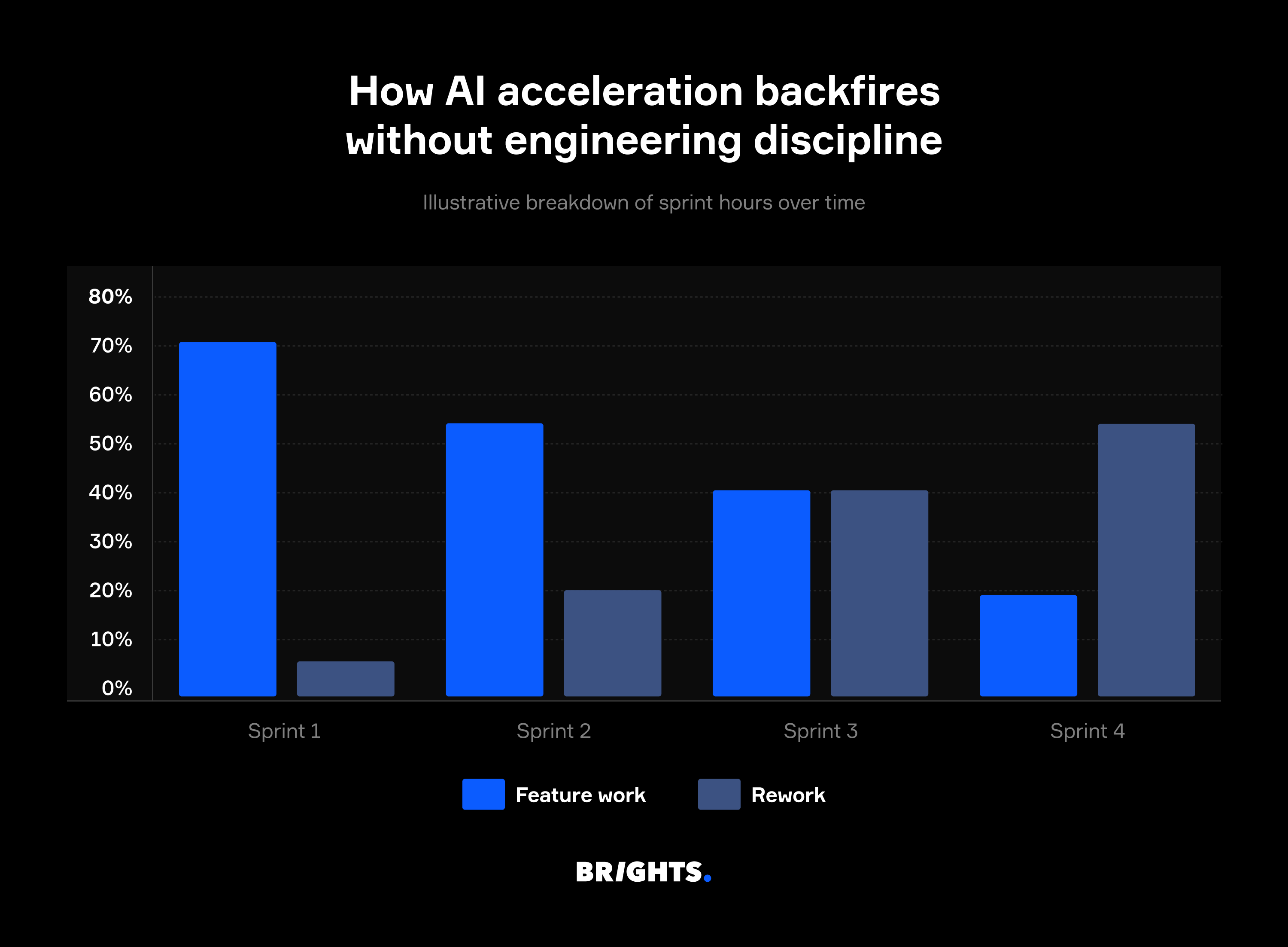
Research on AI in software development keeps pointing to the same pattern: AI amplifies what’s already there. If your engineering practices are solid, AI tools make them faster. If they're shaky, AI makes the problems harder to catch and more expensive to fix.
The DORA report found that AI adoption was associated with a 7.2% reduction in software delivery stability for every 25% increase in adoption. The researchers traced this back to teams skipping fundamentals: larger batch sizes, weaker test coverage, fewer review gates. The AI tools weren't the problem — the dropped practices were.
The most common failure pattern looks like this:
AI generates code faster than the team reviews it.
Review gates get relaxed to keep up.
Test coverage falls behind the pace of changes.
More issues pass through and return later as rework.
By the time the problem surfaces, it's already spread across several sprints of code that no one reviewed closely enough.
In other words, the cost risk comes from using AI output volume as a productivity metric without the engineering discipline to support it.
How Brights approaches AI-accelerated development
At Brights, we've integrated AI tools into the engineering process. Every line of AI-suggested code goes through the same review process as anything written by hand, because our goal is faster delivery of quality software, not just faster delivery.
A few practices that stay non-negotiable regardless of how the code was produced:
Every line of AI-suggested code goes through the same review process as anything written by a developer
Test coverage standards are maintained across the entire codebase. Documentation stays accurate and up to date throughout the project lifecycle
Security requirements are applied at the code level. All development work is carried out under ISO/IEC 27001:2013-certified processes, covering how code is reviewed, how data is handled, and how access is managed throughout the project
This approach keeps productivity gains from creating quality or security problems down the road.
Conclusion
Understanding how AI reduces software development costs starts with how engineering time is spent in the first place — testing, documentation, boilerplate, preparing code for review, and onboarding new developers. This is the work that takes up a large part of every sprint, and this is where AI changes the cost structure.
You can see the productivity gains across independent research, but they don’t happen automatically. Dev teams should maintain engineering discipline (review practices, test coverage, documentation standards), no matter how fast the code is coming out. When they don’t, the extra output returns as rework in the following sprints.
Brights applies AI in development in a way that keeps delivery predictable while reducing the amount of time spent on repetitive work.
FAQ.
The Forrester TEI study reports payback in under six months for a large organization. In practice, the timing depends on how quickly AI fits into existing workflows and how consistently teams keep review and testing practices in place


