How to Outsource Custom Software Development Services: A Step-by-Step Guide (2026)

You have decided that the software you need does not exist off the shelf, and building an in-house team to make it would take longer and cost more than the project can absorb. So you are going to outsource the build. The problem is that the decision to outsource is the easy part. What follows is a series of choices, about model, location, budget, vendor, and contract, and getting any one of them wrong is where most first-time outsourcing goes sideways.
This guide walks through the end-to-end process of outsourcing custom software development. It is written for the person who has to make the call and then defend it: a CTO, a VP of engineering, a founder, or a product lead, evaluating both whether to hire a vendor and which one to hire. By the end, you should be able to pick an engagement model, estimate a budget, shortlist and vet partners, structure the contract and IP terms, and run the engagement without getting burned.
Key takeaways
Outsourcing custom software works best when the model fits the project. Scope clarity, timeline, and the level of control you need should determine whether you use staff augmentation, a dedicated team, a managed team, or a fixed-scope contract.
Location is the biggest cost lever. Rates in Central and Eastern Europe (CEE) and Latin America commonly run 40 to 60% below comparable North American in-house costs, while offshore Asian hubs can be lower still.
Budgets span a wide range. A simple custom application often starts around $20,000, and enterprise-grade systems run $250,000 and up. The average custom project sits at $132,000 across the market.
Due diligence is where trust is won or lost. Reference checks, code-ownership verification, and security certifications such as SOC 2 and ISO/IEC 27001 separate a stable partner from a risky one.
A documented discovery phase de-risks custom work. For a custom build, the requirements you elicit up front prevent most of the cost and quality problems that show up later.
What does custom software development outsourcing mean?
Custom software development outsourcing is the practice of hiring an external technology partner to design, build, test, and maintain purpose-built software, while the client retains ownership of the product vision, priorities, and intellectual property. It gives companies access to skilled engineering talent, faster delivery, and lower overhead than building and retaining an equivalent in-house team.
The word that holds the burden here is custom. Outsourcing a custom build means hiring a partner to create software that does not yet exist, built to your workflows, data model, and compliance constraints. That is a different activity from buying a SaaS subscription, and it runs differently on the ground.
That distinction changes how the engagement runs. Off-the-shelf software ships with its own roadmap. A custom build has no roadmap until you and your partner write one, which is why the early scoping work (often called the discovery phase) matters more for custom projects than for any other kind of software spend.
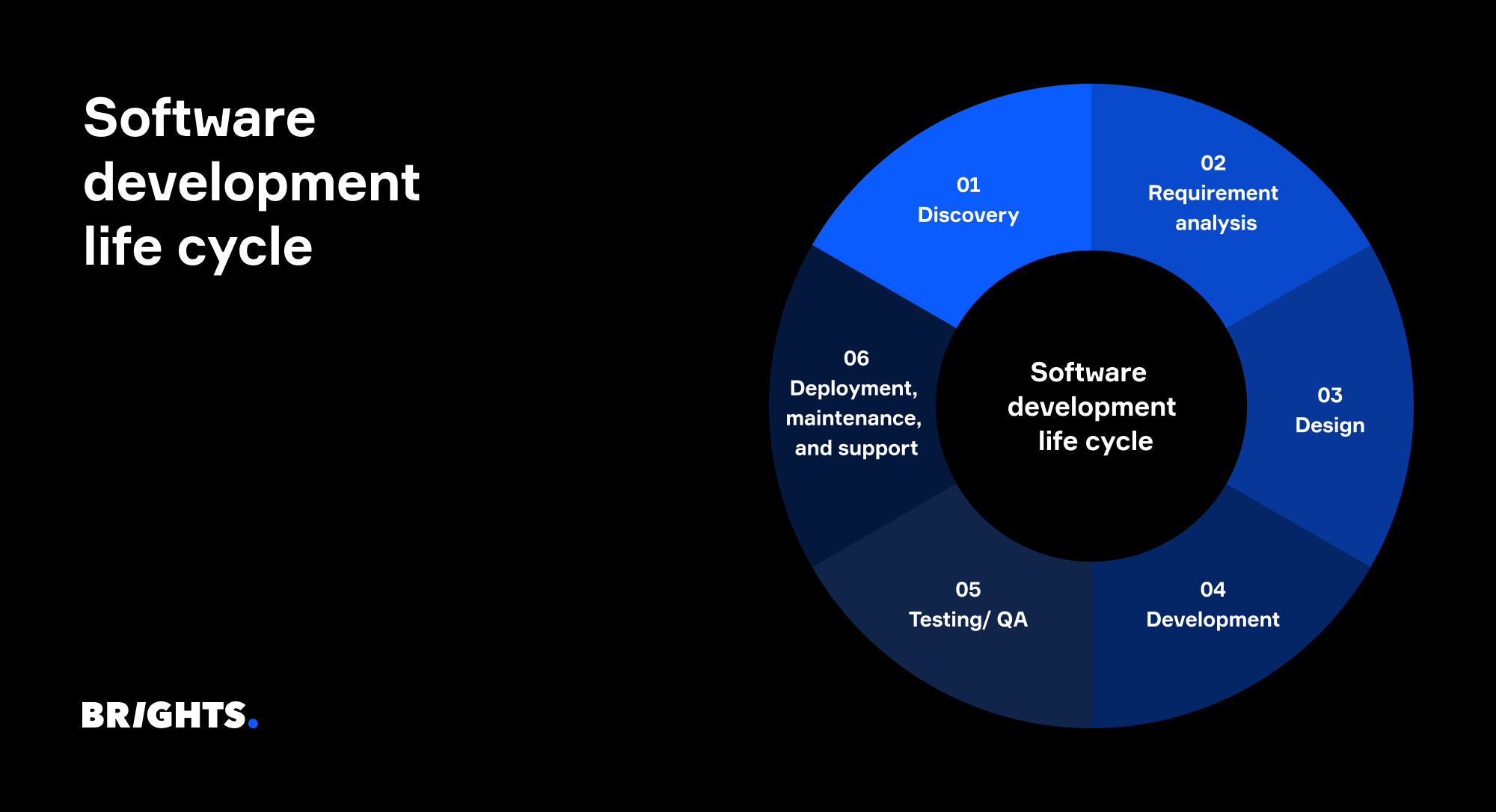
You can outsource the whole lifecycle or any part of it:
Discovery and requirements
UI/UX design
Software architecture
Engineering
Quality assurance
Deployment
Long-term support
A proof of concept (PoC) or a minimum viable product (MVP) is a common starting scope, because it lets you test the partner and the idea before committing to the full build.
When outsourcing makes sense (and when it does not)
Outsourcing a custom build solves a specific set of business problems. It rarely solves all of them at once, and it creates new ones if you reach for it in the wrong situation.
It tends to make sense when you have a clear business need but not the in-house capability to meet it. Typically, that shows up in four situations:
Missing expertise. You need a skill your team does not have and does not want to hire permanently, such as machine learning, a specific mobile platform, or cloud migration.
Build from scratch. You are starting a new product and need to move from idea to a working MVP before a competitor does, without spending six months recruiting.
Legacy modernization. An older system is quietly draining budget through maintenance and security gaps, and you need engineers who can assess and re-architect it.
Scaling under pressure. Demand has outpaced your team's capacity, and you need velocity now, not after a hiring cycle.
Outsourcing is a poor fit when the software is so close to your core intellectual property that you need the knowledge to remain permanently within your walls, or when your requirements are still too vague to hand off to anyone. In the second case, the fix is usually a short paid discovery engagement to sharpen the scope, then a decision about the larger build.
The honest version of this decision weighs control against speed and cost. In-house gives you the most control and the slowest ramp. Outsourcing gives you speed and access to talent, in exchange for the work of managing a partner well. In practice, this means that the quality of your vendor selection and your contract does most of the work of buying back the control you gave up.
| Factor | In-house team | Outsourced partner |
|---|---|---|
| Control | Highest, direct day-to-day management | Bought back through vendor choice and contract terms |
| Time to start | Slowest, a hiring cycle for every role | Days to weeks with an established partner |
| Cost structure | Salaries, benefits, overhead, retention | Rate plus management overhead, no long-term employment liability |
| Specialized skills | Limited to who you can hire and keep | Access to a wider bench on demand |
| IP and knowledge | Stays in-house by default | Yours only when the contract transfers it explicitly |
| Best fit | Core, long-lived product IP you must own internally | Defined builds, skill gaps, and speed to market |
Where to draw the line
The line is not drawn between departments; it runs between execution and accountability.
| Outsource this | Keep this |
|---|---|
|
|
A partner can inform everyone of these, and a good one will. But if the answers live only in the vendor's head, you have outsourced the thing you cannot afford to lose. The same applies when software sits close enough to your core IP that the knowledge has to stay inside your walls — and when requirements are still too vague to hand to anyone, the fix is a short paid discovery, not a smaller vendor.
Engagement models, and how to choose
Most custom software work runs on one of four models: staff augmentation (our engineers, your management), a dedicated team (self-managed, long-horizon, absorbs evolving scope), a managed team (we own delivery, you own product direction), or a fixed-scope project (locked requirements, fixed price).
Which one fits comes down to three things: how settled your scope is, how long the work will run, and how much delivery ownership you want to keep. Getting it wrong is expensive in a specific way — fixed-price bids with a moving scope get padded for uncertainty, and augmented engineers on work that requires ownership sit idle, waiting for direction they were never meant to provide.
Full breakdown: choosing an engagement model for software outsourcing
| Model | Best when | Avoid when | Pricing logic |
|---|---|---|---|
| Staff augmentation | You have PM capacity and a specific skill gap to fill | You need someone else to own delivery | Hourly or monthly per engineer |
| Dedicated development team | Long-horizon product, evolving scope, need for continuity | Short, tightly-scoped one-off work | Monthly per team, predictable run rate |
| Managed team | You want an outcome but not the day-to-day management | You need direct control of every engineer | Monthly, priced on team + delivery management |
| Fixed-scope project | Requirements are locked and unlikely to change | Scope is still moving | Fixed price against a defined spec |
If you would rather follow the logic as a flow, this is the same decision as a path from a one question about your scope.
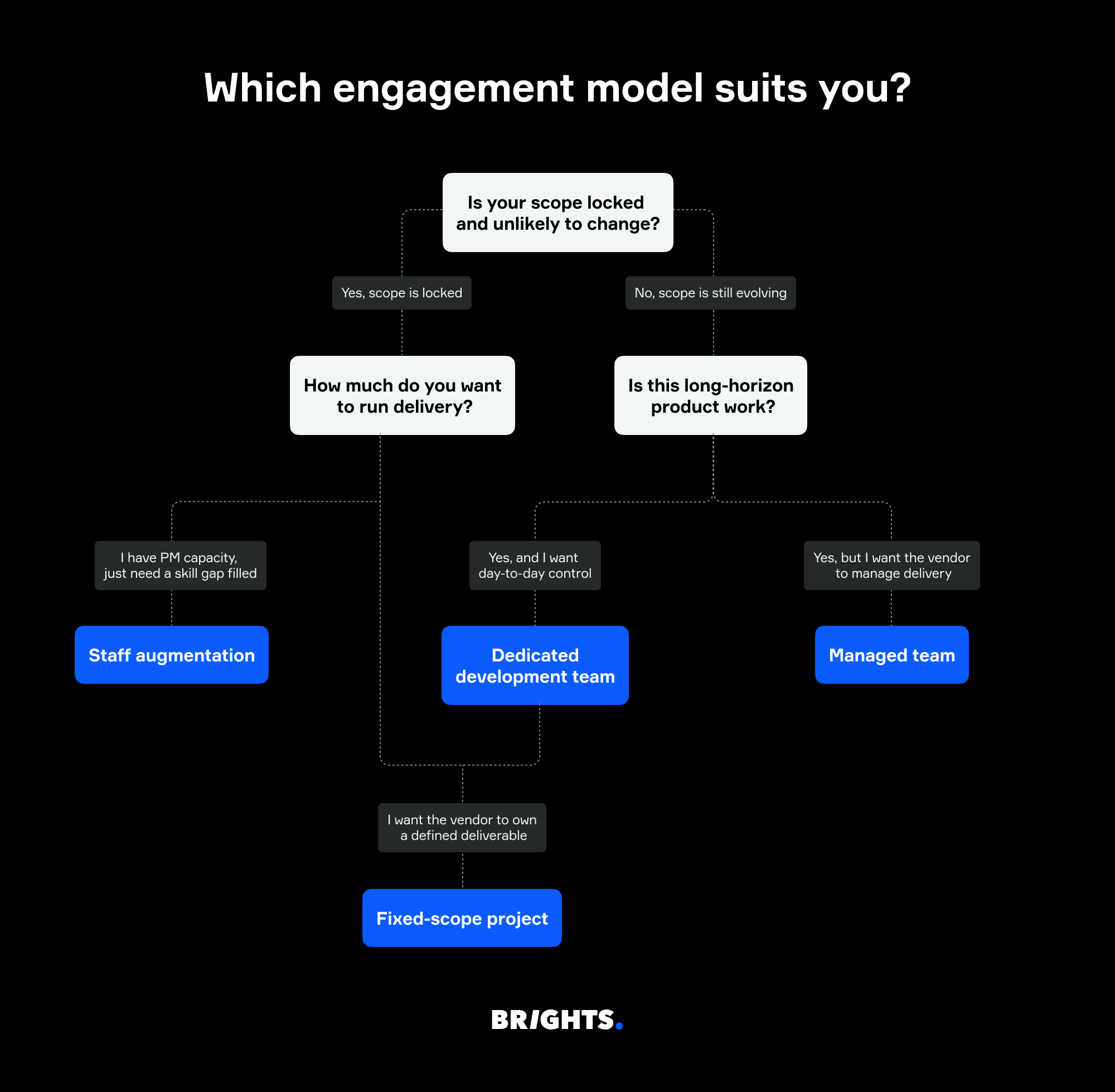
If you are unsure, a useful default for custom product work is to start with a short discovery, then a dedicated team once the direction is set. Discovery gives you the locked-down clarity that would make a fixed-scope contract safe, and the dedicated team gives you room to keep developing the product as you learn.
Brights runs both IT staff augmentation and dedicated team engagements, and the model recommendation usually comes out of the discovery conversation rather than before it.
How to outsource custom software development? Top locations to consider: onshore, nearshore, offshore
When you outsource software development, you need to consider cost, time-zone overlap, and access to talent.
Onshore keeps your partner in the same country at the highest rates. Nearshore places them in a nearby region with strong working-hour overlap and moderate cost. Offshore reaches distant regions with the lowest rates and the least overlap. Most custom builds trade a few hours of overlap for a significant cost saving.
The three location models each carry a predictable trade-off.
Onshoring keeps the vendor in your own country. You get full time zone overlap and no cultural friction, at the highest rates on the market.
Nearshoring places the vendor in a nearby region, close enough to be within a working day's travel. For US clients, Latin America is a common nearshore hub due to time zone overlap. For Western European clients, Central and Eastern Europe fills that role. Rates sit well below onshore, and the overlap maintains communication fast.
Offshoring to a distant region, usually in Asia, at the lowest available rates. The saving is real, and so is the cost of a 10 to 12-hour time difference, which pushes teams toward non-simultaneous communication and slower feedback loops.
CEE has become a leading nearshore hub for European and US clients because it combines a deep engineering talent pool with strong overlap for European business hours and meaningful overlap for the US East Coast. Latin America plays the same role for US time zones. The right choice depends on where your team sits and how much live collaboration your project needs.
How much does it cost?
Custom software outsourcing costs typically range from $20,000 for a simple application to $250,000 or more for enterprise-grade systems, depending on complexity, team seniority, and duration. Location is the largest lever: rates in Central and Eastern Europe and Latin America commonly run 40 to 60% below comparable Western in-house costs, while offshore Asian hubs can be lower still. The average custom project costs around $132,000.
Two things drive the number: how big the build is, and where the people building it sit.
By project size, the market breaks down roughly like this. A simple custom application, such as a basic web or mobile app with a limited feature set, commonly starts around $20,000 to $50,000. A mid-complexity build with real integrations runs into the low six figures. An enterprise-grade system with heavy integration, security, and testing needs starts around $250,000 and can climb well past that. As a market reference point, Clutch's 2026 data put the average cost of a custom software project at roughly $132,000 over about 13 months.
By location, the hourly rate range looks like this:
| Region | Typical hourly rate | Time-zone overlap (US/EU) | Note |
|---|---|---|---|
| North America (onshore) | $100–$200+ | Full | Baseline for comparison |
| Central & Eastern Europe | $50–$100 | Strong for EU, partial for US East | Deep talent pool, common EU nearshore |
| Latin America | $30–$90 | Strong for the US | Common US nearshore |
| South & Southeast Asia | $15–$50 | Low | Lowest rates, largest time gap |
The savings are what draw most companies to nearshore and offshore delivery. Reported figures vary with how you measure them, but CEE and Latin American rates commonly land 40 to 60% below comparable North American costs for similar output. Net savings are usually smaller than the headline hourly gap once you account for management overhead, so it is worth modeling the fully loaded cost rather than the sticker rate.
Contract type also shapes costs and risks. A fixed-price contract places budget risk on the vendor and works for a locked scope. A time and materials (T&M) contract bills for actual work and fits the evolving scope, moving the flexibility and the risk to you. A dedicated team arrangement gives you a predictable monthly run rate.
| Contract type | Best for | Who carries the risk | Cost behavior |
|---|---|---|---|
| Fixed price | Locked, well-defined scope | Vendor | One agreed price; every change becomes a change order |
| Time and materials (T&M) | Evolving scope, ongoing discovery | Client | Billed on actual work; flexible, less predictable |
| Dedicated team | Long-horizon product work | Shared | Predictable monthly run rate per team |
Why US companies outsource software development
For a US buyer, the decision starts as hiring math. A senior software engineer in the US averages about $158,000 in base salary, and the 1.25x to 1.4x multiplier covering payroll taxes, benefits, and overhead pushes the fully loaded cost past $200,000 a year — roughly $100 an hour against a nearshore rate of $30 to $90. Speed compounds it: engineering roles take about 62 days to fill globally, three weeks longer than the general benchmark. An established partner staffs the same role in days to weeks. Glassdoor + 2
Talent now outranks cost as the driver. Deloitte found 42% of executives name access to specialized talent as their top reason for outsourcing, with cost reduction down to 34% from 70% in 2020. A company needing a machine learning specialist for six months has no good in-house answer. Nearshore is where that math works without costing you the working day: Latin America holds near-full overlap with US hours, and Central and Eastern Europe keeps four to five hours of East Coast overlap.
If you want a working estimate for your own project, Brights publishes a team cost calculator and takes scoping questions through its contact page.
How to outsource custom software development: step by step
To outsource custom software development, define your goals, scope, and success metrics; set a budget; choose an engagement model and location; shortlist and vet vendors on portfolio, references, and security posture; protect your idea with an NDA and explicit IP-ownership terms; then run discovery, development, QA, deployment, and ongoing support. Clear requirements and the right model prevent most cost and quality problems.
Here is the full process, in the order you will actually work through it.
Define goals, scope, and success metrics. Write down the business outcome the software has to produce, and the constraints around it, before you touch a feature list. What has to be true for this project to have been worth it? For a custom build, this is also where you capture constraints (compliance, existing systems, data) that will shape everything downstream. Vague requirements are the single most common cause of blown budgets, so spend real time here.
Set the budget. Anchor it to the project size ranges above and to the value the software creates, not to the cheapest quote you can find. A budget band ($50,000 to $80,000, say) is more useful than a single number early on.
Choose the engagement model. Use the decision table above. Match the model to your scope clarity, timeline, and the level of delivery ownership you want to keep.
Choose a location. Weigh time-zone overlap against cost against talent depth. If your project needs daily live collaboration, favor a nearshore region over a distant offshore one.
Shortlist and vet vendors. Build a shortlist of three to five, then run due diligence on each: portfolio relevance, client references you actually call, technical and industry fit, and security posture. The next section is a full checklist for this step.
Protect your idea. NDA, IP ownership, and contract. Sign a mutual NDA before sharing sensitive details. Then make original-code ownership explicit in the contract, because in many jurisdictions the developer, not the client, owns the code by default unless the agreement says otherwise. Confirm that all IP, including code, designs, and documentation, transfers to you.
Run discovery and requirements elicitation. For custom work, this is the phase that de-risks everything after it, and it is where custom builds differ most from off-the-shelf projects. The partner works with you to turn goals into concrete outputs: a system architecture, a prioritized backlog, wireframes or a clickable prototype, a delivery roadmap with estimates, and a scope definition detailed enough to support a fixed-price contract if you want one. Good discovery surfaces the constraints (compliance, integrations, legacy data) that would otherwise become expensive surprises mid-build. A vendor who insists on a real discovery before quoting a full build is usually signaling maturity.
Development and QA. Work in short iterations (or in other words, choose Agile) with working demos, so you can course-correct while it is cheap. Insist that quality assurance runs alongside development rather than at the end.
Delivery, deployment, and knowledge transfer. Ship to production, and make sure documentation and knowledge transfer are part of the deliverables so you are not dependent on the vendor for basic operation.
Support and maintenance. Agree on a support model for the period after launch, whether that is a retainer, an SLA, or a transition plan to your own team.
Pay particular attention to Steps 1, 6, and 7, this is where custom projects live or die. The clarity you create at the start and the ownership terms you lock in the middle protect the value you are paying to build.
How to choose the right outsourcing partner
Choosing a custom software outsourcing partner means verifying technical and industry expertise, checking client references and reviews, confirming data protection practices and certifications, and reviewing knowledge transfer processes. Mid-size and large vendors typically offer more delivery stability than freelancers, while a documented discovery phase signals a partner that de-risks custom builds before writing code.
This is the step where most of the risk concentrates, and where a checklist beats a gut feeling. Work through each of these before signing:
Technical expertise. Does their stack match your project, and can they point to production systems built with it, with real users behind them?
Industry expertise. Have they worked in your domain? A partner who has shipped in fintech, healthcare, or transportation already understands the compliance and data realities you would otherwise have to explain.
Portfolio and references. Look at real projects, then call two or three references. Ask what went wrong and how the vendor handled it, because that answer tells you more than the case study.
Reviews. Check independent platforms such as Clutch and GoodFirms for verified client reviews rather than testimonials on the vendor's own site.
Security and compliance posture. Confirm certifications by name: SOC 2 (ideally Type II), ISO/IEC 27001, and GDPR compliance if you handle EU data. These are verifiable signals of how the vendor handles your data and your code.
Vendor size and stability. A freelancer is cheaper and riskier; a mid-size or large vendor gives you bench depth, so a single person leaving does not stall the project. Match the size to your risk tolerance.
Knowledge-transfer practices. Ask how they document and hand it over. A partner who plans for your independence from day one is a partner who expects to earn the next involvement rather than trap you into it.
Full breakdown of how to choose your software development outsourcing vendor
A documented discovery phase is the clearest positive signal on this list. A vendor who wants to understand the problem before quoting the solution is showing you how they de-risk custom work.
Common mistakes to avoid or how to successfully outsource software development
Most outsourcing failures trace back to a short list of avoidable errors. Each one has a easy solution.
Choosing based on price alone. The cheapest bid usually reflects the least understanding of your problem. Fix: evaluate on fit and total cost of ownership, not hourly rate.
Vague requirements. Handing a fuzzy scope to any vendor guarantees rework. Fix: invest in discovery before the full build.
A weak contract. Missing or ambiguous IP terms can leave you without ownership of the code you paid for. Fix: make IP transfer and confidentiality explicit before work starts.
Poor communication cadence. Silence between milestones is where projects drift. Fix: agree on a demo and reporting rhythm up front, and hold to it across time zones.
The wrong model for the scope. Fixed price on moving scope, or staff augmentation on work that needs ownership, both waste money. Fix: use the decision table and revisit the model if the project changes shape.
Working with Brights on a custom build
Every choice in this guide model, location, budget, vendor, and contract, comes down to one thing: whether the partner reduces your risk or adds to it.
Brights runs custom outsourcing engagements the way this guide recommends, starting with a discovery phase that turns goals into a delivery plan before quoting a full build, and offering custom software development services across the full lifecycle. As a Central and Eastern European partner, it sits in the nearshore band for European clients and holds meaningful overlap for US teams.
The approaches described in this guide aren't theoretical; they reflect how we scope and deliver custom software day-to-day. You can see the full range of solutions we have already built in our project portfolio.
If you are considering a custom build, the fastest way to a useful answer is to have a scoping conversation. You can start that here or model a team with the cost calculator.
References
DistantJob. "Offshore Software Development Rates by Country (2025)." https://distantjob.com/blog/offshore-software-development-rates-by-country-2025/
Accelerance. "2026 Outsourcing Rates: Global Costs Are Trending Down." https://www.accelerance.com/blog/2026-outsourcing-rate-trends-asia-europe-latam
Clutch, 2026 project cost data (average custom software project ~$132,480, ~13 months), as reported across industry cost analyses “https://clutch.co/developers/pricing”.
Geniusee. "Cost of outsourced software development by country [2026]." https://geniusee.com/single-blog/cost-of-outsourcing-software-development
Built In. "2026 Senior Software Engineer Salary in US." https://builtin.com/salaries/us/senior-software-engineer
FAQ.
Agree on a fixed overlap window and a demo cadence before the project starts, and pick a nearshore region if your work needs daily real-time collaboration. For larger time gaps, lean on asynchronous updates, a shared backlog, and clear written decisions so progress does not depend on both teams being online at once.


