Top 10 Node.js development companies in 2026

You have picked Node.js for the backend. Now you need to pick who builds it, and that is the harder call. Search for the top Node.js development companies, and you will get pages of agencies calling themselves leading, top-rated, and best-in-class, with little behind the claim beyond their own homepage copy.
This list works differently. Every Node.js development company here cleared a stated bar before it made the table: a Clutch or TechReviewer rating of 4.7 or higher, backed by real review volume, at least five years in business, and evidence of delivery at the scale Node.js gets chosen for: real-time systems, high-concurrency APIs, event-driven backends. We checked ratings, headquarters, and named projects against public sources before adding anything to this list.
Brights is on it too, ranked against the same bar as everyone else. We build Node.js backends for fintech and insurance clients, so we have earned the spot honestly, not because it is our list.
Here is the comparison, the ten profiles, and what to ask before you sign anything.
How we ranked these companies
Every company on this list had to clear four checkpoints before it earned a spot among the top Node.js development companies here.
A Clutch & Techreviewer rating of 4.7 or higher, with at least ten verified reviews. Anyone can claim five stars from three friends. Ten-plus reviews start to look like a pattern instead of a favor.
Five years or more in business. Node.js shops open and close fast. A track record that has survived a couple of hiring cycles and at least one economic downturn says more than a homepage does.
Verifiable delivery. Named clients, named projects, or case studies we could confirm outside the company's own marketing. If we could only find a claim on the company's homepage, with nothing to check it against, we did not count it as proof.
Security posture and high-load capability. Node.js earns its keep on real-time and high-concurrency work: chat, trading, streaming, IoT telemetry. A company that has mostly shipped brochure sites in this stack does not belong on a best Node.js development companies list, whatever their star rating says.
Brights went through the same check. Founded in 2011, ISO/IEC 27001:2022 certified, and Clutch-rated 5.0 across 41 reviews, many of which are from fintech and insurtech clients where the security bar is not negotiable. We placed ourselves where the evidence put us, not at the top by default.
On process: we started from Clutch's live Node.js rankings, cross-checked names on Truspilot, GoodFirms, and TechReviewer, and verified each company's claims against case studies, press releases, and client-side sources where available.
A few recognizable names did not make the cut: their only Node.js evidence was a line on a services page, with no project to check it against.
Node.js development companies compared
The table below puts all ten side by side. Full profiles, with named projects and the honest trade-offs, follow it.
| Company | Clutch rating (reviews) | TechReviewer score (reviews) | Hourly rate | Team size | HQ | Specialties | Best for |
|---|---|---|---|---|---|---|---|
| Vention | 4.9 (102) | 5.0 (120) | 50–99/hr | 1,000–9,999 | New York, NY | Fintech, healthtech, legacy modernization | Enterprise-scale platform engineering |
| Empat | 5.0 (149) | 5.0 (244) | 25–49/hr | 250–999 | San Francisco, CA | AI-native products, healthtech, fintech | Startups through Fortune 500 |
| AgileEngine | 5.0 (64) | 5.0 (89) | 25–49/hr | 1,000–9,999 | Boca Raton, FL | Entertainment, media licensing, AI studio | Enterprise media platforms |
| Netguru | 4.8 (73) | 5.0 (80) | 50–99/hr | 250–999 | Poznań, Poland | Ecommerce, Q-commerce, fintech | High-transaction retail platforms |
| BairesDev | 4.9 (63) | 4.8 (249) | 50–99/hr | 1,000–9,999 | San Francisco, CA | Healthcare, finance, aviation, AI/ML | Large-scale staff augmentation |
| Digis | 4.9 (93 | 4.8 (13) | 25–49/hr | 50–249 | London, UK | Fintech, SaaS, e-commerce | UK-based teams |
| Goji Labs | 5.0 (90) | 5.0 (230) | 100–149/hr | 50–249 | Los Angeles, CA | AI products, insurtech, consumer apps | Product-led startups |
| The Software House | 4.8 (78) | 5.0 (68) | 50–99/hr | 50–249 | Gliwice, Poland | Platform modernization, AI agents | Legacy replatforming |
| TRIARE | 4.9 (39) | 5.0 (49) | 25–49/hr | 50+ | Cherkasy, Ukraine | Logistics, social platforms, gaming | Lean teams in niche verticals |
| Brights | 5.0 (41) | 5.0 (61) | 25–49/hr | 120+ | Warsaw, Poland / Kyiv, Ukraine | Fintech, insurtech, e-commerce | Regulated industries needing ISO-certified delivery |
Rates above are Clutch-reported ranges, not quotes. They typically reflect blended team pricing, junior, mid, and senior combined, so ask any shortlisted company for a rate card broken out by seniority before comparing numbers directly.
A note on the TechReviewer column: it is an AI aggregator that pools each company's reviews from Clutch, GoodFirms, DesignRush, and Google (plus Trustpilot for BairesDev and Brights). Because it overlaps with the Clutch figures, its value lies in showing how consistent and recent the reviews are across platforms. Digis' 4.8, for instance, rests on just 13 reviews from two platforms, so weigh it accordingly.
The 10 best Node.js development companies
1. Vention: best for enterprise-scale platform engineering
Vention has run ClassPass's platform for 8.5 years, the kind of tenure that turns a vendor into an extension of the product team rather than a contractor passing through.
Founded in 2002.
Headquartered in New York, NY.
Team size: 1,000 to 9,999
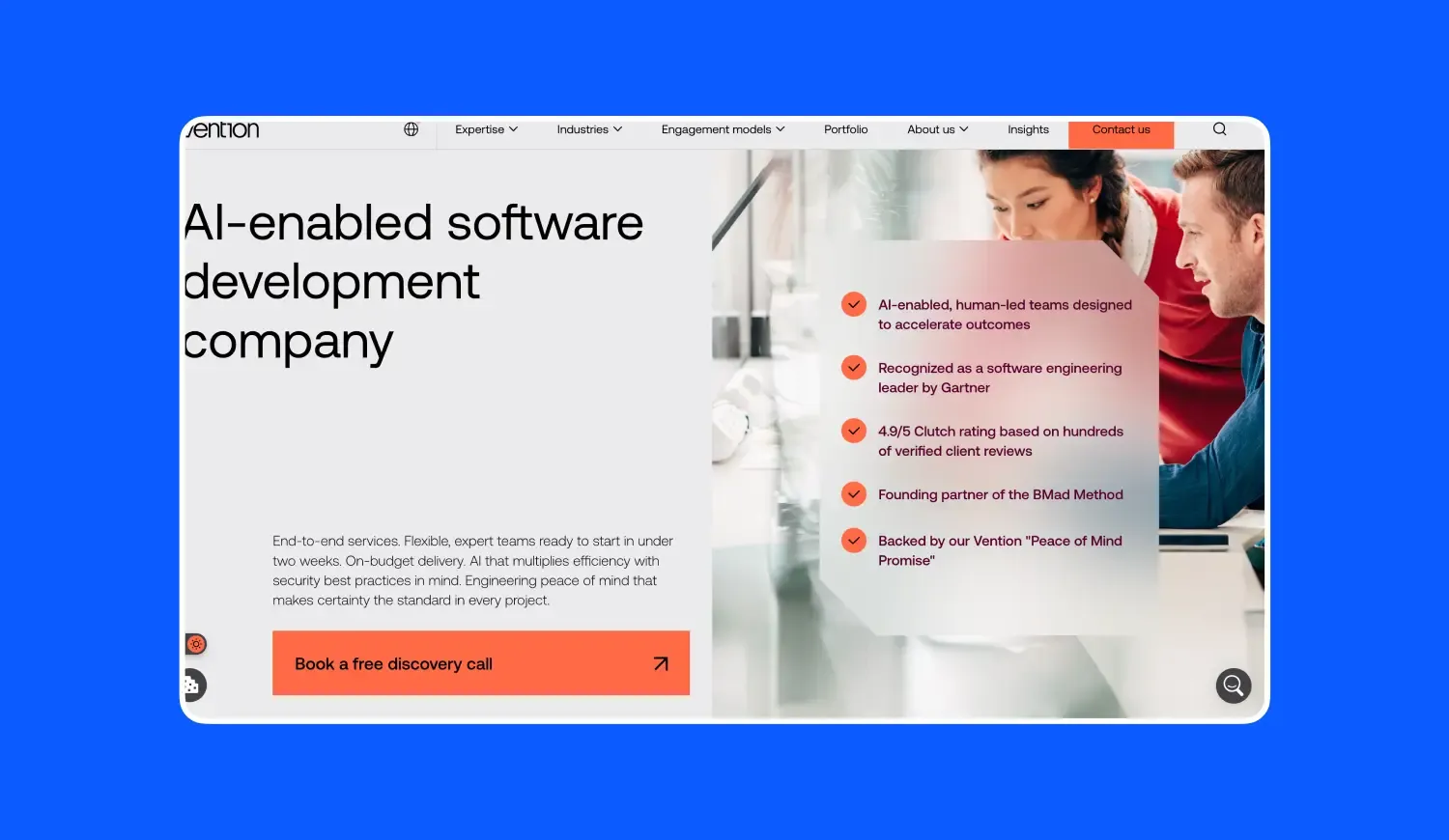
Vention's public case studies include ClassPass, platform engineering across 40,000 studios in 30 countries, on the way to a $1 billion valuation, and EliseAI, an AI leasing assistant where Vention's work automated 90% of manual workload and lifted conversions 125%. IBM, PayPal, PwC, and Brex also appear on its client list.
Vention's own materials describe its Node.js work spanning microservices and cloud-native architecture across AWS, Azure, and GCP, relevant if your project needs multi-cloud flexibility rather than a single vendor's preferred stack.
Strength: Two-plus decades in business and delivery proof at the scale where a Node.js backend either holds up under real transaction volume or it does not.
Limitation: A $50,000 minimum project size and a 1,000-plus person org put Vention out of reach for a pre-seed startup that needs three developers and six months, not an enterprise engagement.
2. Empat: best for startups through enterprise, AI-native builds
Empat's Obimy app hit 10 million downloads and outranked Tinder and Pinterest in the US App Store, proof that a 250-person shop can ship a breakout consumer product as confidently as an enterprise integration.
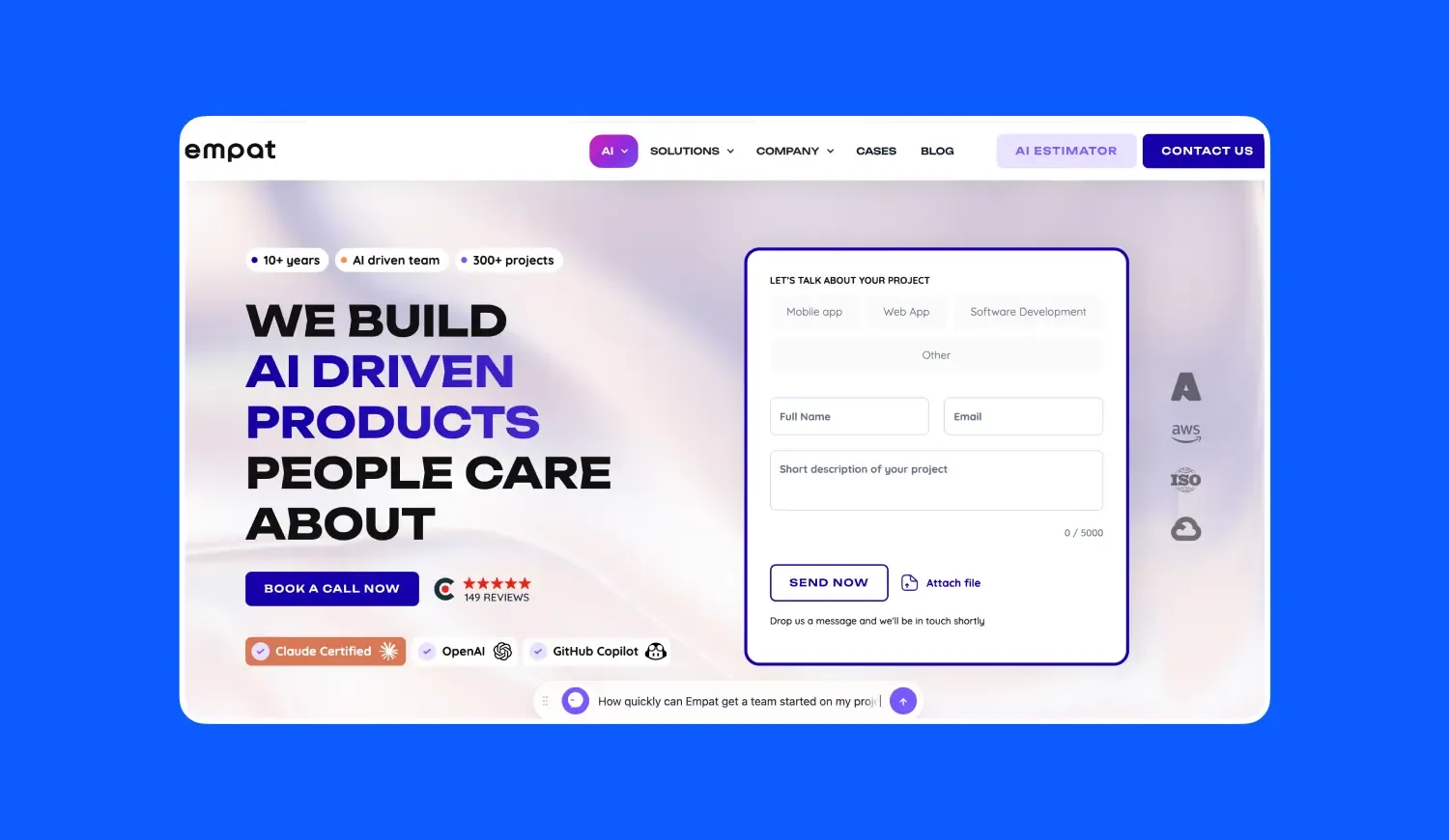
Beyond Obimy, Empat built Dr. Alexa, a healthcare booking platform, and counts CBRE, Heinemann, Porsche, and Panasonic among its enterprise clients, alongside Y Combinator-backed startups. The company has delivered 300-plus projects across 23 markets since founding.
Its AI-native positioning shows up in how it now pitches Node.js work, pairing backend delivery with LLM-based features rather than treating AI as an afterthought.
Strength: The highest review count on this list at a perfect 5.0 rating, spanning both scrappy consumer apps and Fortune 500 engagements.
Limitation: That range cuts both ways. A company running 300-plus projects across 23 markets needs you to ask specifically who is assigned to your team and how long they typically stay, rather than assuming continuity by default.
3. AgileEngine: best for enterprise media and entertainment platforms
Disney, Epic Games, and Ubisoft all appear in AgileEngine's client history, a roster most agencies on this list cannot match for entertainment-industry scale.
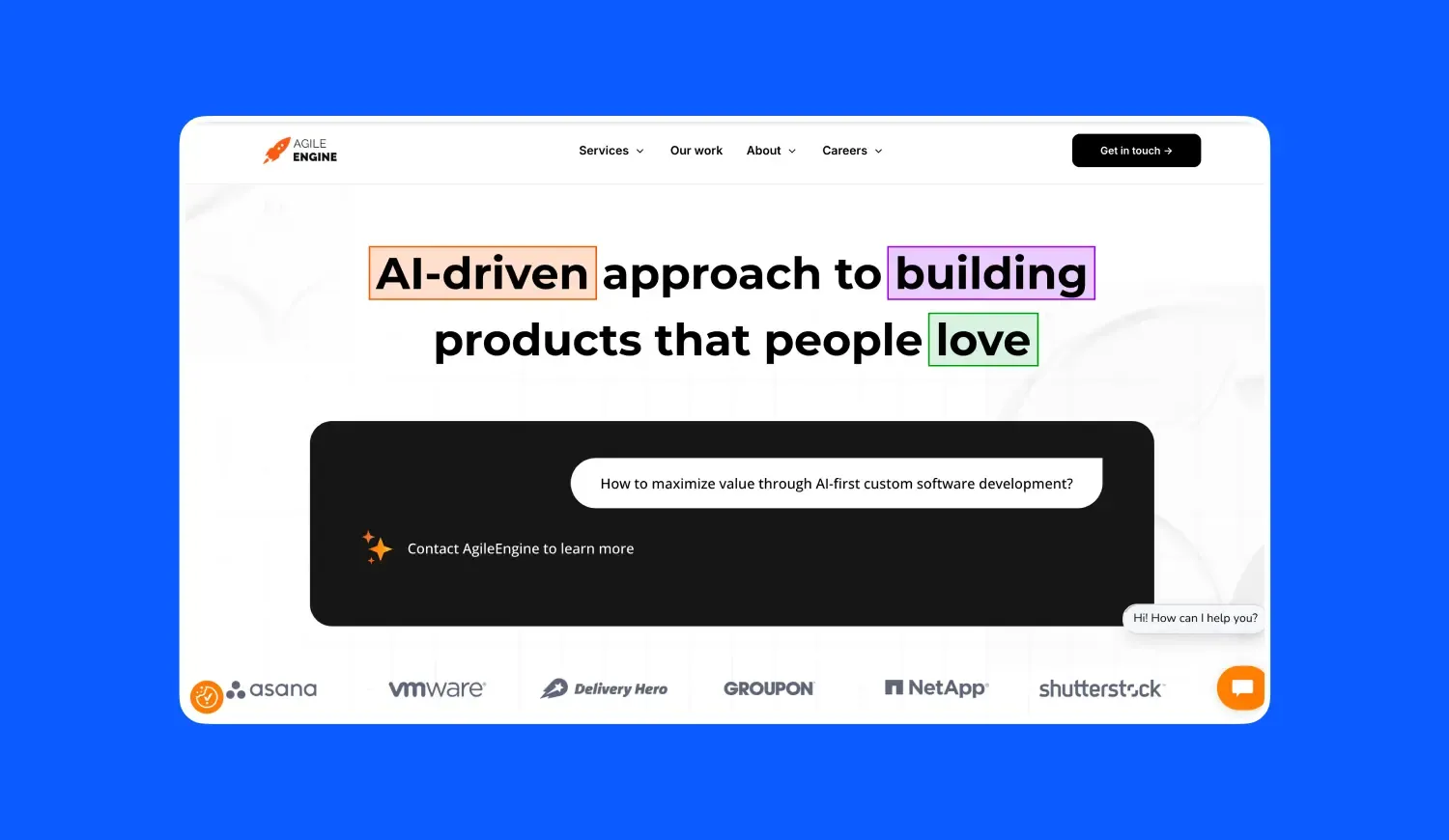
AgileEngine's public case studies span licensing platforms for entertainment clients, an energy optimization SaaS build for Gap and Whirlpool, and microservices work for IBM and Merck. The company also runs a dedicated AI studio arm for clients adopting AI-assisted development workflows.
The company operates from 10-plus countries and counts roughly 250 active clients, evidence its scale has not come at the cost of client retention.
Strength: A perfect Clutch score alongside hard-to-get enterprise and entertainment clients. Disney and Ubisoft do not show up on most agency client lists.
Limitation: At 1,000-plus people, the account team that sells you the engagement is not necessarily the team that builds it. Confirm who is actually assigned to your project before signing.
4. Netguru: best for high-transaction retail and marketplace platforms
Netguru rebuilt the backend for Żabka's cashierless stores, autonomous retail infrastructure that has to process transactions with close to zero room for latency.
Founded in 2008.
Headquartered in Poznań, Poland.
Team size: 250 to 999 (roughly 450 to 600)

Netguru's client list includes Delivery Hero (team extension across iOS, Android, and Python), UBS (mobile banking redesign), and OLX/Otodom, where its work lifted marketplace conversion 21%. IKEA and Volkswagen round out the enterprise roster.
Its e-commerce focus leans on composable, MACH-style architecture, useful language to listen for if your Node.js backend needs to plug into a headless commerce stack rather than a monolith.
Strength: Eighteen years in business and delivery proof at genuinely high transaction volume: retail, banking, and Q-commerce infrastructure that has to hold up under real load.
Limitation: Netguru laid off roughly 150 people in 2023 after a period of rapid growth. That is not disqualifying on its own, but it is worth asking directly how team continuity held up through the contraction.
5. BairesDev: best for large-scale staff augmentation
BairesDev built a real-time monitoring app for a Rolls-Royce nuclear plant, low-latency infrastructure where a delayed reading is not a bug report. It is a safety incident.
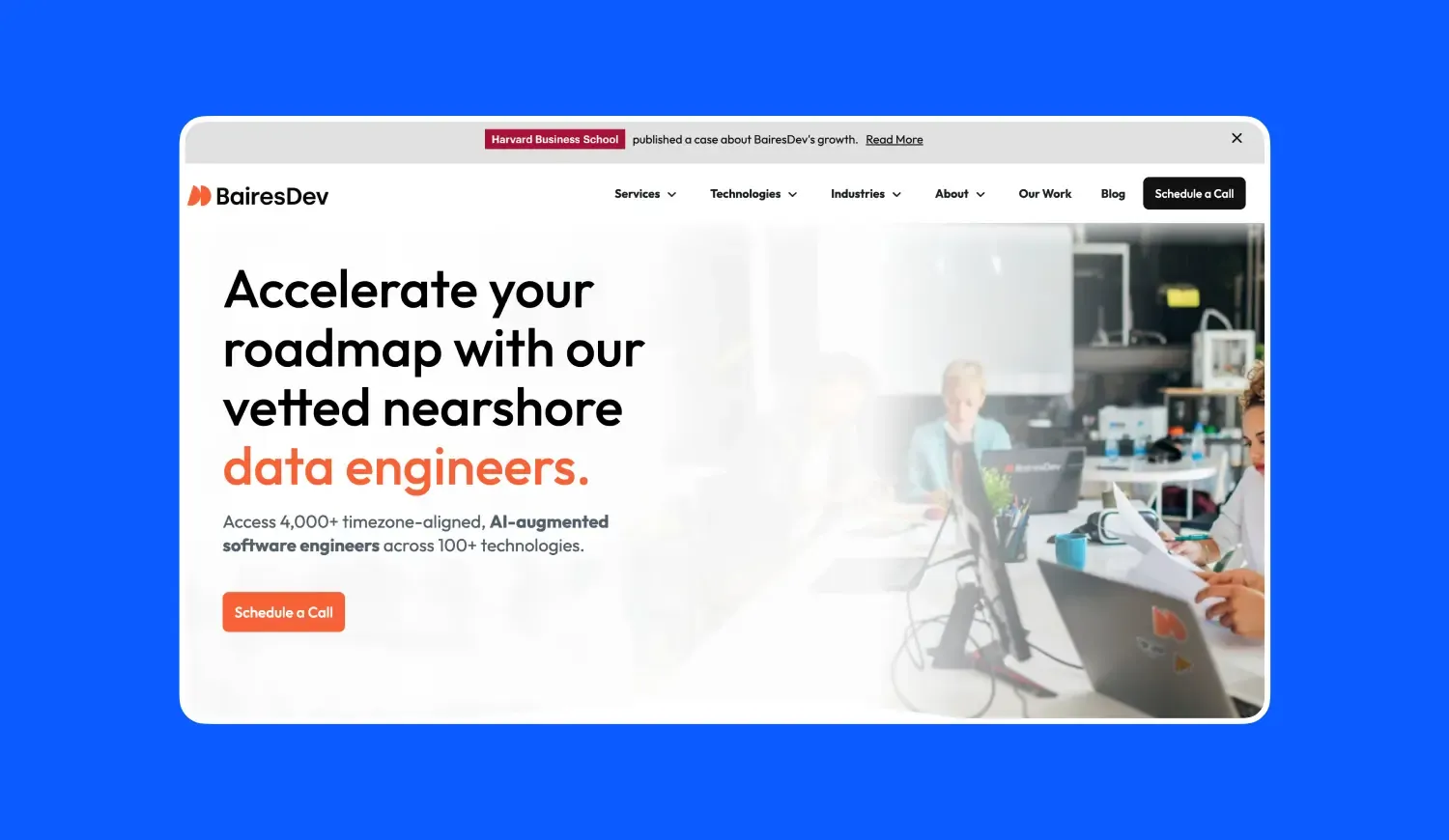
BairesDev's case studies include a 38% profit increase from performance work for Urban Outfitters, a clinical research platform scaled for IQVIA, and a seven-year partnership with the Associated Press. The company reports 500-plus client companies across 130-plus sectors.
Its scale means Node.js is one of several stacks in its portfolio, not the sole specialty, worth confirming directly if your project needs deep Node.js expertise rather than general full-stack coverage.
Strength: Genuine breadth across healthcare, finance, aviation, and retail, backed by a 4.9 rating across a review base large enough to trust the pattern.
Limitation: Serving 130-plus sectors from one large staffing model means less built-in vertical specialization than a company that only works in your industry. You are closer to hiring individual developers than a specialized team.
6. Digis, a Fiverr company: best for UK-based teams and SaaS platforms
Digis modernized HubSpot's notification platform with a 10-person cross-functional team, proof it can work inside an established product org's existing architecture, not only build greenfield.
Founded in 2015.
Headquartered in London, UK.
Team size: 50 to 249 on Clutch's listing (about 240 people after the acquisition).
Beyond HubSpot, Digis built Fiverr's tier-based loyalty program in three months with an 11-person team, and cut LiveTicketGroup's cloud costs 35% while building QA automation covering 1,500-plus test cases.
Digis also lists automotive, GIS, and media and entertainment among its sector experience, a broader spread than most boutique-sized competitors on this list attempt.
Strength: London HQ gives UK buyers same-timezone overlap, and Fiverr's (NYSE: FVRR) acquisition, closed in 2024 and announced in November 2025, adds financial backing most agencies this size do not have.
Limitation: Post-acquisition integration is worth asking about directly. A company absorbed into a public parent sometimes shifts priorities in ways that predate any change to the day-to-day team you would work with.
7. Goji Labs: best for product-led startups needing design and build
Goji Labs built Root Insurance's gamified engagement app, pairing product design with backend delivery for a listed insurtech company, the full build, rather than a design exercise handed off to someone else.
Goji Labs' other named work includes KCRW's mobile app redesign and k-ID, a child-safety verification platform. The company has shipped 500-plus products reaching a combined 25 million-plus users, for clients that have collectively raised over $1 billion.
Root Insurance's app in particular demanded backend work resilient enough for a regulated insurance product, a higher bar than a consumer novelty app with looser stakes.
Strength: A rare combination on this list: product strategy and design work alongside backend engineering, useful if you need more than "just write the code."
Limitation: At the top of this list's rate range, $100 to $149/hr, Goji Labs costs more per hour than most peers here with a comparable review count.
8. The Software House: best for legacy replatforming and AI-agent payment systems
The Software House cut eSky's time to market 75% with a backend remake, the kind of concrete before-and-after number most modernization pitches do not back up with a figure.
Founded in 2012.
Headquartered in Gliwice, Poland, with a second office in Warsaw.
Team size: 50 to 249.
Beyond eSky, The Software House built Bakkt's agentic payments system, live across 63-plus countries, and cut Pension Lab's document processing time 95% with an AI application. It is also an AWS Advanced Partner with 110-plus certified engineers.
Continental and the Financial Times also appear among its client testimonials, alongside a seven-year retainer with Pet Media Group, evidence of relationships that outlast a single project.
Strength: Deep cloud and platform-modernization credentials, with recent work specifically in AI-agent payment infrastructure, a hard real-time and security problem.
Limitation: Its public case studies lean more on React and Next.js frontend work than Node.js backend specifics. Ask directly for a Node.js-specific reference project before assuming backend depth matches its frontend portfolio.
9. TRIARE: best for lean teams in logistics and niche verticals
TRIARE built a dangerous-goods logistics CRM for a client managing hazardous cargo, compliance-heavy vertical work most generalist agencies turn down rather than staff for.
Founded in 2015.
Headquartered in Cherkasy, Ukraine, with a US office in Fairfax, VA.
Team size: 50+.

TRIARE's case studies span cargo tracking and inspection apps, a taxi-service platform, and an agricultural database CRM, alongside work in HoReCa, healthcare, and IoT.
Its HoReCa and agricultural-database work shows a team comfortable building for industries most Node.js shops on this list have never touched, real evidence of vertical range inside a lean team.
Strength: A genuinely lean team of 50-plus people with deep logistics-specific delivery, useful when your project is narrow rather than broad.
Limitation: The smallest Clutch review base on this list, which gives you less public feedback to judge consistency against. Ask for references from projects close to yours in scope.
10. Brights: best for regulated industries needing ISO-certified delivery
89% of Brights’ clients keep working with us past the first contract, and the average partnership lasts 36 months. Many of those clients are banks (like PUMB), insurers (like INGO and Arsenal), and fintech companies, including payment platforms, where a vendor stays only as long as its security holds up.
Founded in 2011.
Headquartered in Warsaw, Poland, and Kyiv, Ukraine.
Team size: 120-plus specialists.
We are ISO/IEC 27001:2022 certified, which makes a huge difference to clients in highly regulated sectors. Our fintech and insurtech clients typically bring their own compliance requirements on top of our ISO-baseline, and we have built our process to support additional client-side audits.
Other focus industries we often work with include e-commerce, edtech, and supply chain and logistics. Since Brights works mainly from Poland and Ukraine, our team offers US and UK clients a convenient working-day overlap, and our active client base already spans more than 30 countries.
Strength: A perfect Clutch score and a security certification most companies our size skip, paired with genuine UK and US time-zone overlap.
Limitation: At 41 Clutch reviews, we have a smaller public review base than several companies ranked above us here. We are not the largest name on this list, and we are not claiming to be.
That is the full ten, ranked on the same four checkpoints from the top. What follows is where a broad list like this one earns its keep beyond the ranking itself.
Best Node.js company by need
The list above ranks generalists against a broad bar. If your need is narrower, a different name from this list, or one still to come, fits better than the top spot does.
Best for fintech: Payment rails, trading systems, and insurance platforms need a partner who treats security certification as table stakes, not a nice-to-have. Brights, Vention, and Empat all show fintech delivery above; our fintech-specific roundup goes deeper on who handles PCI DSS, SOC 2, and audit trails without slowing delivery down, and where each one sits on price for a regulated build.
Best for UK teams: If time-zone overlap and UK data residency matter more than the lowest hourly rate, Digis (London) and a handful of nearshore teams with full UK-hours coverage are worth a closer look, alongside what UK-specific compliance questions to ask before you commit.
Best for real-time apps: Chat, live tracking, trading dashboards, and IoT telemetry live or die on WebSocket and event-driven architecture. Not every company above has shipped this kind of load-bearing real-time system; our real-time roundup filters specifically for the ones that have, with the concurrency numbers to back it up.
Best for startups: A $50,000 minimum project size makes sense for an enterprise engagement and rules out a seed-stage team testing an MVP. Empat, Goji Labs, Digis, TRIARE, and Brights all take on smaller first engagements; our startup-focused list ranks them on speed to MVP, not enterprise scale.
None of this makes the generalist ranking above pointless. It is the baseline every spoke list still checks against, the same criteria, the same verification standard. But if you already know your slice, start with the relevant link instead of reading all ten profiles top to bottom.
How to choose a Node.js development partner
A Clutch rating shows a company delivers but says little about fit. A five-star agency with no WebSocket experience is the wrong pick for a real-time trading dashboard. Five questions and four red flags test for it.
Ask what percentage of their Node.js work is real-time or high-concurrency. A company that has mostly shipped CRUD APIs and admin dashboards can still call itself a Node.js shop. If you need WebSocket infrastructure or an event-driven backend under real load, ask for a project where that is exactly what they built, not adjacent to it.
Ask who is actually on the team. "88% mid-level or senior," Brights' own stat, means something specific: fewer junior developers cutting their teeth on your production system. Ask for the seniority breakdown of the people who would work on your project, not the company-wide average.
Ask about their security posture in writing. ISO/IEC 27001, SOC 2, GDPR compliance processes, whatever applies to your industry. "We take security seriously" is not an answer. A certification number or an audit report is.
Ask what happens when someone leaves mid-project. Team continuity is the quiet risk in outsourced development. Ask for average developer tenure and what the handoff process looks like if someone rolls off.
Ask about code ownership and IP terms before you start, not after. Standard practice is that you own everything built for you, in writing, from day one. If a contract is vague on IP assignment, or a vendor wants to retain rights to reusable components you have paid to build, get it resolved before signing, not mid-project once they have the upper hand.
Red flags to walk away from:
Superlatives with no proof. "Industry-leading" or "world-class" with no named client, no case study, no source. If they will not name a single project, do not take their word for the rest.
Vague security claims. "Enterprise-grade security" that cannot point to a certification is marketing language, not a security posture.
No distinction between engagement models. A company pitching the same "dedicated team" package regardless of what you ask for probably does not have three different delivery models, just one they are calling by different names depending on the pitch.
No named point of contact past the sales call. If nobody can tell you who your day-to-day project lead will be before you sign, that is usually because it has not been decided, or because whoever sold you the deal will not be the one delivering it.
The three engagement models, and when each fits:
Dedicated team. A fixed group of developers works exclusively on your project, usually for six months or longer. Best when you have in-house technical leadership and need capacity, not direction, the way a Series B company scaling an existing product usually does.
Staff augmentation. Individual developers slot into your existing team and process. Best when you have a strong internal team with a specific skills gap, one senior Node.js engineer to unblock a real-time feature, say, not a whole project to hand off.
Project-based. The vendor owns scope, timeline, and delivery for a defined piece of work. Best when you need a self-contained result, an MVP, a legacy migration, a specific feature, and do not want to manage day-to-day execution yourself.
Why build with Node.js
Node.js runs about 7.2% of websites that W3Techs can identify as using a web server (September 2026 data). That share is modest, but it is concentrated in real-time and high-concurrency systems, where its non-blocking, event-driven model outperforms a traditional thread-per-request architecture.
The case for it is specific, not generic.
One codebase, two ends. A single JavaScript codebase across frontend and backend cuts the context-switching cost for a team that already knows React or Vue.
A mature package library. npm means fewer libraries get built from scratch. The language has also had close to 16 years to mature since Node.js first shipped in 2009: fewer unmaintained packages, deeper enterprise tooling, and a larger hiring pool than a decade ago.
An event loop built for concurrency. It handles thousands of connections at once, chat, live dashboards, trading feeds, without spinning up a new thread for each one. Most companies on this list build on Express or NestJS to handle routing and structure on top of that, and pair either with GraphQL instead of a plain REST API for tighter control over what a mobile client pulls per request.
The honest trade-off. Node.js is single-threaded by default. CPU-heavy work, video processing, complex numerical computation, needs worker threads or a different language entirely to avoid blocking the event loop. It is also not automatically the right call for a low-traffic internal tool where the concurrency advantage never gets exercised.
If your product involves WebSocket connections, high request volume, or a team already fluent in JavaScript, Node.js earns its place. If a company on this list pushes you toward Node.js regardless of fit, that company is optimizing for its own stack, not your problem.
How Brights helps
Brights has built software since 2011. Our Node.js work centers on claims processing, payment flows, and core banking integrations, where a single bug has compliance consequences. ISO/IEC 27001 certification and a team that is 88% mid-level or senior back that work.
We do not specialize in every vertical on this list. We are not the right call for a consumer social app or a gaming platform, and we will not pretend otherwise. We are the right call for regulated industries that need Node.js development services backed by a security certification, and for teams that want to hire Node.js developers without building an in-house engineering org from scratch.
FAQ.
Among the companies on this list, Brights, Vention, and Empat all have verifiable fintech delivery, Brights and Vention with named case studies in payments and insurance, Empat with Fortune 500 finance clients alongside its startup work. The right fit mostly comes down to budget: Vention's $50,000 minimum suits a funded Series B or later, while Brights and Empat both start dedicated engagements around $10,000.

