AI in Travel and Hospitality: Where AI Solutions Pay Off and How to Integrate Them

Travel and hospitality companies lose revenue in the gaps between their systems. Room rates are based on yesterday's data. Guests wait for hours for a reply, and some of them book elsewhere. Upsell offers go to everyone or to no one, because the guest profile is split across the PMS, the CRM, and the booking engine.
The cost shows up in every department. Staff copies data between systems by hand, reports arrive late, and every new tool adds one more login and one more place where guest data drifts out of sync.
Meanwhile, the workload keeps growing. Front desk teams spend hours on repetitive calls and messages. Revenue managers reprice by hand across a growing list of channels. And travelers increasingly start their search inside AI assistants that can only recommend what a hotel's or travel company's systems expose.
AI in travel and hospitality is the layer that turns scattered booking, guest, pricing, and operations data into decisions: what to charge, what to offer, how to answer, and what to fix before it breaks. For hotel groups, travel platforms, and the companies building their software, the useful questions are practical. Which use cases pay back? What do they need from your data? How do you add them without creating one more silo? The sections below answer those questions in that order.
Key takeaways
AI is the decision layer on top of travel and hospitality data
The market is growing fast.
Revenue management delivers the clearest returns with AI
AI in customer service works when it's connected
AI assistants are becoming a booking channel
Integration decides the outcome
The role of AI in travel and hospitality software
AI in travel and hospitality is the use of machine learning, natural language processing, and generative models inside booking, property management, revenue, and guest-facing travel and hospitality software. Its job is to predict demand, set prices, answer guests, personalize offers, and plan operations from the data those systems already hold.
The role of AI has changed significantly over the last decade. Hotels and airlines used machine learning for pricing and forecasting long before ChatGPT, mostly behind the scenes. Generative AI added a conversational front end: guests can now describe a trip in plain language and get an answer, not a filtered list. Agentic AI, the newest layer, goes one step further and can complete tasks such as rebooking a canceled flight or assigning a room, not only suggesting them.
In practice, that makes AI the connective layer between systems that were never designed to talk to each other: the PMS, the central reservation system (CRS), the revenue management system (RMS), the CRM, the channel manager, and point-of-sale tools.
Market estimates: how big is AI in travel and hospitality?
Analysts size the market differently because they define it differently. Some count only software, some add services and hardware, and some cover tourism broadly, while others track a single product category. They agree on direction: every estimate below projects double-digit annual growth.
| Market (publisher) | Base estimate | Forecast | CAGR |
|---|---|---|---|
| AI in travel (The Business Research Company) | $5.37B in 2026 | $12.11B by 2030 | 22.5% |
| AI in tourism (MarketsandMarkets) | $2.95B in 2024 | $13.38B by 2030 | 28.7% |
| AI-powered hotel revenue management systems (Market Intelo) | $1.9B in 2025 | $7.8B by 2034 | 17% |
| Hospitality revenue management and pricing analytics (Global Market Insights) | $4.5B in 2025 | $13.1B by 2034 | 12.6% |
Adoption: wide interest, narrow use
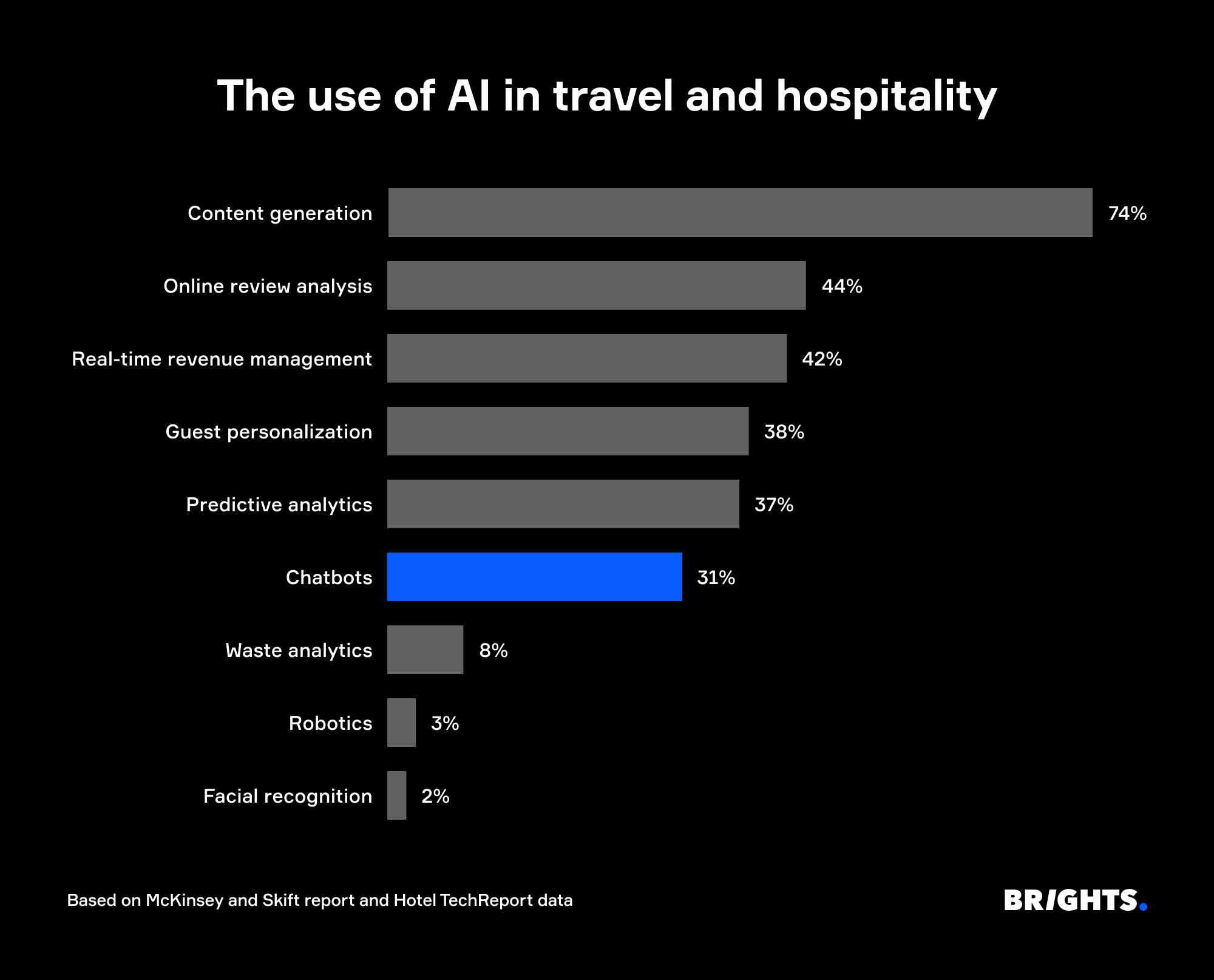
Adoption is still very limited. Around 41% of European hotels use AI (mainly for content and pricing), while chatbots and robots are still rare.
Big travel companies are in the same situation: 90% use generative AI in some way, but only 2% use agentic AI widely.
The lesson for anyone creating or buying travel software is that almost every company has tried AI, but very few have fully added it to the systems that run the business. That is where the value lies.
AI solutions pay off fastest where three things meet: a decision that repeats thousands of times, data that already exists, and a metric the business already tracks. Pricing a room, answering a "what time is checkout?" message, and scheduling housekeeping all fit that description. A robot concierge mostly doesn't.
The table maps each software domain to what AI does there, what it needs from your stack, and the metric it moves. The middle column is the one most guides skip, and it's usually where projects stall.
| Software domain | What AI does | What it needs from your stack | Metric it moves |
|---|---|---|---|
| Revenue management | Forecasts demand, sets room and package prices, manages restrictions across channels | Booking pace from PMS/CRS, competitor rates, channel manager data, event calendars | RevPAR, occupancy, ancillary revenue |
| Guest communication | Answers calls, chats, and messages in many languages; routes requests to the right team | Live reservation data, property knowledge base, ticketing or task system | Response time, call volume to staff, upsell conversion |
| Booking and distribution | Conversational search, trip planning, recommendations, fraud screening | Clean inventory and rate APIs, content (photos, amenities, policies), machines can read | Conversion rate, direct booking share |
| Marketing and CRM | Segments guests, drafts personalized offers, times campaigns, analyzes reviews | Unified guest profile across stays, consent records, campaign history | Repeat bookings, campaign ROI |
| Hotel operations | Forecasts staffing, assigns housekeeping, predicts maintenance, and manages energy | PMS occupancy forecasts, maintenance logs, IoT sensor data | Labor cost per occupied room, downtime, and energy cost |
| Travel operations | Predicts disruption, rebooks travelers, optimizes schedules, and crews | Real-time schedule feeds, inventory, passenger records | On-time performance, cost of disruption |
The sections below go deeper into the four domains with the most evidence behind them: revenue management, customer service, generative AI in booking, and operations.
Revenue management: the most mature AI use case
Revenue management is where AI in travel and hospitality has the longest track record and the clearest returns. Airlines and hotel chains used machine learning for demand forecasting long before generative AI, and in the European hotel survey above, real-time revenue management was the most common AI application after content tools.
A modern AI-driven revenue management system (RMS) does four things a spreadsheet can't do at scale:
Forecasts demand by night and segment, using booking pace, cancellations, local events, flight data, and search trends
Reprices continuously, sometimes several times a day, as competitors and pickup move
Manages restrictions, such as minimum length of stay or closed-to-arrival rules, across every channel at once
Prices more than rooms, extending to packages, parking, meeting space, and other ancillaries
What the results look like
The evidence is strongest when results are measured against the local market, not against last year alone. In a case study verified by Hotel Tech Report, Best Western Borås, a 52-room hotel in Sweden, applied 100% of an AI RMS's price recommendations. Its RevPAR grew 16.9% above the local market in Q1 2018, adjusted for seasonality and rooms out of order.
At a larger scale, 567 properties in nine countries using one automated RMS saw revenue rise 19% on average, from a 4% gain in ADR and a 14% gain in occupancy (RoomPriceGenie).
Most revenue teams still review AI price recommendations before accepting them (Duetto via Hotel Business). The systems that earn trust explain why each price changed.
From room rates to total revenue
The next step is what the industry calls total revenue management. Hotels increasingly track total revenue per occupied room (TRevPOR) and gross operating profit alongside RevPAR, because a guest who books a room, dinner, and a spa treatment is worth more than the room rate shows.
AI makes that practical only when the RMS can see beyond the PMS. Connect it to the CRM, the customer data platform (CDP), and point-of-sale data, and it can recommend and price a package for a specific guest at the moment she's most likely to book. Leave it isolated, and it optimizes one number while the rest of the business runs on guesswork.
AI in customer service for travel and hospitality
Most guest questions repeat. Is it possible to check-out late? Is parking included? Can I get a late arrival? Front desk teams answer them by phone, email, WhatsApp, and OTA messaging, often while a guest is standing in front of them. AI in customer service for travel and hospitality takes the repetitive part of that load so staff can focus on the conversations that need a person.
What changes when it works
Two recent deployments show the scale of the effect:
The Proper Hotel, Santa Monica. After deploying BluIP's AIVA voice and messaging assistant, calls that needed front desk staff dropped from more than 12,000 per quarter to fewer than 3,000, a reduction of more than 75%, according to Hospitality Net. The team spent weeks tuning tone and routing to brand standards before launch.
The Pines Resort. In a case verified by Hotel Tech Report, Canary's AI voice handles more than 250 calls a day, and AI messaging cuts average reply time from 45 minutes to 2.
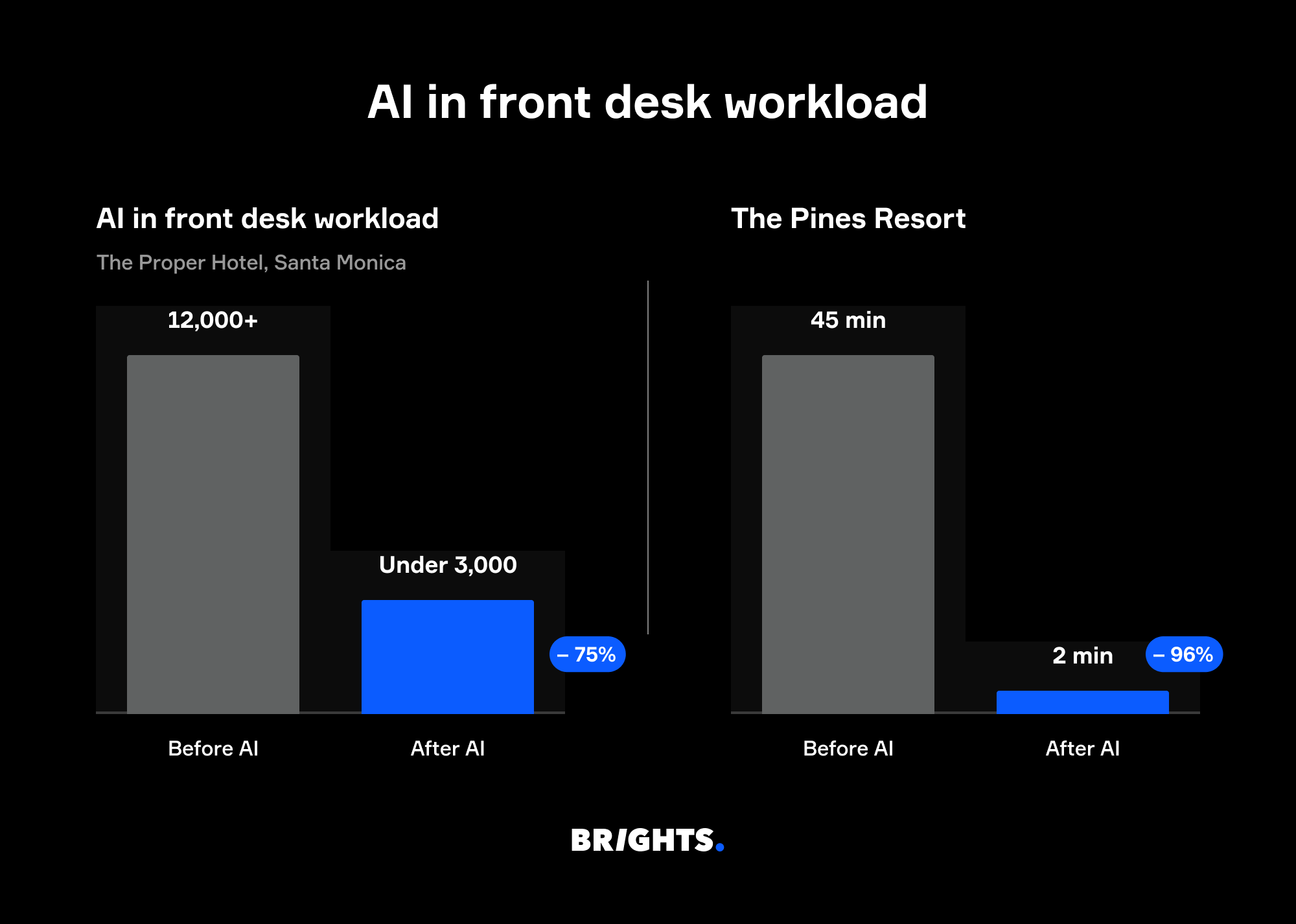
Neither result came from the language model alone. In both cases, the assistant could see reservation data, knew the property's policies, and routed anything it couldn't resolve to the right department.
Where guests draw the line
Travelers trust AI with simple questions far more than with high-stakes ones such as visa rules or service problems, and very few will let an AI tool book or change a trip with no human oversight.
That shapes how a good guest-facing AI system is designed:
Ground every answer in live data. An assistant who reads the PMS, booking engine, and policy documents gives the actual checkout time for this guest's room type. One that relies on a static FAQ eventually invents an answer.
Design the handoff first. Define which requests the AI resolves, which it drafts for staff approval, and which it routes straight to a person, such as complaints, refunds, and accessibility needs.
Write back, don't just reply. A request for extra towels should create a housekeeping task. A late-checkout request should check availability and update the reservation, or the AI has only moved the work to someone else.
Measure response time and resolution, not deflection. A drop in calls means little if guests get answers that send them back to the front desk.
Integration is also why fewer hotels run AI chatbots than AI pricing tools. A chatbot that can't read the PMS has little useful to say.
Brights case study: an AI consultant that answers thousands of questions
A training and consulting company running two expert platforms, one for HR professionals and one for accountants, needed to answer more client questions without growing its team of consultants. Brights built an AI consultant widget for both websites.
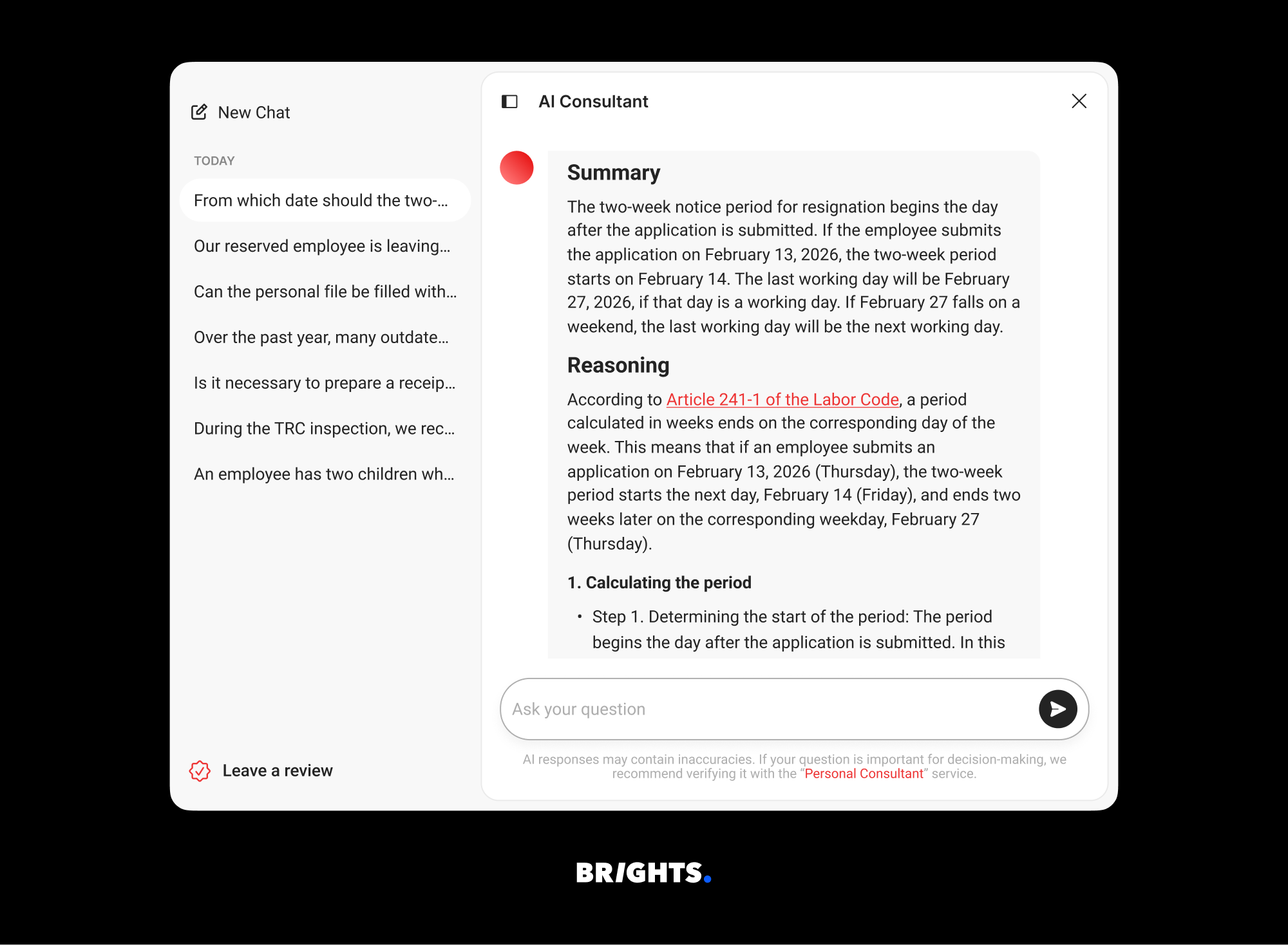
Proof of concept first. We tested the approach as a Telegram bot. The client's experts scored it on 250 real questions and rated 80% of the answers excellent.
Answers grounded in the client's data. A multi-agent system with retrieval-augmented generation (RAG) draws on the client's knowledge base, which updates as laws and rules change.
A clear path to a person. Human consultants step in when users need clarification or personal advice.
Results. The MVP launched on both platforms in three months. It handles thousands of questions around the clock, replies in under 90 seconds, and runs at 99%+ availability.
A hotel or travel platform needs the same foundation: a validated proof of concept, answers drawn from its own booking and property data, and a reliable handoff to staff.
Generative AI in travel and hospitality changes two things at once: how travelers find and book trips, and how companies produce the content and answers those trips depend on.
Booking is moving into AI interfaces
For 20 years, online booking meant a search form with filters. Travelers now describe what they want in a sentence and expect an assistant to do the filtering. The large platforms have moved quickly to be inside those conversations:
| Date | What happened | Why it matters for travel software |
|---|---|---|
| August 27, 2026 | Google began rolling out hotel booking inside AI Mode in the US with five OTAs and five hotel chains, including Marriott, Hilton, IHG, Choice, and Wyndham | The hotel or booking platform stays merchant of record and handles service. The integration does the selling. |
| March 2026 | Alibaba's Fliggy released a tool that lets any AI agent search and book its catalog. Marriott got dedicated commands for its hotels and packages. Every other hotel goes through a five-field room search | An agent can sell an afternoon tea or spa package only if the data behind it is exposed. |
| October 6, 2025 | Expedia launched an app inside ChatGPT, returning live prices, availability, and maps in the chat | The first wave of conversational distribution ran through OTAs. |
The Fliggy example is the one worth reading twice. Through the shared search, an AI agent sees a hotel as a star rating, bed type, price, property type, and distance to an attraction. The terrace bar, the Sunday brunch, and the spa that sells out on weekends are invisible. Marriott's dedicated commands let the agent sell those outlets as bookable products.
For anyone building booking software, the lesson is practical. AI agents can only sell what your APIs expose. Inventory, rates, packages, policies, and content need to be structured, up to date, and machine-readable, not just for people browsing a website.
Generative AI behind the scenes
Most of the generative AI value today sits away from the guest. Among European hotels that use AI, 74% use content tools and 44% use online review analysis, per the HES-SO survey. Typical uses include:
Content at scale: room descriptions, offer pages, and email campaigns in many languages, drafted by AI and edited by people
Review analysis: grouping thousands of reviews by theme so managers see what guests complain about and where
Staff copilots: answering staff questions about SOPs, policies, and systems so new hires get up to speed faster
Reply drafting: first drafts of responses to reviews and guest emails, approved by staff before sending
Company-wide chatbots and copilots spread quickly, but their gains are hard to measure. The measurable value sits in travel-specific use cases connected to booking and operations systems.
AI in hotel and travel operations
Operations is where AI saves money rather than earning it, and the savings come from the same source as the revenue gains: better forecasts acted on faster.
Hotel operations run on hundreds of small decisions a day. Which room goes to which guest? How many housekeepers does Thursday need? Is the chiller about to fail? McKinsey identifies four places where AI agents can take on those decisions:
Room allocation that considers guest preferences, loyalty tier, and feedback from past stays, drawn from the customer data platform
Predictive maintenance that plans repairs from smart sensors, maintenance logs, housekeeping notes, and guest feedback before something breaks
Housekeeping task management that assigns rooms dynamically based on staffing, departure times, and room status
Menu engineering that adjusts food and beverage offers and prices to demand and margins, and orders stock ahead of time
In travel operations more broadly, the same logic applies to rebooking during disruptions, processing refunds, and issuing vouchers. These are high-volume, rule-heavy tasks where an agent can act within limits a person sets, and frontline staff can spend their time on the traveler whose trip just fell apart.
The business case is easy to see in the cost of the status quo. In the Access Hospitality research, US hoteliers estimated that 14% of their operating expenses are wasted because their systems don't connect. Operational AI only removes that waste when it can read from the PMS and write tasks back into the tools staff already use.
Integration of artificial intelligence: why architecture matters more than models
The integration of artificial intelligence into travel software rarely fails because the model is weak. It fails because the model can't access the data it needs or act within the systems where work happens.
Travel data is spread across many vendors and systems with no shared owner, which makes personalized, real-time answers hard to deliver at scale .
Five architecture decisions separate AI that pays back from AI that becomes one more tool to log into:
One guest record across systems. Match the same guest across the PMS, CRS, CRM, booking engine, and POS, so personalization and service draw on one profile instead of five partial ones.
Event-driven data flow. Push bookings, cancellations, check-ins, and payments as events the moment they happen. A nightly export can't support real-time pricing or a chatbot that knows a room just became free.
APIs that AI agents can use. Expose inventory, rates, packages, policies, and actions (book, modify, cancel, create task) through documented APIs. This is what lets your own assistant, and third-party platforms such as Google AI Mode, transact with your system.
Grounded answers. Connect language models to your property data and policy documents through retrieval, so answers cite the source of truth and the model doesn't fill gaps with guesses.
Guardrails and human approval. Set price floors and ceilings, approval thresholds for refunds and exceptions, and clear escalation paths. Log every automated decision so staff can review and correct it. For a step-by-step view of the process, see our guide on how to integrate AI into SaaS platforms.
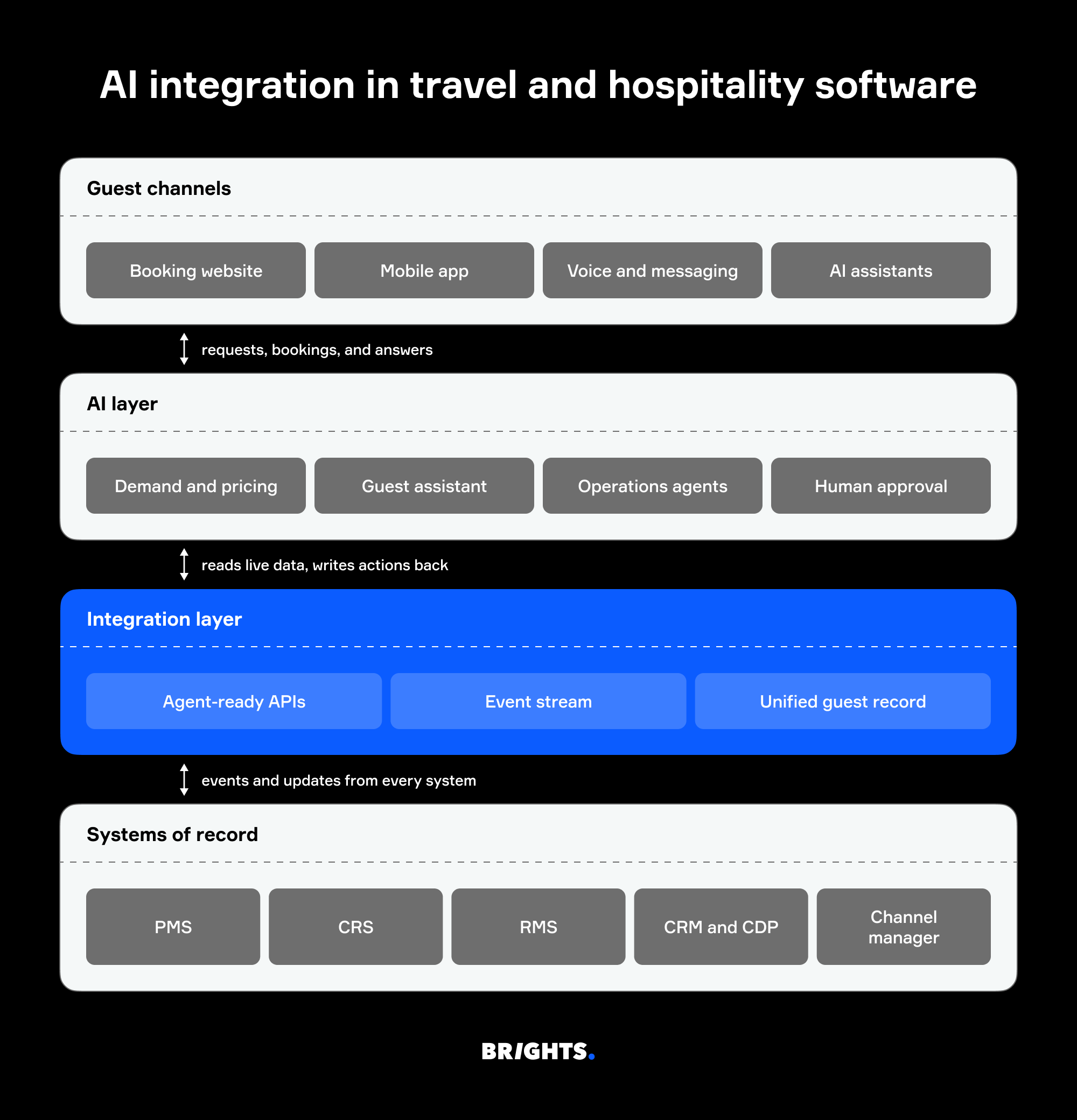
Guest channels and AI features sit on top of one integration layer, which reads from and writes to the systems of record. Without that middle layer, each AI tool needs its own connection to every system.
Data protection is part of the architecture
Guest profiles hold names, contact details, payment data, travel patterns, and sometimes health or accessibility information. Plan consent management, data minimization, retention rules, and vendor access controls before scaling any AI feature. GDPR applies to every guest who is an EU resident, regardless of where the hotel is located, and PCI DSS governs any flow that touches card data. Security certifications such as ISO/IEC 27001 are a reasonable baseline to ask of any vendor that will process guest data.
Adoption barriers and how to get past them
The main blockers are knowledge, cost, and integration, not enthusiasm. Hoteliers most often cite poor knowledge of available solutions, high setup costs, technical complexity, and missing skills.
Each barrier has a practical way through:
| Barrier | What it looks like in practice | How to get past it |
|---|---|---|
| Unclear options | Teams can't tell which vendor tools fit their stack or which problems AI solves well | Start from one costly, measurable problem and evaluate tools against it |
| Setup cost and unclear ROI | Pilots launch without a baseline, so nobody can prove they worked | Record the current metric (response time, RevPAR, labor hours) before the pilot starts |
| Legacy systems | The PMS has limited APIs, data sits in exports, and every new tool needs custom work | Modernize where needed, build an integration layer once, and connect AI tools to it, not to each system separately |
| Skills gap | No one in-house can configure, monitor, or improve models | Partner with a dedicated team for the build, and train internal owners to run and adjust the system |
| Privacy and trust | Legal and IT block guest-facing AI over data concerns | Bring compliance into scoping, and keep humans in the loop for sensitive decisions |
| AI fatigue | Staff get vague instructions to "use AI" with no clear purpose | Roll out a few tools with a defined job, and drop the ones nobody uses |
There is one more barrier that no tool removes: the worry that automation will erode hospitality itself. The hotels getting value from AI use it to take repetitive work off staff, not to take staff away from guests.
The future of AI in hospitality: four shifts to plan for
The future of AI in hospitality is less about new models and more about where AI sits in the business: who it acts for, what it can touch, and which channels it books through. Four shifts are already visible.
1. From assistants who advise to agents who act
Generative AI answers questions. Agentic AI completes tasks: it rebooks, reprices, assigns, and orders within limits people set. Adoption is still early. Only 2% of travel executives in the McKinsey and Skift survey say agentic AI is widespread in their organization. Expect the first scaled uses in internal workflows, such as disruption handling, refunds, and housekeeping, where mistakes are cheaper and outcomes easy to measure.
2. AI agents become a booking channel
Google's AI Mode, ChatGPT apps, and Fliggy's agent tool turn AI assistants into a new distribution layer. Google's Universal Commerce Protocol (UCP) for Lodging is an open standard for agentic hotel booking, and it keeps the hotel as a merchant of record with ownership of guest data and the post-booking relationship. Properties and travel platforms that expose clean, structured inventory and packages through APIs will be easier for agents to recommend and sell.
3. Total revenue replaces room revenue
As revenue systems connect to CRM, POS, and event data, pricing extends from rooms to everything a guest can buy. The commercial question shifts from "what should tonight's rate be?" to "what is this guest worth across the stay, and which offer should she see now?"
4. People move to the moments that need them
As AI absorbs routine calls, messages, and admin, staff time shifts toward in-person service and problem-solving. McKinsey's travel team frames it as AI changing how travel is delivered rather than why people travel. The service moments, memories, and relationships remain human work.
None of these shifts depend on a specific model. They depend on connected data, open APIs, and clear rules about what AI may decide on its own, which is why the build-or-buy question matters now.
How to introduce AI solutions into travel and hospitality software
Start with one business problem, connect the data it depends on, then expand. Companies that start with a tool and look for a problem to solve tend to end up with pilots that never scale.
Buy, build, or combine
Most companies end up with a mix: commercial AI tools where their workflows are standard, custom development where their data, logic, or distribution is what sets them apart.
| Factor | Off-the-shelf AI tool | Custom AI development |
|---|---|---|
| Best for | Standard tasks: guest messaging, review analysis, basic dynamic pricing | Proprietary logic: custom pricing rules, packages, multi-brand or multi-property workflows |
| Time to value | Weeks | Months, starting with an MVP |
| Integration | Pre-built connectors to popular PMS and CRS platforms | Any system, including legacy and in-house platforms |
| Data ownership | Data and models sit with the vendor | Data, models, and logic stay with you |
| Differentiation | Competitors can buy the same tool | Built around how your business sells and operates |
| Ongoing cost | Subscription per property, room, or user | Maintenance and a development team or partner |
A common pattern is to buy AI point tools and build the integration layer that connects them. That keeps you free to swap vendors without rebuilding your data foundation each time.
Read also: Build or buy software
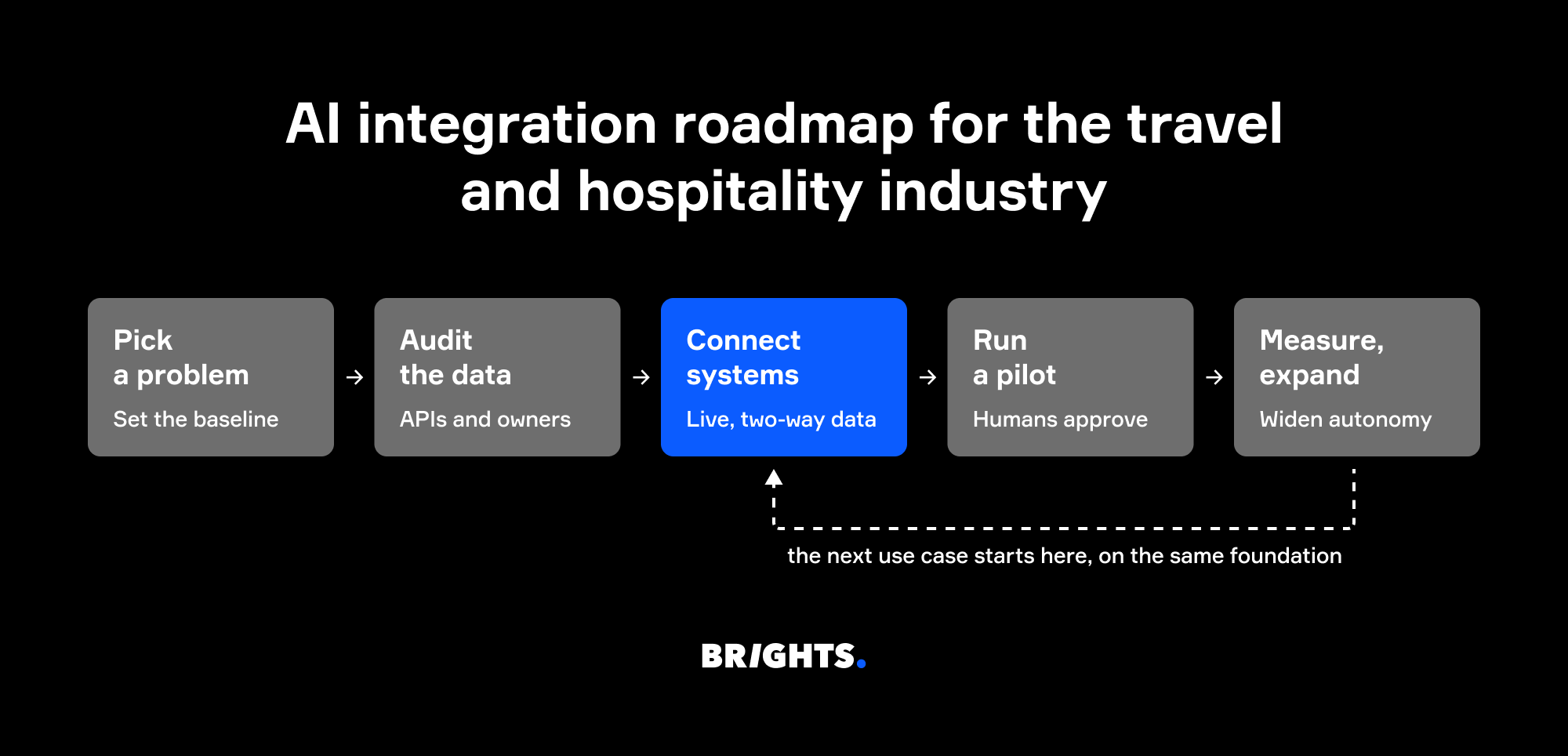
A phased roadmap
Pick one measurable problem. Slow guest response times, manual repricing, or high labor cost per occupied room. Record the current baseline.
Audit the data it needs. List the systems involved, what their APIs allow, how fresh the data is, and who owns it.
Connect before you automate. Build or fix the integrations so the AI reads live data and can write results back.
Launch a narrow pilot with humans in the loop. One property, one channel, or one segment, scoped like an MVP. Staff approves AI decisions until accuracy is proven.
Measure against the baseline, then widen autonomy. Raise approval thresholds where the AI performs, and add the next use case on the same data foundation.
How Brights can help
Brights builds custom booking systems and travel and hospitality software, and integrates AI into the platforms our clients already run. We start with the business problem and the data behind it, then build the integration layer, APIs, and AI features that act on it.
Our work in this space covers:
Booking system development: booking engines, reservation management, and resource and room booking built around how your customers actually book
AI integration services: connecting AI tools and models to your PMS, CRS, CRM, and channel manager, with the guardrails and approval flows your team needs
Custom AI development: recommendation engines, pricing and forecasting models, and assistants grounded in your own data
Data analytics and application modernization: unifying guest and booking data, and moving legacy platforms to architectures that AI can work with
Since 2011, Brights has launched more than 300 projects for clients in more than 30 countries. 89% of our clients continue working with us past the first contract, 88% of our team is mid-level or senior, and we hold a 5.0 rating on Clutch. Brights is ISO/IEC 27001 certified, so guest data stays protected across every integration we build.
References
Disconnected systems cost US hoteliers over 40 working days a year in "toggle tax”
In China, the AI agent can already sell Marriott's afternoon tea
Remapping travel with agentic AI by McKinsey & Company and Skift
Global Market Insights: Hospitality revenue management and pricing analytics market
BluIP launches AIVA 3 with proven 75%+ reduction in front-desk call volume
Hotel Tech Report: 16.9% RevPAR increase: Atomize at Best Western Borås
Hotel Tech Report: Fewer calls, better service: Canary AI at The Pines Resort
Market Intelo: AI-powered hotel revenue management systems market report 2034
MarketsandMarkets: Artificial intelligence in tourism market worth $13.38 billion by 2030
Artificial intelligence (AI) in travel global market report 2026
FAQ.
The most common uses of AI in the hospitality industry are content generation, revenue management, dynamic pricing, guest personalization, predictive analytics, review analysis, and guest messaging. Among European hotels that use AI, 74% use content tools and 42% use real-time revenue management. Operational uses such as housekeeping, scheduling, and predictive maintenance are growing.


