Trusted SaaS Development Companies: A Curated List

Choosing among trusted SaaS development companies gets difficult once you move past sales pages and generic case studies. With hundreds of SaaS software development companies on the market, how do you know who can design the architecture that will hold up? Or has experience handling relevant types of SaaS and can ship your MVP without leaving technical debt behind?
Evaluation criteria for selecting a SaaS development company
When you compare top SaaS development companies, the difference rarely comes down to tech stacks or hourly rates. Most SaaS software development companies can work with the same tools. The real differences show up in how a vendor designs systems, structures delivery, and handles trade-offs early in the product lifecycle.
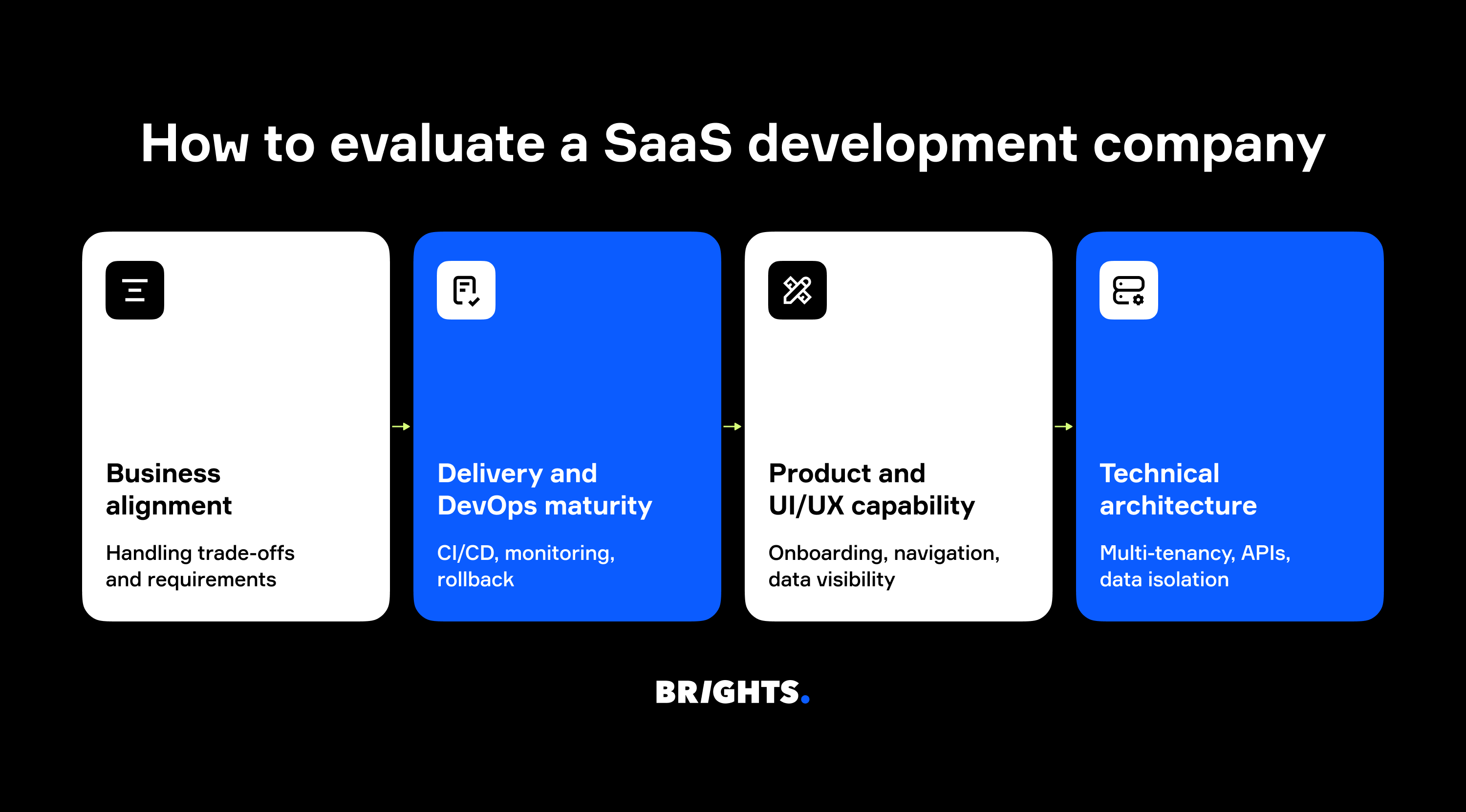
Technical architecture
A reliable SaaS development company should be able to explain how your product will handle growth before development starts. This includes:
Multi-tenant design
Data isolation
API structure
How services communicate
For example, if your product relies on third-party APIs or processes large volumes of data, the system must account for rate limits and failure scenarios from the beginning.
Product and UI/UX capability
You will see the difference in how a vendor approaches MVP scope. Some implement requested features as-is, while others map user flows, identify gaps, and adjust the scope before development starts.
In SaaS products, onboarding, navigation, and data visibility all affect how users adopt the product, especially in B2B tools where workflows are more complex. This is where SaaS design companies differ from vendors that only focus on implementation.
Delivery and DevOps maturity
Look at how the vendor delivers changes over time. Ask how deployments are handled, how environments are separated, and how issues are detected after release. Experienced SaaS application development companies typically have a defined CI/CD process, monitoring in place, and a rollback strategy.
This level of delivery discipline usually comes from experience in SaaS software consulting, where long-term system behavior matters as much as initial implementation.
Business alignment
Finally, look at how the vendor handles incomplete or conflicting requirements. In SaaS product development, a new feature can change how access control works or require adjustments to existing integrations, so ask how they handle that situation. Do they implement the request as written, or do they pause and explain how those changes affect the system and future features? This will tell you how often you’ll need to revisit and modify parts of the system as the product evolves.
At this point, you can start looking at actual vendors. Here are six SaaS software development companies to begin with.
A curated list of trusted SaaS development companies
Even top SaaS development companies offer similar services on paper. But look closely, and you’ll see the differences in how they design architecture for SaaS startups, handle product decisions, and support systems after launch.
We selected the companies below based on their experience building SaaS platforms, public case studies, and delivery models. Each one reflects a different approach to SaaS product development, from early-stage MVP work to long-term platform scaling.
BairesDev
Location: USA (HQ), distributed engineering teams across Latin America
Team size: 4,000+ engineers and specialists
Core SaaS expertise: SaaS platform development, backend systems, cloud infrastructure, integrations
Industries served: fintech, healthcare, e-commerce, enterprise software
Engagement model: dedicated teams, staff augmentation, long-term development
Average hourly rate: $50 - $99
What makes BairesDev stand out
BairesDev is often included among the top SaaS development companies in the USA when products need to run under constant load and still respond quickly. They split heavy operations like report generation or data processing into background jobs, so user requests don’t get blocked. That keeps the product responsive even during spikes. They also plan how services run across regions when latency or data residency becomes a factor.
Test coverage and monitoring stay close to what happens in production, so issues show up early. This allows frequent releases without destabilizing the product as it grows.
BairesDev expertise
Supported SaaS platforms with active users where ongoing development required coordinating changes across multiple services without interrupting existing functionality.
Worked on SaaS systems that depend on integrations, including external APIs, where handling failures and maintaining data consistency required changes to service communication.
Extended engineering capacity for SaaS products with frequent releases, where new contributors had to follow existing patterns to avoid inconsistencies in shared components.
Net Solutions
Location: Canada (HQ), distributed teams across North America and Asia
Team size: 400+ engineers and specialists
Core SaaS expertise: SaaS product development, cloud-native apps, product design, integrations
Industries served: e-commerce, education, healthcare, media, enterprise software
Engagement model: product development partnerships, dedicated teams, long-term collaboration
Average hourly rate: $25 - $49
What makes Net Solutions stand out
Net Solutions focuses on how SaaS products handle account structure and subscription logic early on. Their projects often include SaaS products with multiple pricing tiers, where feature access, usage limits, and permissions differ across customers. They implement this logic in the backend, so access is determined by the user’s plan and updates automatically when the plan changes.
Billing, access control, and product behavior are defined together instead of being handled separately. That setup makes it easier to support different customer segments without adding manual steps or revisiting core logic every time plans or features change.
SaaS expertise
Delivered SaaS platforms with subscription and billing logic where user access depended on pricing tiers and account state.
Built SaaS products with configurable workflows, where business rules controlled how data moved between modules.
Worked on multi-tenant SaaS applications where each customer required isolated data with shared infrastructure and consistent performance.
STX Next
Location: Poland
Team size: 500+ engineers and specialists
Core SaaS expertise: Python development, backend systems, data processing, cloud platforms
Industries served: fintech, healthcare, logistics, marketplaces
Engagement model: dedicated teams, long-term development, staff augmentation
Average hourly rate: $50 - $99
What makes STX Next stand out
STX Next focuses on SaaS products where data processing lies at the core of the product. Their projects often include platforms that collect large volumes of data, run scheduled jobs, or generate reports that take time to compute. STX Next separates these workloads from user-facing requests, for example, by running background jobs for data aggregation or model training, so users don’t wait on heavy operations.
This setup works well for products with analytics, forecasting, or machine learning features used daily. It keeps the interface responsive while the system continues processing data in parallel as usage grows.
SaaS expertise
Built Python-based SaaS platforms where performance depended on how data is processed and transferred between services.
Worked on products with external APIs where handling rate limits and failures required changes to service communication.
Supported long-term development of SaaS systems with frequent releases, where multiple engineers worked on shared components and needed consistent implementation patterns.
Langate
Location: USA (HQ), with engineering teams in Eastern Europe
Team size: 150+ engineers and specialists
Core SaaS expertise: SaaS platform development, healthcare systems, data processing, integrations
Industries served: healthcare, fintech, logistics, enterprise software
Engagement model: dedicated teams, full-cycle development, long-term partnerships
Average hourly rate: $50 - $99
What makes Langate stand out
Langate focuses on SaaS products where data accuracy and reliability are critical, especially in regulated environments like healthcare. They define how data is validated, stored, and exchanged across systems, including how the platform handles updates, inconsistencies, and external inputs, ensuring the system remains consistent as it scales and integrates with other services.
SaaS expertise
Delivered healthcare SaaS platforms where data accuracy and consistency were critical across integrated systems.
Worked on SaaS products with complex data models, where multiple services interacted with shared records and required clear validation rules.
Built platforms that rely on external integrations, where maintaining consistent system state required handling asynchronous updates and data conflicts.
AnyforSoft
Location: Ukraine (HQ), with distributed teams across Europe
Team size: 80+ engineers and specialists
Core SaaS expertise: SaaS platform development, CMS-driven applications, web platforms
Industries served: media, education, non-profit
Engagement model: full-cycle development, dedicated teams, long-term collaboration
Average hourly rate: $25 - $49
What makes AnyforSoft stand out
AnyforSoft focuses on SaaS products where content drives the product experience. They define how content is structured, stored, and delivered across the system, ensuring it stays consistent and responsive as users interact with it. This is particularly important for platforms with dynamic content, personalization, or frequent updates, where delays or inconsistencies directly impact usability.
SaaS expertise
Built SaaS platforms for media and content-heavy products where performance depended on how quickly content could be delivered and updated.
Worked on CMS-driven SaaS applications where structured content needed to be reused across multiple interfaces and user flows.
Developed e-learning and engagement platforms where user activity and content interactions had to remain consistent across sessions.
Brights
Location: Ukraine (with clients across Europe and the USA)
Team size: 120+ engineers and other specialists
Core SaaS expertise: SaaS platform development, system architecture, AI features, web apps
Industries served: fintech, insurtech, edtech, analytics platforms, telematics, e-commerce
Engagement model: full-cycle product development, long-term partnerships
Average hourly rate: $25 - $49
What makes Brights stand out
Clients select Brights when they need to define early how the system will handle traffic spikes, background jobs, and growing data volume. This includes platforms that process user-generated data, rely on external APIs, or require predictable response times as usage grows, which is why Brights is often considered among the top development companies for AI features in SaaS.
Brights focuses on structuring systems before complexity increases. For example, when building a SaaS platform that collects and processes data from multiple sources, they define how data moves between services, how failures are handled, and how workloads are distributed. This reduces the risk of bottlenecks when new features are introduced or when usage increases.
SaaS expertise
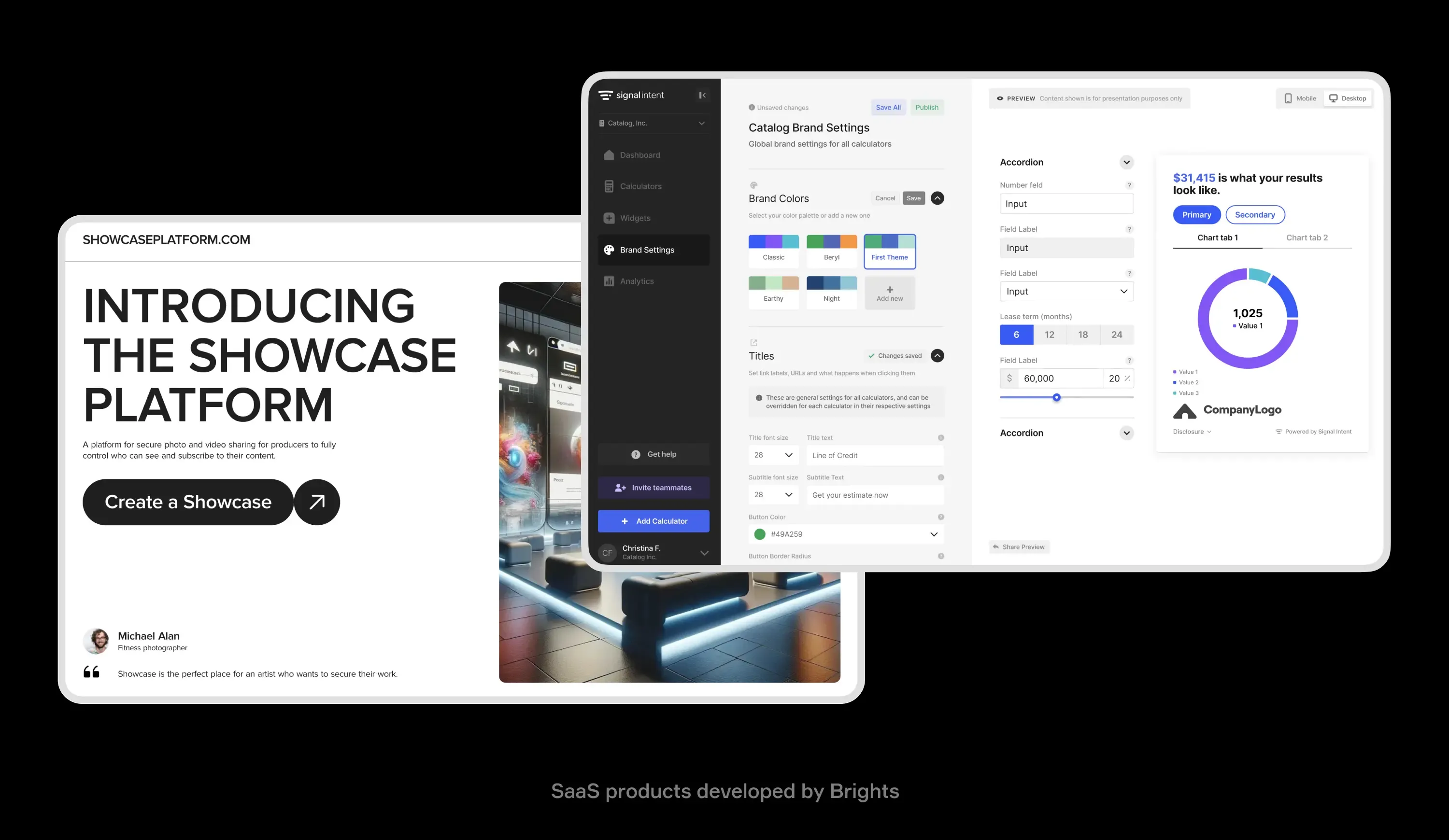
SignalIntent: Built a customizable financial calculator platform — from the admin interface and formula configuration to real-time analytics and lightweight embeddable widgets that integrate into any webpage without developer involvement.
NovaAssure: Developed a centralized IoT management platform that unified devices from different manufacturers into a single dashboard, with real-time monitoring, geofencing, access control, and dynamic reporting across web and mobile.
Showcase: Built the platform infrastructure for a creator-focused website builder — including digital watermarking for IP protection, a Stripe-based subscription and paywall system, and scalable media delivery via AWS.
Explore our case studies to see the full range of software products we’ve worked on.
Red flags when choosing a SaaS development vendor
You can spot problems early just by how the first conversations go. A vendor jumps to timelines before understanding the product, gives short answers when you ask about integrations, or keeps the discussion at the feature level? This gives you plenty of information about how they approach decisions.
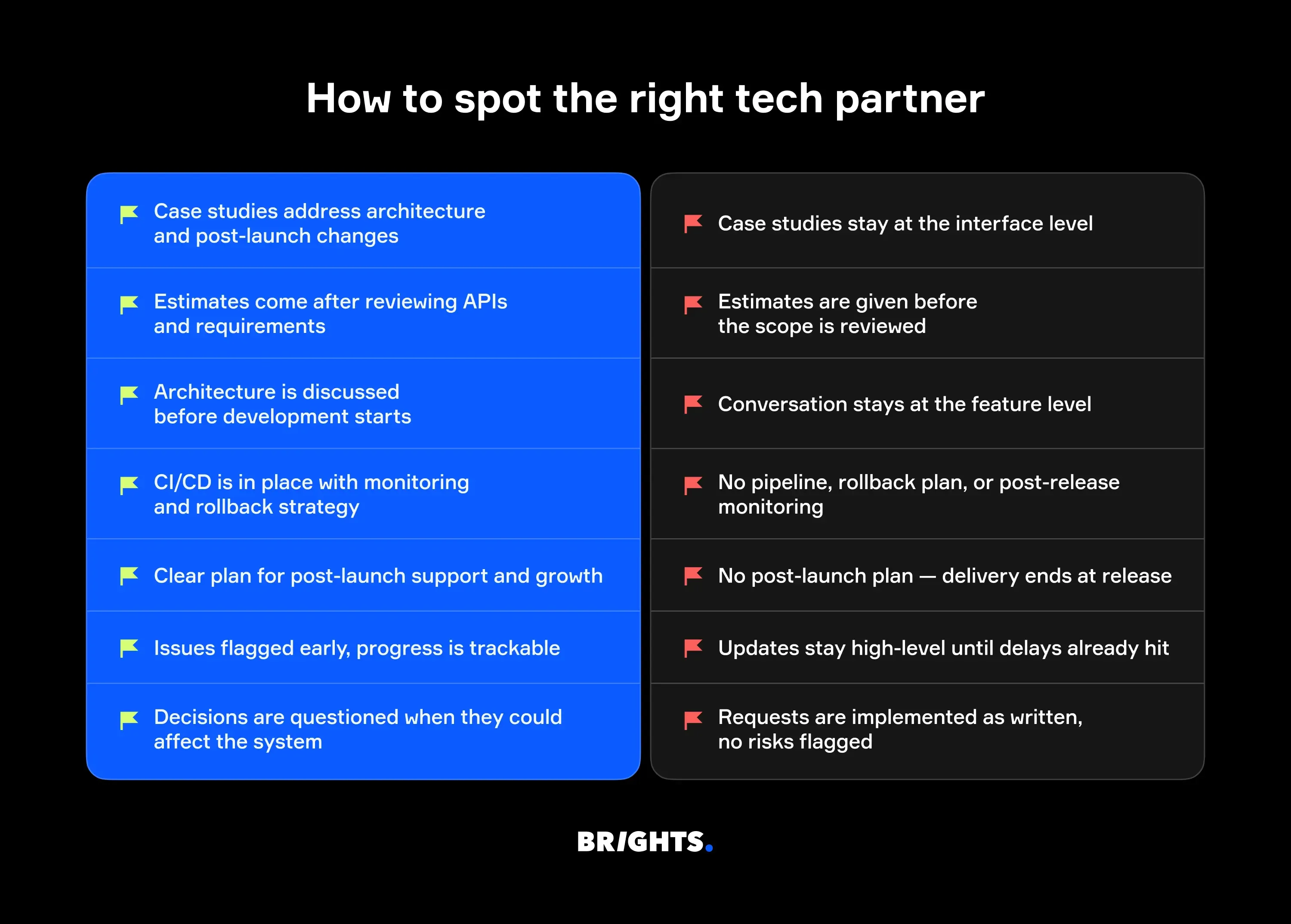
From there, the gaps become more visible:
No real SaaS case studies. You ask how the system handled users or integrations, and the answer stays at the interface level.
Timelines fixed too early. Estimates are given before anyone looks at APIs, data structure, or edge cases.
Architecture is never discussed. The conversation stays around features, with no explanation of how services connect or how the system behaves under load.
Releases depend on manual steps. No clear pipeline, no rollback plan, no monitoring after deployment.
Delivery ends at launch. No plan for updates, fixes, or handling growth after the first release.
Progress is hard to verify. Updates stay high-level, so issues become visible only when delays already happen.
Another thing you’ll notice is that generic vendors follow instructions with no questions asked, but the best SaaS application development companies offer their expertise and question the decisions that they know won’t work.
How to shortlist the right SaaS development partner
A trusted SaaS development company should be able to walk you through how a real product changed after it went live. Not just what was built, but what had to be adjusted once users started using it.
For example, how they handled increased load, where the system failed, and what they had to redesign to keep it stable. This matters whether you're building internal tools or planning website development for SaaS companies with external users.
When you evaluate vendors, focus on a few things that are hard to fake:
Ask how a recent SaaS product handled growth. What exactly changed in the architecture?
Pick one project and ask what broke after launch and how they fixed it.
Look at how they manage releases. How often do they deploy, and what happens when something fails in production?
Ask how multiple engineers work on the same system without introducing inconsistencies.
These questions show how decisions are made under pressure, which matters more than a shiny portfolio page. And if you want a second opinion at this stage, Brights can review your SaaS architecture or run a discovery workshop before development starts.
Conclusion
Choosing a SaaS development company affects how often you’ll need to revisit core parts of your system. In some projects, adding a feature stays local. In others, the same change touches billing, access control, and integrations because of how the system was structured from the start.
To assess how a vendor handles real-world issues, ask what broke after a launch, what had to be rebuilt, and why. Check how they handled API limits, data inconsistencies, or overlapping changes across services. The best SaaS development companies of 2026 can walk through these situations in detail, without staying at the feature level.
If you want to see a top SaaS vendor in practice, contact Brights to book a discovery call.
FAQ.
A trusted SaaS development company shows how its systems work after launch, not just what was built. Look for a proven SaaS portfolio, clear architecture decisions, and consistent delivery practices. The best SaaS development companies explain trade-offs, not just features.


