Top-Rated SaaS Design Agencies to Elevate Your Product

The best SaaS design companies know how to go beyond creating visually impressive interfaces — they design products that convert, retain, and scale. The challenge is that SaaS requires different thinking than other digital products. A poorly designed onboarding flow can increase churn, and confusing navigation drives up support costs. After all, your interface is the product's core experience, directly tied to activation rates and revenue growth.
At Brights, we approach SaaS web design as a business problem rooted in understanding how your users think and what they expect from your product. Our process combines full-cycle technical expertise with iterative, user-centered design: running usability tests, analyzing behavior patterns, and refining interfaces based on real feedback rather than assumptions.
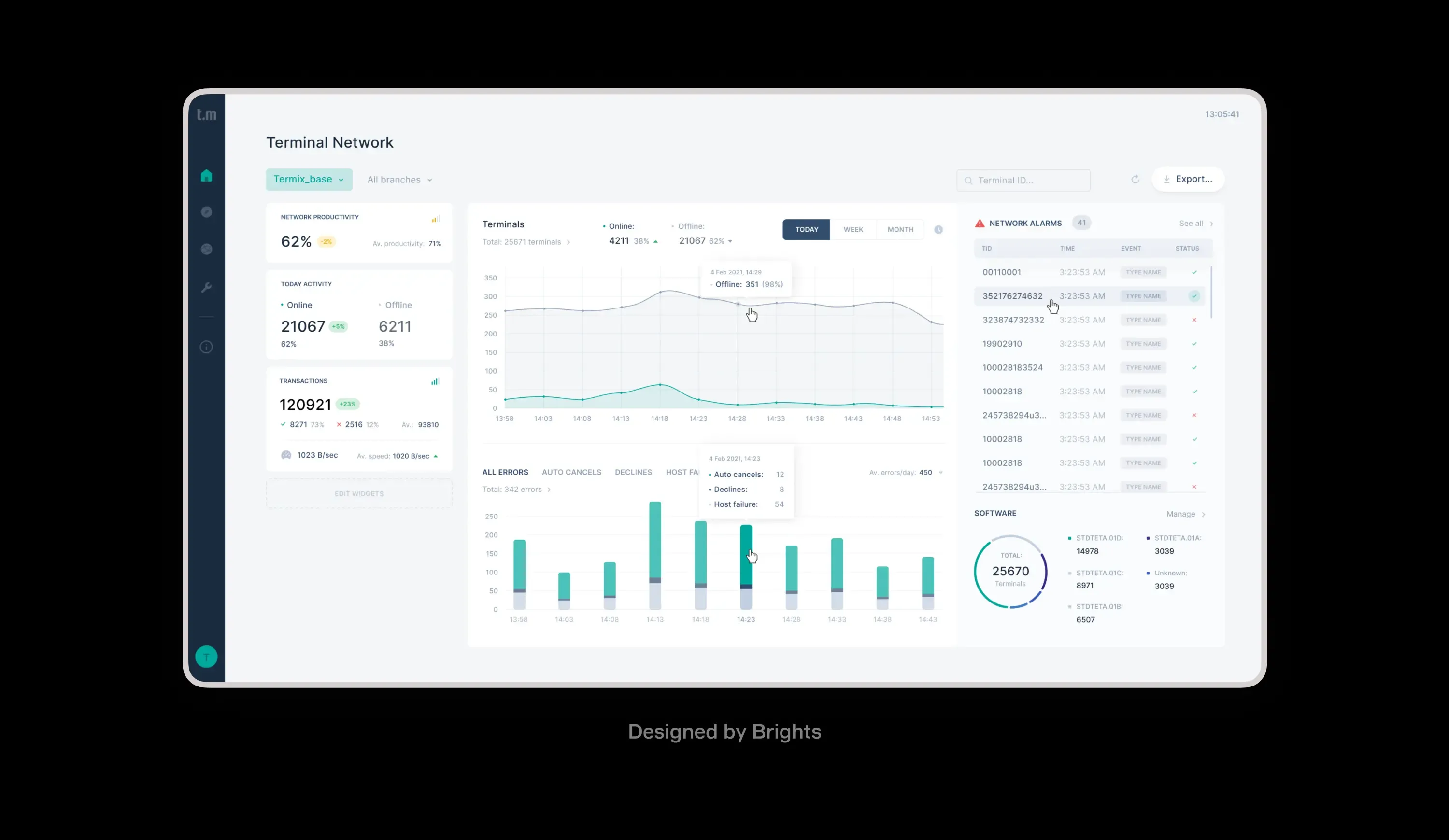
Delivering projects like Nova Assure and Termix, we've guided teams building SaaS MVP solutions from validation through growth stages, creating something that not only solves problems but keeps users engaged over time.
This guide will show you exactly what to look for in a SaaS design partner — and what red flags to avoid.
Key takeaways
SaaS design directly impacts activation rates and churn: poorly designed onboarding flows and confusing navigation drive users away and increase support costs.
It’s crucial to look for agencies with documented SaaS experience who can explain specific design patterns, trade-offs, and metrics they've improved.
SaaS design agencies fall into different pricing tiers: budget ($25-49/hour), mid-tier ($50-99/hour), and premium ($100-199/hour), with quality available at every level depending on location and specialization.
Designers who don't understand your tech stack often end up creating mockups that cost 3x the estimates to build. Technical capability matters as much as visual skills.
Evaluating your options: SaaS design company comparison
When evaluating SaaS design companies, the details that matter most are often buried in lengthy case studies. This comparison breaks down six agencies across the criteria that impact your decision: pricing, delivery speed, team capabilities, and verified track record. The data comes from Clutch profiles, company websites, and publicly available project documentation
| Company | Clutch rating | Hourly rate | MVP timeline | Services | Expertise |
|---|---|---|---|---|---|
| Brights | 5.0/5 | $35-50/hr | 3–4 months | Full-cycle (design, frontend, backend, mobile, cloud) | 14+ years, 300+ projects, 24 industry awards, ISO certified |
| Halo Lab | 4.9/5 | $25-49/hr | 2–4 months | Full-cycle (design, development, marketing) | #1 on Dribbble, 20 Awwwards, 70+ total awards |
| Eleken | 4.9/5 | $25-49/hr | 2–3 months | Design only (SaaS focused) | 10+ years, 150+ SaaS clients exclusively |
| Cieden | 4.9/5 | $50-99/hr | 3–4 months | Full-cycle with B2B focus | 9 years, 200+ projects. Apollo, Activision Blizzard |
| Goji Labs | 5.0/5 | $100-149/hr | 12–16 weeks | Full-cycle (React, React Native, Node.js, Python) | 11 years, 400+ products, clients raised $1B+ combined |
| Clay | 4.8/5 | $150-199/hr | 4–5 months | Full-cycle premium (design, dev, mobile, AI/AR) | 12+ years. Slack, Stripe, Salesforce, Coinbase |
The comparison table covers the spectrum from budget-friendly to premium, design-only to full-cycle development. You can use it to narrow your options based on budget, service scope, and the level of SaaS specialization your product needs. The choice depends less on rankings and more on fit with your specific stage, constraints, and working style.
Brights' approach to full-cycle SaaS design and development
After 14 years and 300+ projects, we've learned what SaaS founders actually need: predictable costs, reliable delivery, and partners who understand the product challenges you're facing. That's why we structured Brights differently.
We're a 120-person team based in Eastern Europe, and the location allows us to keep an affordable rate of $35-50/hour (depending on the specialists involved) while maintaining a 5.0 Clutch rating. That pricing-to-capability ratio means we work with everyone, from early-stage startups to Fortune 500 companies like Microsoft, Samsung, Suzuki, and Philip Morris.
Our average client relationship spans 3+ years — we're always aiming for a marathon, not a sprint.
SaaS projects we've delivered
Our portfolio spans fintech, ecommerce, insurance, education, supply chain, AI, and more. We build SaaS products across diverse industries with specific technical and regulatory requirements. Apart from multiple NDA projects, recent SaaS work includes:
Showcase, a web builder for digital creators
WindowSeat, a subscriptions-based audio adventures mobile app
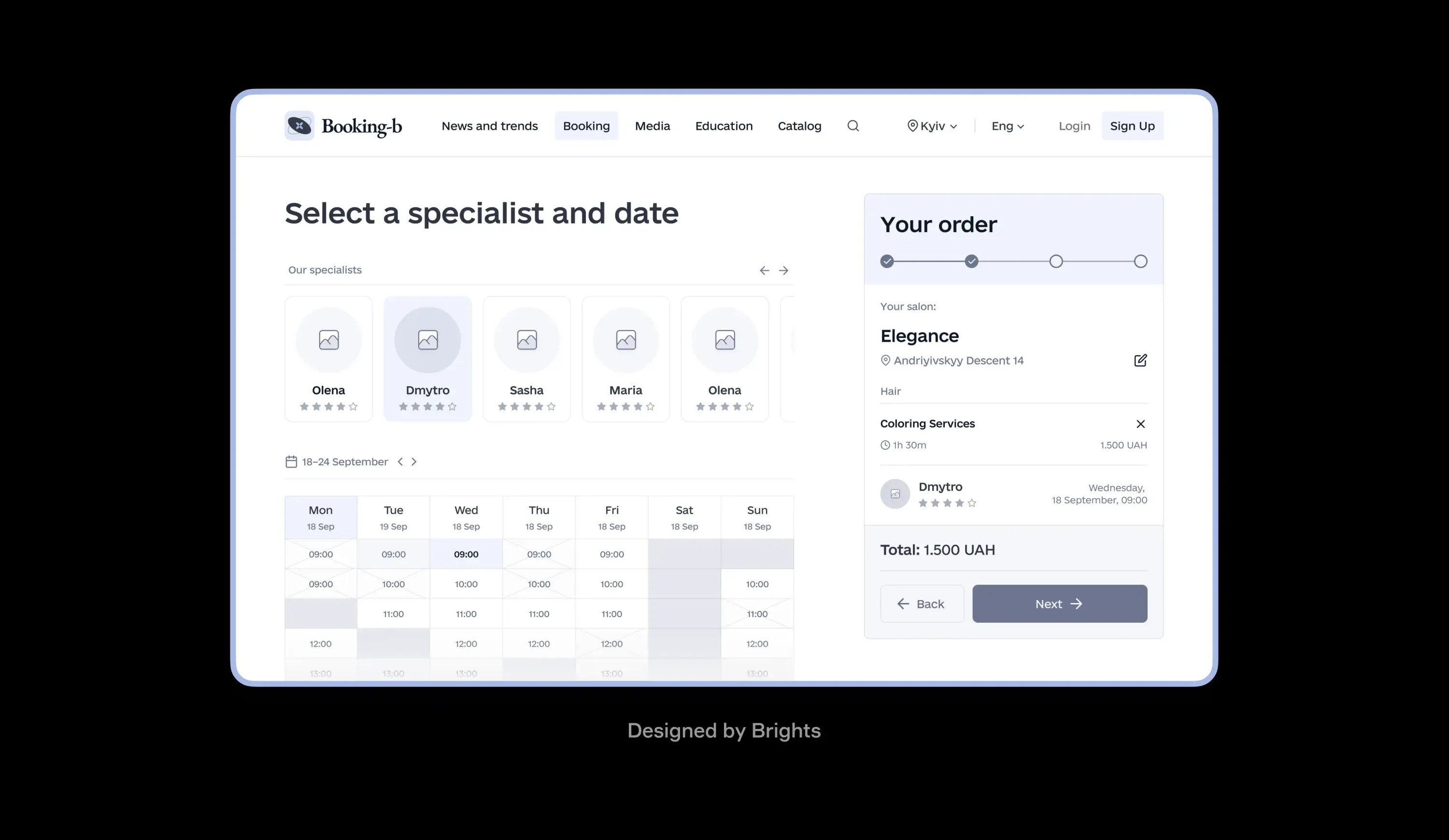
A SaaS booking system created for beauty service providers
Nova Assure, an IoT management solution
What makes our model different
We handle the full cycle: discovery, design, frontend, backend, mobile, and cloud services — no handoffs. This means designers who understand React component architecture, developers who think about UX implications, and one team accountable for results. When technical constraints affect design decisions, we solve them in real time rather than discovering problems during handoff.
What to expect working with us
We're transparent about timelines (our typical SaaS implementation roadmap spans 3–4 months for MVPs), upfront about trade-offs, and honest when something won't work. Our process starts with understanding your business model and user workflows before touching design tools. If you're evaluating where your budget goes furthest without compromising quality, we'd be happy to show you how we approach SaaS projects.
How we designed Signal Intent: A case study
Signal Intent (now Chimney) demonstrates how we approach SaaS design as a usability problem. The platform needed to let non-technical users build custom financial calculators without coding knowledge. This meant the interface itself had to be intuitive enough to replace developer involvement entirely.
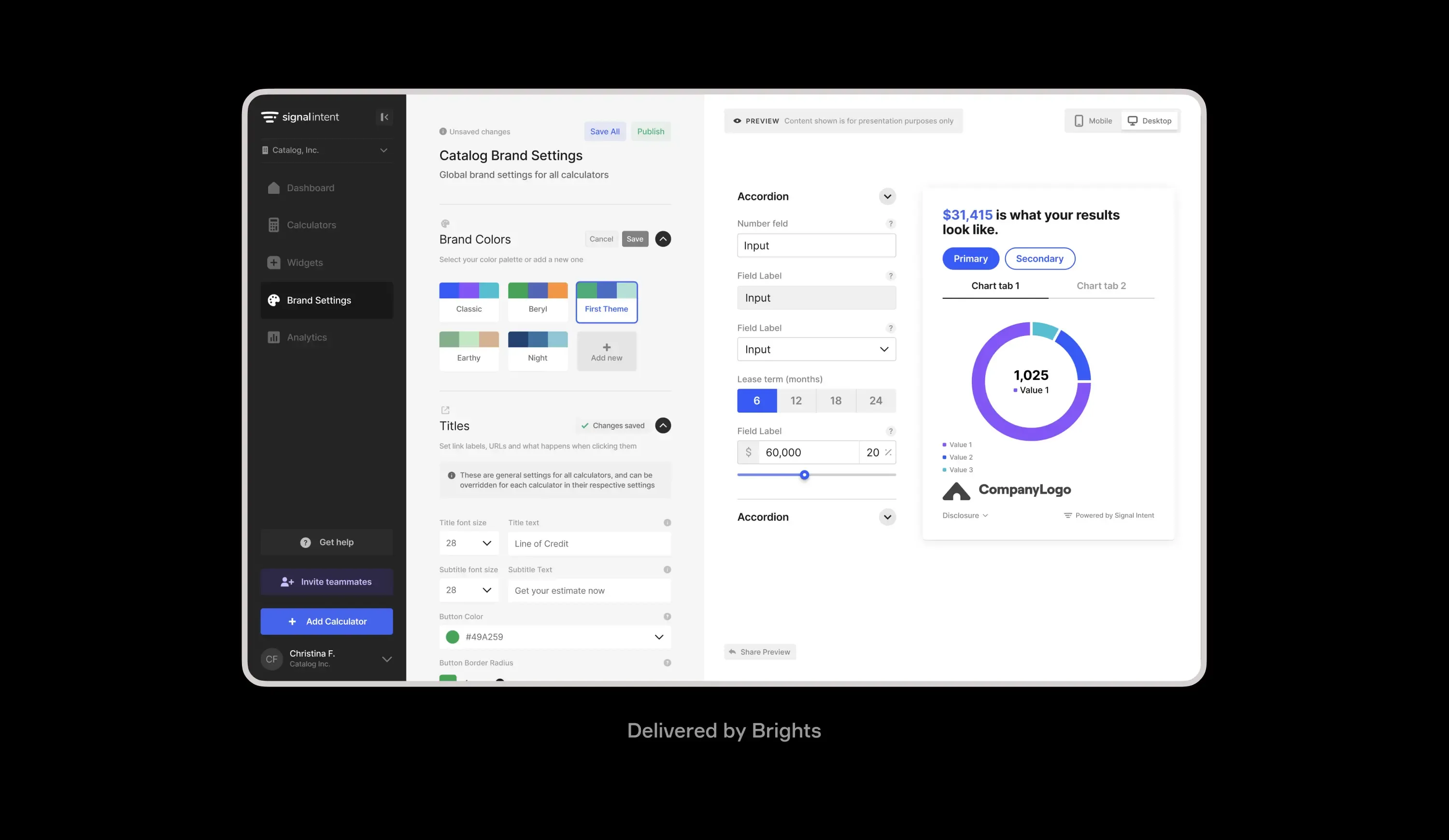
We designed a system where users could modify calculation formulas and visual branding through an admin panel, with real-time previews showing changes before publishing. The result was a platform offering over 35 calculator templates that businesses could customize and deploy in minutes.
Single-view dashboard: All configured calculators with essential analytics visible on the main screen without navigating through multiple pages, allowing users to quickly assess performance metrics;
Real-time preview editing: Intuitive calculator management interface where users modify parameters while viewing changes in the preview panel, then deploy immediately;
Corporate visual integration: Full customization with company colors, logos, and fonts, with all changes visible in real-time as users configure their calculators;
Flexible widget system: Customizable button appearance, unrestricted screen positioning, and the ability to assign different widgets to individual pages — all styled in branded colors;
Real-time analytics: Live data about audience, traffic, engagement, and conversion enables fast adjustments and data-driven decisions without delay.
Design flexibility, combined with one-click integration, transformed a technical implementation task into a simple configuration exercise, helping organizations improve customer relationships while gaining real-time analytics on user behavior.
Top SaaS design-only agencies worth considering
If you already have a strong internal development team and only need design expertise, two agencies we regularly collaborate with deserve your attention. Both Spiilka and Lazarev. agencies specialize exclusively in design, which means they can focus entirely on interface quality, brand identity, and user experience.
Spiilka Design Büro
Spiilka operates as a boutique studio of senior designers who receive Red Dot Awards almost every year. Their most notable achievement is designing Diia, Ukraine's digital government platform, which has gained over 23 million users as of 2025.
What makes them distinctive is their design director-led model. Every project receives personal guidance from a design director from initial brief through launch. Their client roster includes MacPaw, BetterMe, and other major platforms. The agency maintains a 5.0/5 Clutch rating with a $10,000 minimum project size and $50-99/hour rates.
In December 2025, Brights and Spiilka launched a pro bono project together: a redesigned website for the Maria Zankovetska Ukrainian drama theater. Our colleagues at Spiilka handled the design, while we at Brights took over the development.
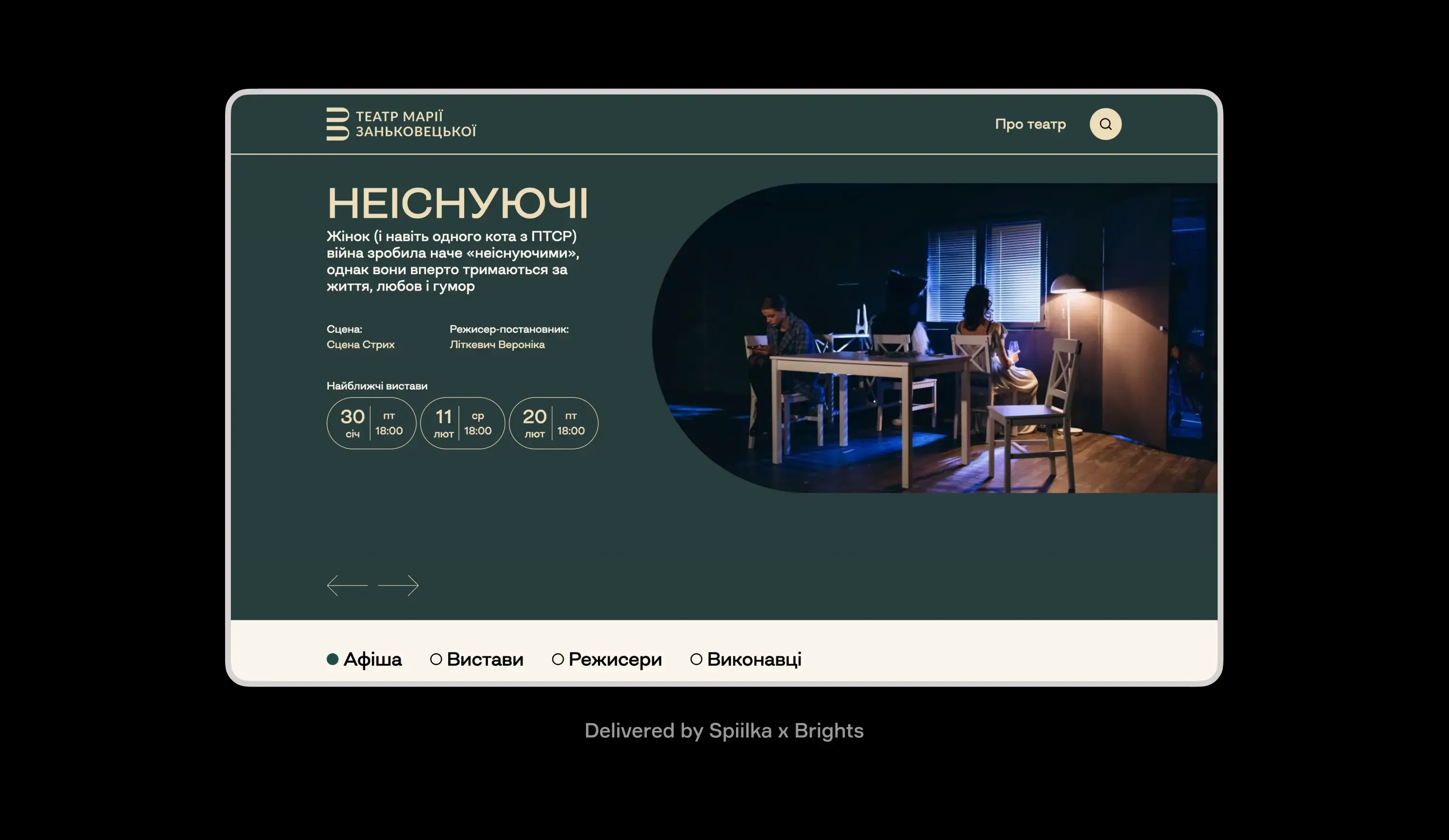
Website for Maria Zankovetska Ukrainian drama theater. Delivered by Spiilka x Brights
Lazarev. Agency
Lazarev. brings more scale with 40+ designers and positions itself as an AI-forward design agency. Their portfolio spans Fortune 500 companies (Payoneer, Hewlett Packard, Boeing) and venture-backed startups, with clients collectively raising $500M+ in funding.
The agency has earned 125+ international design awards, including Webby Awards and 15+ Awwwards Site of the Day honors. With a $50,000+ minimum and $100-149/hour rates, they sit in a higher tier but deliver corresponding sophistication and operational excellence. Their 5.0/5.0 Clutch rating consistently highlights their workflow quality.
Both Spiilka and Lazarev Agency deserve to be on the list of top SaaS website design agencies in 2026. Furthermore, they can be a perfect choice when you have development capacity in-house and want world-class design thinking. And even if you need both design and development, we've maintained strong partnerships with both agencies for years and regularly collaborate on client projects.
What to look for in a SaaS design partner
Choosing a design company is about identifying a team that understands SaaS business models, user behavior patterns, and the technical constraints you're working within. When researching “What are the top web design agencies for SaaS?”, the agencies that deliver results share five characteristics worth evaluating carefully.
SaaS product experience
Look for agencies with documented SaaS work, not just consumer apps or marketing sites. Questions to ask during interviews include:
How do you approach designing for empty states versus data-heavy views?
What's your process for feature prioritization when everything feels important?
How do you balance power user needs with simplicity for new users?
Can you walk me through how you'd design a permissions system for a multi-tenant SaaS?
Generic answers like “we focus on user needs” are red flags. Experienced SaaS designers should reference specific patterns, trade-offs, or metrics they've improved.
Understanding your product and customers
Strong agencies ask about your business model before discussing design. Acquiring users, pushing upgrades, dealing with churn — B2B and B2C SaaS require fundamentally different approaches. B2B involves multiple stakeholders, longer sales cycles, and enterprise features like SSO and audit logs. B2C demands self-service onboarding, mobile-first thinking, and freemium conversion optimization — and UX design for SaaS growth directly impacts these metrics.
Agencies that treat all SaaS the same haven't done enough of it. Look for teams that ask about your users' workflows, pain points, and the jobs they're trying to accomplish.
Technical capabilities
Designers who don't understand technical constraints create beautiful mockups that cost 3x estimates to build. Red flags that signal weak technical understanding:
Designs that ignore your existing tech stack or require complete rebuilds
No questions about API response times, data loading states, or error handling
Proposing patterns that would require engineering effort disproportionate to user value
Look for agencies that ask about your technical infrastructure early, discuss component libraries and design systems, and can articulate trade-offs between visual complexity and development cost.
Cost and project model
Understanding SaaS development cost structures helps you choose the right engagement model. Three primary models dominate the market, each with distinct advantages:
Project-based, which works for well-defined redesigns
Team extension with dedicated designers, which suits ongoing product development
Subscriptions with unlimited requests, which fit companies needing consistent design capacity without hiring
The right model depends on your stage. Funded startups with runway can commit to longer engagements. Bootstrap companies benefit from flexible month-to-month arrangements. Enterprise teams often need dedicated resources integrated with internal processes.
Communication and collaboration
The best design happens through iteration, requiring honest feedback loops. During evaluation calls, assess how agencies handle pushback. Do they defend their work or get curious about your concerns? Can they explain design decisions in business terms?
Check Clutch reviews for mentions of “responsive,” “understood our vision,” or “felt like an extension of our team.” Red flags include defensiveness, vague timelines, or only showing work at major checkpoints rather than throughout.
Making your decision
Choosing the right SaaS design partner mainly comes down to four factors:
Proven SaaS experience
Technical capabilities that match your stack
Engagement models that fit your expectations
Transparent pricing aligned with your budget
The top design agencies for SaaS brands listed in this article represent legitimate options across different tiers, from design-only specialists to full-cycle development partners.
We built Brights to address a gap we kept seeing: SaaS founders needing enterprise-quality work without enterprise budgets. Our affordable rates and full-cycle capabilities from discovery through ongoing support reflect years of refining what actually delivers ROI: reduced time-to-market, lower total cost of ownership, and interfaces that improve conversion and retention metrics.
If you're evaluating partners and trying to determine where your budget goes furthest, we'd welcome a conversation about your specific challenges. Review our SaaS product development services to see how we can be helpful, or reach out right away to discuss whether our model fits your needs.
FAQ.
The best SaaS design companies understand subscription business models and know how to help you achieve measurable results: reduced churn, improved onboarding conversion, increased feature adoption. They should ask about your pricing tiers and customer acquisition before discussing design.


