8 Software Development Outsourcing Trends That Change How You Buy

Your AI budget for next year went up. Your delivery budget did not. Every vendor deck now has a slide about AI productivity, and the invoice still bills by the hour.
The numbers behind that feeling are public. Gartner expects worldwide IT spending to grow 14.2% in 2026, while IT services, where outsourced development sits, grows 5.3%. Most software development outsourcing trends you will read about this year come from that gap: money flowing to AI infrastructure, and vendors changing how they sell the work that is left.
If you are renewing vendor contracts or setting the 2027 plan, you need to know which of those shifts are real enough to act on. The eight trends below are the ones backed by primary data: ISG contract figures, Gartner forecasts, Deloitte and Google DORA surveys, and public numbers from the largest service providers. Each one ends with the change it calls for, in your contract or in the questions you ask your vendor. Each one ends with the change it calls for, in your contract or in the questions you ask your vendor.
Software outsourcing trends at a glance
| Trend | What is changing | What to do |
|---|---|---|
| Pricing moves from hours to outcomes | Large providers report a growing share of fixed-price and outcome-based revenue | Ask how AI productivity shows up in your price |
| AI-assisted delivery is standard | Up to 90% of developers use AI tools, and fewer than half trust the output | Ask for the review process and measured results |
| Teams get smaller and more senior | Hourly rates fell in 2025 and are flat in 2026; new AI roles appear | Compare total cost and seniority mix, not blended rates |
| Buyers consolidate vendors and mix models | Fewer, larger contracts; more insourcing and in-house centers | Keep fewer partners and govern them better |
| Time-zone overlap matters more | Faster code generation moves the bottleneck to review and decisions | Write a minimum daily overlap into the contract |
| Regulation moves into the contract | EU DORA, AI Act deadlines, the proposed US HIRE Act | Add compliance clauses now and model the HIRE Act |
| AI governance decides vendor selection | Most organizations hit by AI-related breaches lacked AI access controls | Ask where your code and prompts go |
| Modernization pulls AI budgets toward legacy | Legacy systems are slowing AI adoption in engineering | Fund the modernization step before the AI feature |
Where outsourcing budgets were going in 2026
Technology spending is growing fast. Very little of that growth reaches outsourced software development.
Gartner's July 2026 forecast puts worldwide IT spending at $6.37 trillion in 2026. Most of the growth goes to hardware and software: data center systems grow 62.5% and software 15.5%. IT services trail at 5.3%.
ISG's contract data shows the same split from the buyer's side. In Q3 2026, combined contract value for deals worth $5M a year or more hit a record $52.5B, up 63%. Most of that came from infrastructure-as-a-service: $35.5B, up 115%.
Outsourcing, by contrast, barely moved. Managed services grew 2.1%, IT outsourcing was flat at $8.4B, and application development and maintenance contract value fell 8%.
ISG's explanation is worth reading twice: application development "occurs downstream from AI-driven process redesign." Companies are rethinking how work gets done before they commission the software to support it.
What this means for you is twofold. Your delivery budget is competing with AI infrastructure for attention, so you will be asked to justify it in outcomes. And vendors are competing for a narrower pool of development work, which gives you more room to negotiate on price and scope than you had two years ago.
8 software development outsourcing trends for 2027
1. Pricing moves from hours to outcomes
AI changes how much work an engineer can do in a day. What you pay for that day stays the same unless your contract says otherwise.
Deloitte's 2024 Global Outsourcing Survey of more than 500 executives found that 83% already use AI as part of their outsourced services, but only 25% report lower vendor costs or better service quality. Deloitte points to governance and contracting for AI requirements as the main reason the benefits stay with the vendor.
Vendors, meanwhile, are already changing how they charge. A January 2026 William Blair equity research report collected the numbers from the largest providers:
| Provider | What they reported |
|---|---|
| Cognizant | 47% of Q3 2025 sales were outcome-based |
| Accenture | 60% of fiscal 2025 revenue was fixed-price, and revenue is becoming "less linearly tied to headcount" |
| Endava | 24% of revenue is outcome-based, and traditional time and materials work is declining |
| ExlService | Shares productivity gains of 10 to 30% with clients when it moves work to its AI-based offering |
Accelerance, which benchmarks outsourcing rates across 60 partner firms, sums up the buyer's side in one line: "Don't buy by the hour, buy by the outcome."
Outcome-based pricing has a catch. It works when the outcome is measurable and the scope is stable. On a vague scope, the vendor prices in the risk, and you pay a premium for certainty you could have bought more cheaply up front.
A small proof of concept is often the cheapest way to get that certainty. When we built an AI consultant for HR and accounting platforms, the team first tested the idea as a Telegram bot on 250 real tax and personnel-law questions. Only then did the MVP go into a 3-month build, with a scope everyone could measure.
What to do:
Ask every vendor how AI productivity shows up in your price: lower estimates, fixed-price milestones, or a shared-savings clause.
Use outcome or fixed-price terms for well-defined work, such as a migration or an MVP with a locked scope. Keep time and materials for product work where priorities shift every sprint.
2. AI-assisted delivery is standard, so proof sets vendors apart
Almost every vendor uses AI coding tools now. So "we use AI" tells you nothing.
The adoption numbers are settled. In the 2025 Stack Overflow Developer Survey of more than 49,000 developers, 84% use or plan to use AI tools. Google's 2025 DORA report, based on nearly 5,000 technology professionals, puts adoption at 90%, with a median of two hours of AI use a day.
Trust has not caught up. Stack Overflow found that 46% of developers distrust the accuracy of AI output and 33% trust it. Their top frustration, cited by 66%, is AI answers that are "almost right, but not quite."
The productivity question is less settled than vendor slides suggest. A July 2025 METR study gave 16 experienced open-source developers 246 real tasks. With AI tools allowed, they took 19% longer, while believing AI had made them 20% faster.
METR's February 2026 update says newer tools likely speed developers up, and calls its own new evidence "very weak." So treat any industry-wide productivity multiplier with suspicion, including the one in your vendor's deck.
DORA's main finding is the most useful one for a buyer: AI amplifies an organization's existing strengths and weaknesses. Good engineering practices get faster. Weak ones produce more broken code, faster.
The practices that matter are the unglamorous ones. On Shugaland, a real estate platform on .NET and AWS, our team set a Definition of Ready and a Definition of Done for every increment. The product launched on schedule with an issue density under 0.1%.
What to do:
Ask who reviews AI-generated code before it merges, and what blocks a change from shipping.
Ask which delivery metrics the vendor tracks on real projects, such as the four DORA metrics (lead time, deployment frequency, change failure rate, and recovery time). Compare them with your own baseline.
Treat any productivity percentage without a named project behind it as marketing.
See how we run AI-assisted development with human review on every change, and what it does to development costs.
3. Teams get smaller and more senior, and rates stay flat
Hourly rates fell in 2025 across every major outsourcing region. Accelerance's data shows effective rates down 7.1% in Latin America, nearly 8% in Asia, and 4.4% in Europe, which it ties to price competition and "the exploding pool of AI-augmented developers." For 2026, Accelerance CEO Andy Hilliard's summary is short: "Rates are stable."
| Region | Junior (per hour) | Senior (per hour) |
|---|---|---|
| Europe (mainly Central and Eastern Europe) | $31 to $39 | $64 to $76 |
| Latin America | $33 to $45 | $60 to $75 |
| Asia | $24 to $31 | $31 to $41 |
Source: Accelerance, November 2025.
Flat rates hide a change in team shape. If AI tools absorb part of the boilerplate and test-writing that junior developers used to do, more of a team's value sits with the people who review the work and make the decisions. Accelerance's 2026 guide lists new roles showing up on outsourced teams, including LLM integrators, prompt engineers, and AI governance leads.
So a lower blended rate can be the more expensive option. A team of six with two seniors can cost less per delivered feature than a team of ten with one.
What to do:
Ask for the seniority mix, and who reviews whose work, before you compare quotes.
Compare cost per milestone or per delivered feature, not the average hourly rate.
You can model a few team shapes side by side with our team cost calculator.
4. Buyers consolidate vendors and mix sourcing models
Fewer contracts, bigger contracts. In Q3 2026, managed services contract value reached a record $11.3B while the number of contracts fell 8%, according to ISG. Steve Hall, ISG's chief AI officer, said enterprises are "concentrating their spending on fewer, larger strategic commitments."
At the same time, companies are bringing more work back in. Deloitte's 2024 survey reports that insourcing and global in-house centers are surging as companies rebalance between their own teams and vendors. Managing the vendors that remain is a weak spot: 70% of executives in the same survey say their vendor management office is not fully mature.
The setup this points to for 2027 is a hybrid: an in-house core that owns architecture and product decisions, plus one or two external partners that own delivery for defined areas. More vendors means more coordination overhead, and AI tools do nothing to reduce it.
Long partnerships are where this setup pays off. Our work on an agentic AI platform for marketing teams started with first prototypes in 3 weeks and has run for more than 2 years, from concept to a deployed multi-tenant product. The team that made the early architecture calls is the team still extending it.
What to do:
Cut the long tail of small vendors. Keep the partners you would trust with a second project.
Decide in writing who owns architecture, code review, and release decisions on each workstream.
Match the model to the work: a dedicated team for a product area you want fully covered, or team extension when your own leads stay in charge.
5. Time-zone overlap matters more as coding gets faster
This trend is our own argument, built on how delivery works day to day, so judge it on the logic.
When code generation speeds up, the slow part of delivery becomes everything around it: clarifying requirements and reviewing changes. Both need people from each side online at the same time. A 10-hour time difference can cost a day on each question. When coding took a week, that day was a small share of the cycle. If the code itself takes an hour, the one-day wait becomes most of it.
Here is what overlap looks like for Central and Eastern European delivery, on a standard 9 a.m. to 6 p.m. day on both sides:
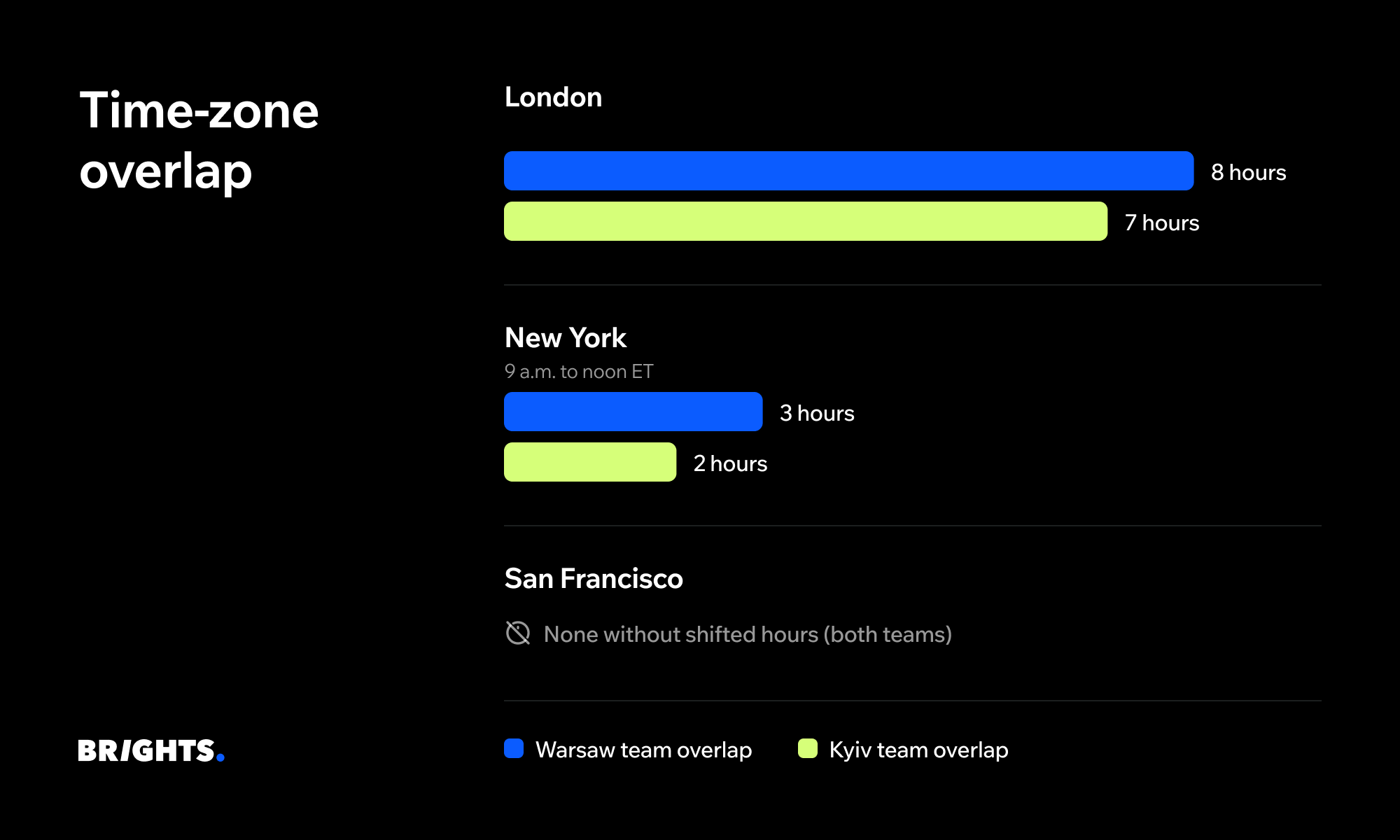
The US and Europe change clocks on different dates, so overlap shifts by an hour for a few weeks in March and in October and November.
Overlap only helps if the team stays available, and the region has held up under pressure. Ukrainian IT services exports reached $6.66B in 2025, up 3.3% and back to growth after two years of decline, according to Lviv IT Cluster data.
What to do:
Write a minimum daily overlap, and who shifts hours to cover it, into the statement of work.
For US West Coast teams, plan async handoffs on purpose: written decisions, recorded demos, a single backlog.
6. Regulation moves into the contract
Three regulatory threads now land directly in outsourcing contracts, and each one affects a different kind of buyer.
The first is the EU's Digital Operational Resilience Act (DORA), which has applied since January 17, 2025. It shares an acronym with Google's DORA research in trend 2, but this one is a law. EU banks, insurers, and other financial entities must keep a register of their information and communication technology (ICT) third-party providers and include specific contractual terms for those services. If you build software for an EU financial institution, your vendor's contract is part of your client's compliance.
The second is the EU AI Act. The AI Omnibus, formally adopted in summer 2026, moved the deadlines for high-risk AI systems. Rules for stand-alone high-risk systems, such as AI used in hiring, now apply from December 2, 2027. Rules for high-risk AI embedded in regulated products apply from August 2, 2028. The obligations themselves stay the same, so use the extra time to prepare.
The third is a US proposal. Senator Bernie Moreno's HIRE Act (S. 2976, introduced October 6, 2025) would place a 25% excise tax on "outsourcing payments" from US companies to foreign providers for services that benefit US consumers, and make those payments non-deductible. A House companion, H.R. 7559, followed in February 2026. As of October 2026, neither bill has had a committee vote.
What to do:
Add clauses on audit rights, incident reporting, subcontractor disclosure, and exit support. DORA lists most of them, and they are good practice outside finance too.
If you build AI features for hiring, credit, health, or other high-risk uses, ask your vendor how they will document the system for the AI Act.
Model the HIRE Act as a scenario in your 2027 budget. Do not restructure contracts around a bill that has not left committee.
7. AI governance becomes a vendor selection criterion
Security questionnaires used to ask about data centers and access badges. Now they need to ask about AI tools.
IBM's 2025 Cost of a Data Breach report puts the global average cost of a data breach at $4.44M, and AI is a growing part of the risk. Of the organizations surveyed, 13% reported breaches of AI models or applications, and 97% of those lacked proper AI access controls. Breaches involving shadow AI, meaning tools employees use without approval, cost an extra $670,000 on average.
An outsourced team that pastes your code into an unapproved AI tool is your shadow AI. You will not see it on your network.
What to do:
Ask which AI tools touch your code and data, under which accounts, and whether your data can be used to train outside models.
Confirm in the contract that you own all code, including AI-generated code, from day one.
Check for certifications that cover the vendor's whole organization, such as ISO/IEC 27001, and ask how AI tool use fits inside them.
8. Modernization pulls AI budgets toward legacy code
Many companies want AI features and discover their systems cannot support them. ISG reports that integration complexity and legacy technology are slowing AI adoption in software engineering.
That makes modernization a prerequisite. It is also one of the areas where AI-assisted work shows measurable gains: Endava reported 25 to 30% lower manual effort in code migration, according to the William Blair report.
The trap is skipping the step. An AI feature bolted onto a fragile system adds a new layer of technical debt on top of the old one.
What to do:
Before you scope an AI feature, ask what in the current system has to change for it to work in production.
Budget modernization as its own phase with its own outcome metrics.
See how we plan that phase in our application modernization services.
Is AI making software outsourcing obsolete?
The data shows a shift in what gets bought.
Application development and maintenance contract value fell 8% in Q3 2026, per ISG. IT services spending still grows 5.3% in 2026, per Gartner. What is shrinking is demand for large teams billing hours on repetitive work. What is holding up is demand for teams that can scope the work and stand behind what they ship, which is the part AI tools still need a person to own.
If you are still deciding whether to outsource at all, start with the decision itself.
Read more: How to Outsource Custom Software Development: A Step-by-Step Guide (2026)
Software outsourcing trends vs wider outsourcing trends
If you search for "outsourcing trends," most results mix software development with business process outsourcing (BPO) and customer support. The segments move differently.
In Q3 2026, ISG recorded BPO contract value up 12% to $2.1 billion, its fourth straight quarter of double-digit growth, while customer experience services declined. IT outsourcing was flat over the same period.
So when a report says "outsourcing is booming" or "outsourcing is shrinking," check which segment it measures before you apply it to your engineering plan.
How to update your outsourcing plan for 2027
Read together, these eight outsourcing software development trends point the same way: buyers want to pay for judgment and accountability, while most contracts still bill for hours.
The fastest way to act on that is to take your largest vendor contract and run it through these questions before the renewal date:
Does the price reflect AI productivity, through lower estimates, fixed-price milestones, or shared savings?
Can the vendor show delivery metrics from real projects, with named cases you can check?
Who reviews whose work, and what is the senior-to-junior ratio?
How many hours a day do your teams share, and is that number in the contract?
Which AI tools touch your code, and who owns the output?
Does the contract cover audit rights, incident reporting, subcontractors, and exit support?
Could fewer partners with clearer ownership do the same work?
Is there a modernization step hiding inside your AI roadmap?
Any question you cannot answer from the current contract is a line item for the negotiation. The vendor market is changing how it sells, and 2027 renewals are where buyers get to set the terms.
How Brights works with these trends
Brights has built custom software for 15 years from Warsaw and Kyiv, for clients in more than 30 countries, mostly in North America and Europe.
The way we run AI-assisted delivery follows the logic in this article. Engineers use tools like Claude Code, Cursor, and GitHub Copilot for the repetitive work, and a senior engineer reviews every change before it merges. You own the code from day one, your data is not used to train outside models, and we are ISO/IEC 27001 certified.
89% of our clients continue past the first contract, and the average partnership runs 36 months. That is the setup trend 4 describes: fewer partners, kept longer.
References
Gartner Forecasts Worldwide IT Spending to Grow 14.2% in 2026, Totaling $6.37 Trillion
Infrastructure Spending More Than Doubles in Q3 on Growing AI Momentum, ISG Index Finds
Measuring the Impact of Early-2025 AI on Experienced Open-Source Developer Productivity
EU Lawmakers Reach Provisional Agreement to Delay Key EU AI Act Obligations
Financial Entities in the EU: Time to Register Your ICT Third-Party Service Providers under DORA
Tax the Outsourcers? The HIRE Act’s 25% Bet on American Jobs


