AI-DLC Explained: The New Software Development Lifecycle

You've probably heard "We use AI throughout our development process" from more than one vendor. Yet few explain what that means for delivery speed, cost, or software quality. If you've already worked on an AI-assisted project that failed to move faster than a conventional one, skepticism is understandable.
By 2024, 65% of organizations were already using generative AI regularly in at least one business function; however, delivery timelines still didn't improve for many. Teams often added AI tools to existing workflows while keeping the same processes, communication patterns, and delivery practices. The AI-driven development life cycle was created to close this gap.
We built our AI-accelerated development practices around this methodology at Brights, and we've seen where it helps teams move faster and where its limits become clear. So keep reading if you’re evaluating whether the AI-driven development life cycle is worth investing in and how to determine if a vendor is genuinely following it.
Key takeaways
AI-DLC is a methodology introduced by AWS in 2025. It defines how AI and humans can work together throughout a software project.
The results are real but conditional. Wipro completed a few months of planned work in 20 hours, and Dhan built a production-ready stock trading application in 48 hours. However, both had clear requirements, greenfield codebases, and continuous team participation behind those outcomes.
AI-DLC changes how people contribute to delivery. Teams spend less time creating artifacts and more time reviewing, validating, and approving AI-generated outputs.
If a vendor can’t explain its Mob Elaboration process, Bolt cycles, or provide a decision audit trail from a previous engagement, they’re probably not following AI-DLC.
What is AI-DLC?
The AI-driven development life cycle is a methodology AWS introduced in 2025. Built around Amazon Q Developer and Kiro, it integrates AI into every stage of a software project instead of treating it as a tool that developers use occasionally.
The SDLC vs. AI-DLC comparison starts with how decisions are made and how outputs are validated. In a traditional software development lifecycle, product owners write requirements, architects design systems, and developers implement the solution. Requirements, architecture, implementation, and testing — software teams have worked this way for decades.
In AI-DLC, AI generates an initial plan, identifies gaps in requirements, and proposes implementation approaches. The team reviews each output before the next step begins. Architects, product owners, and team members evaluate the outputs, add context, approve decisions, or change direction when needed.
The main shift is in how people spend their time: less effort goes into producing artifacts, while more attention goes into reviewing, validating, and making decisions.
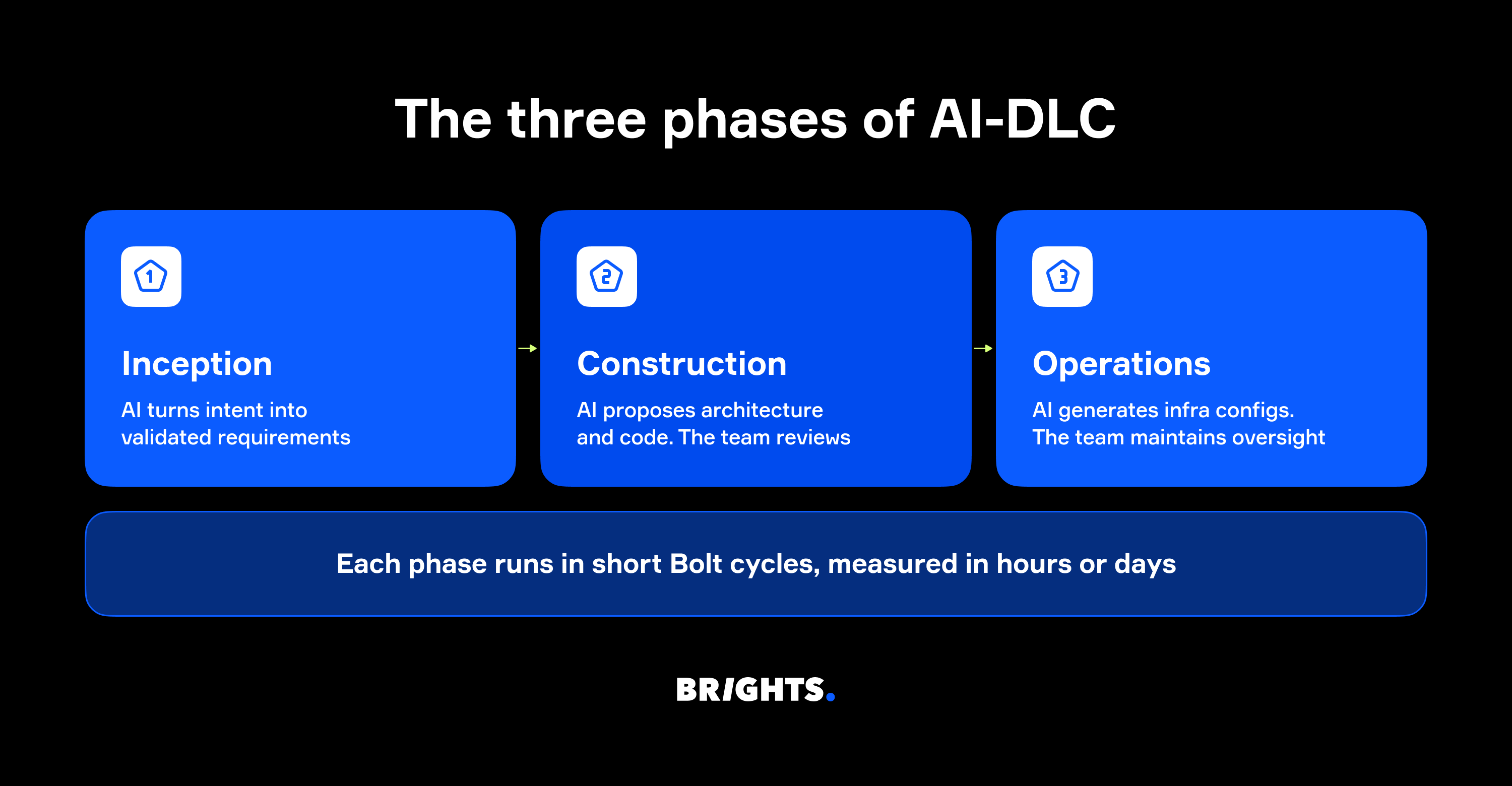
AWS structures the AI-DLC workflow into three phases, with each phase building on decisions and outputs from the previous one:
Inception. AI converts business intent into requirements and user stories through "Mob Elaboration," where the entire cross-functional team reviews and validates AI-generated outputs together in real time.
Construction. Using the requirements and decisions established during Inception, AI proposes architecture, domain models, and code through "Mob Construction": the same cross-functional group working together in real time to clarify technical decisions as they arise.
Operations. AI generates infrastructure and deployment configurations based on information gathered during the earlier phases. The team reviews the outputs and maintains oversight throughout delivery.
The iteration unit across all three phases is a "Bolt" — AWS's alternative to the traditional sprint. Bolts are measured in hours or days instead of weeks.
SDLC vs. AI-DLC: What actually changes
AI-DLC changes how people contribute to software delivery. Teams spend less time creating requirements, documentation, and implementation artifacts from scratch, and more time reviewing, validating, and approving AI-generated outputs. For technology leaders, this changes how work is organized and governed across the delivery process.
Here's how the two approaches compare:
| SDLC | AI-DLC | |
|---|---|---|
Iteration length | Weeks (sprints) | Hours or days (Bolts) |
Requirements | Written by product owners | Generated by AI, validated by the team |
Review cadence | End of sprint or phase | Continuous, at every AI-generated artifact |
Human decisions | Spread across execution | Concentrated on validation and approval points |
For developers and architects, daily work includes more review, validation, and decision-making. For builders on the business side, shorter cycles require more frequent feedback and earlier involvement than a traditional engagement.
So if you're evaluating a vendor that uses AI-DLC, pay close attention to how your organization participates in the process. Teams should contribute throughout Mob Elaboration and Mob Construction sessions, not only during milestone reviews. Consistent feedback helps the team move from one Bolt to the next without waiting for missing decisions or business context.
What AI-DLC delivers — and when to believe the numbers
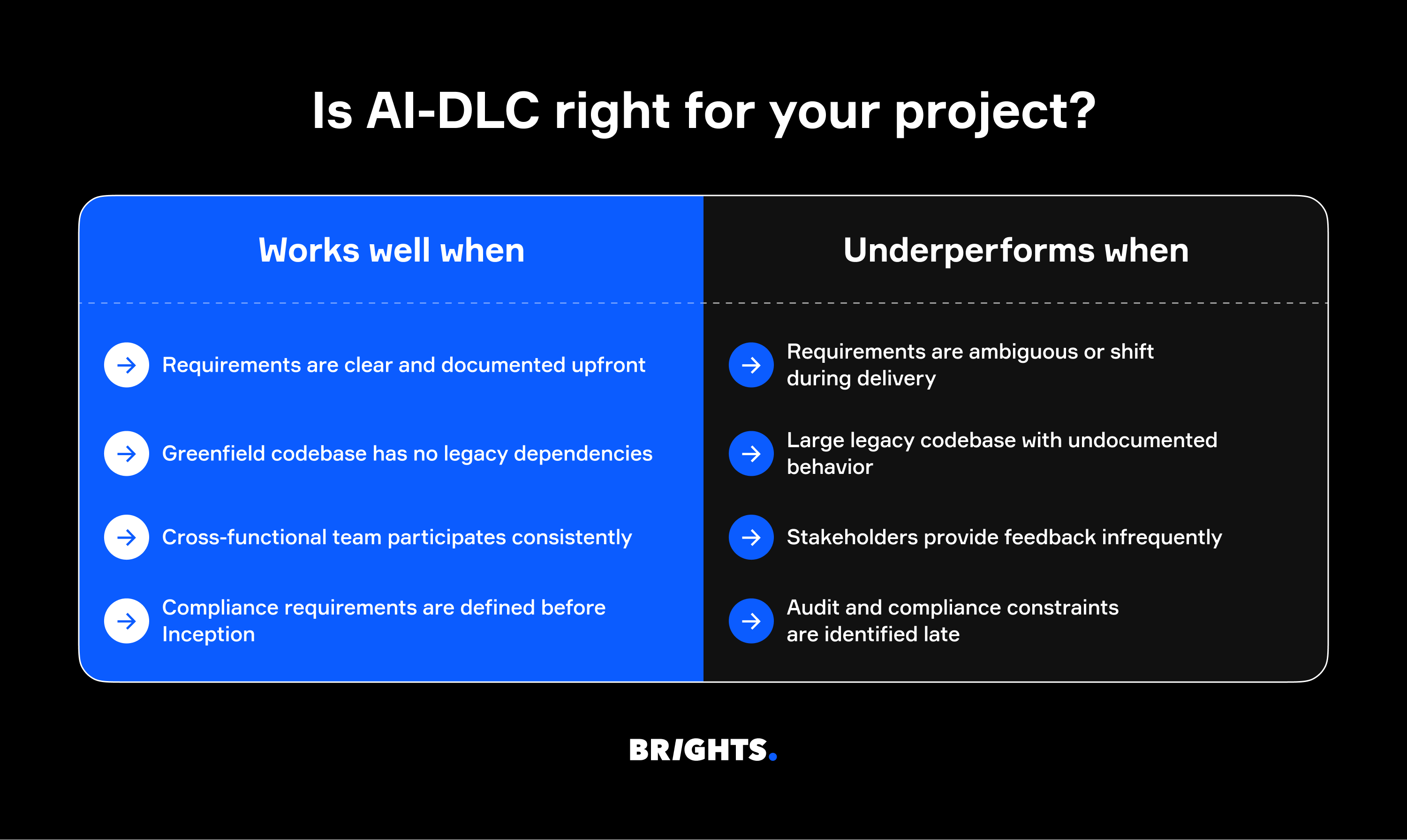
AWS presented several AI-DLC case studies at re:Invent 2025. Wipro, a global system integrator, had a few months of work planned across three distributed teams in three countries and completed it in 20 hours. Dhan, an Indian fintech company focused on stock trading, moved from an idea to a production-ready application in 48 hours and released it the following week.
What made those results possible?
Clear business requirements at the start of the project.
Cross-functional teams actively participating in Mob Elaboration and Mob Construction sessions.
Greenfield codebases without legacy dependencies or undocumented logic.
Yet, the AI-DLC approach will underperform if you have:
Ambiguous or changing requirements. Planning quality depends heavily on the quality of the inputs provided to AI. Unclear requirements lead to incomplete outputs, and revisions become more expensive once a Bolt is underway.
Large legacy codebases. Technical debt, custom workarounds, and undocumented behavior make it harder to maintain consistent context across phases.
Teams that provide feedback infrequently. Delayed reviews slow progress, especially in larger organizations where decisions involve multiple stakeholders.
Undefined compliance requirements. Audit, security, and regulatory constraints need to be documented early because when teams identify them later in the project, they can disrupt the entire AI-DLC workflow.
As you can see, AI tools alone don’t guarantee faster delivery. Review cycles, decision-making, and validation practices have a direct impact on whether teams save time or spend additional effort correcting outputs.
How to tell if a vendor is genuinely using AI-DLC
Vendors that follow AI-DLC can explain their delivery process in detail. Focus on how work moves through the project, how decisions are reviewed, and how your team participates throughout delivery.
Ask how they handle requirements
A vendor running AI-DLC should be able to describe a structured Mob Elaboration process where your team participates in validating AI-generated requirements in real time. If the answer sounds more like "we gather requirements upfront and come back with a spec," you're probably looking at a traditional SDLC with AI tools added to the process.
Ask what a Bolt looks like
AI-DLC vendors work in short cycles measured in hours or days, with continuous human validation throughout the process. If the conversation quickly shifts to two-week sprints, it's worth asking how Bolt cycles fit into their delivery model.
Ask who attends the construction sessions
In AI-DLC, developers, architects, and product owners work together in Mob Construction sessions — cross-functional and in real time. If your team is only brought in for milestone reviews, the collaboration model looks very different from the one AI-DLC describes.
Ask how decisions get documented
The AI-DLC workflow requires every human approval and AI-generated artifact to be logged. If a vendor can’t show a decision audit trail from a previous business engagement, ask how decisions are documented throughout the project.
These questions focus on the delivery process itself. Any vendor can list the AI products they use. The key question is whether the project includes the review, validation, and oversight practices that AI-DLC requires.
Best practices for getting the most out of an AI-DLC engagement
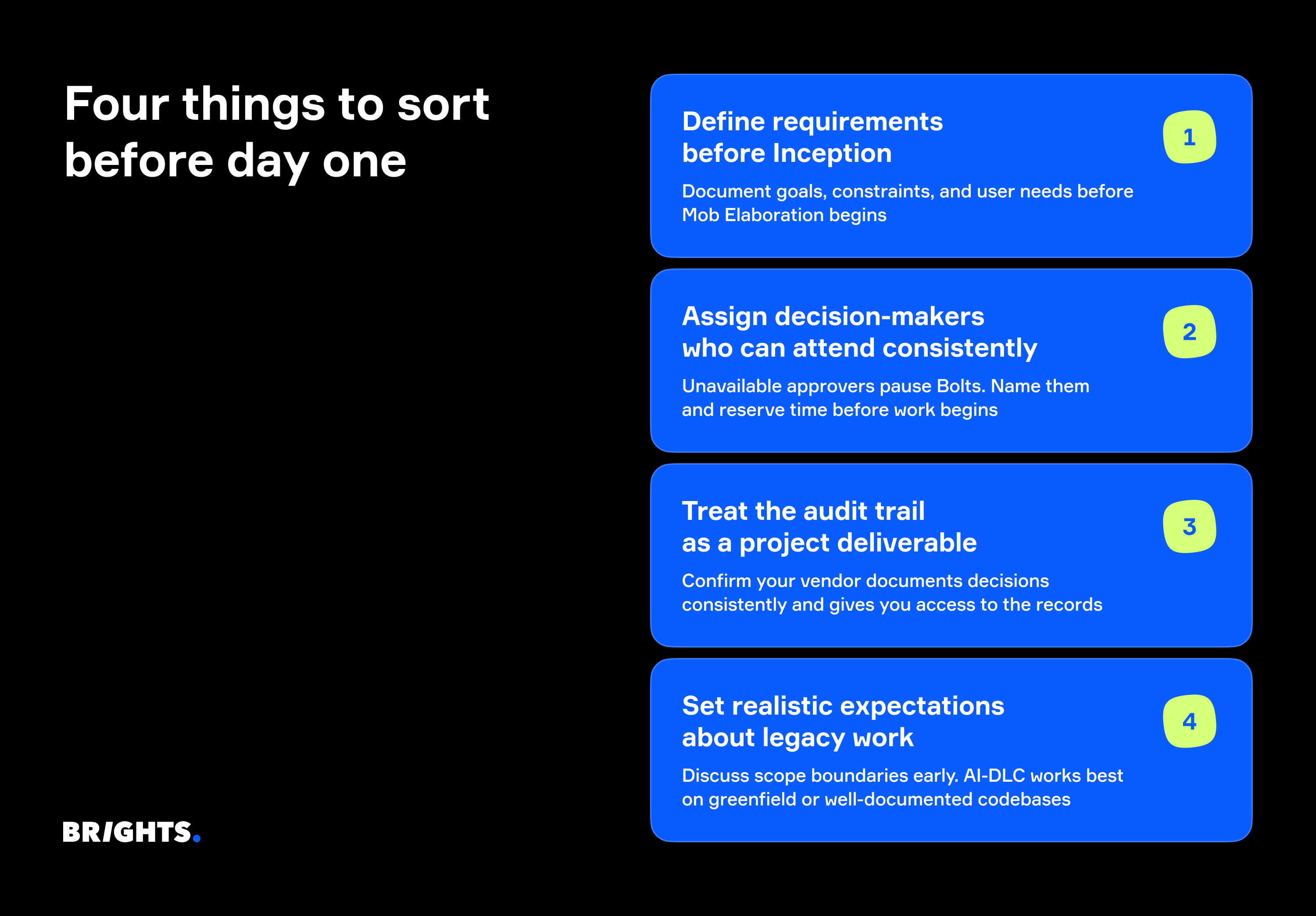
AI-DLC depends heavily on the information, decisions, and availability your team brings into the project. That’s why the following areas deserve attention from the start.
Define your requirements before Inception
AI-generated requirements depend on the quality of the business context available during Mob Elaboration. Documented goals, constraints, and user needs make it easier to review, validate, and refine outputs from the first session.
Assign decision-makers who can attend sessions consistently
AI-DLC uses short delivery cycles. If the people responsible for approvals are unavailable during Mob Elaboration and Mob Construction sessions, questions remain unresolved, and work can pause between Bolts. So identify specific team members before the project begins and reserve time for their participation throughout the engagement.
Treat the audit trail as part of the project deliverables
Every decision recorded in the AI-DLC workflow becomes part of the project's history. Your organization can use these records during compliance reviews, onboarding, or future development work. Confirm that your vendor documents decisions consistently and provides access to those records.
Set realistic expectations about legacy work
If your project involves an existing codebase, discuss scope boundaries before work begins. The AI-driven development life cycle produces the most predictable results in greenfield projects and codebases with clear documentation.
Conclusion
AI-DLC is a methodology that places AI at the center of the software development process instead of using it only as a coding tool. AWS structures it into three phases where AI contributes to requirements, architecture, implementation, and operations, while your team reviews, validates, and approves outputs throughout the project. Work is organized into Bolts measured in hours or days, and teams remain involved at every stage of delivery.
For technology leaders assessing vendors that claim to follow an AI-driven development life cycle, successful engagements depend on preparation and participation. Clear requirements help teams review AI-generated outputs more effectively, decision-makers need to be available throughout the project, and vendors should be able to explain how they run the process and document decisions along the way.
FAQ.
An AI-DLC workflow delivers the strongest results in greenfield projects, well-documented codebases, and initiatives with clear requirements and active stakeholder participation. Teams building new products, internal platforms, or MVPs often see the greatest gains in delivery speed and collaboration.

